|
||
02/09/04 |
   
|
|
Definition VoIP stands for 'V'oice 'o'ver 'I'nternet 'P'rotocol. VoIP is the ability to make telephone calls and send faxes over IP-based data networks with a suitable quality of service and superior cost/benefit. Background There was no Internet about 20-30 years ago. Thus, the only source of interactive communication was telephone at PSTN line cost. Data exchange was quite expensive, especially for a long distance. Internet has allowed people to communicate with each other by using new services like email, chat etc. Today, Internet is being used for various purposes like exchanging data (like images, sounds, documents) and talk to each other using applications like NetMeeting, Internet phone and different types of messaging services (Carden). Introduction Voice over IP allows companies to provide long distance phone services that are usable, very affordable and of good quality. Although most of these phone services utilize the Internet, the consumers need not have a computer, or an Internet connection, or even realize that they are talking through the internet (Sirius). VoIP converts voice in data packets from analog to digital, sends them and reconverts then in voice at destination. How It Works? VoIP technology uses packet-switching method to provide several advantages over the traditional method of circuit switching. For example, packet switching allows several telephone calls to occupy the amount of space occupied by only one in a circuit-switched network. This gives businesses a competitive advantage in customer support. How it works is that the sending computer splits data into small packets, with an address on each one telling the network where to send them. When the packets are receiver by the computer, it reassembles them into original data. Packet switching is very efficient. It minimizes the time that a connection maintained between two systems. It also frees up the two computers communicating with each other, so they can accept data from other computers (Tyson).
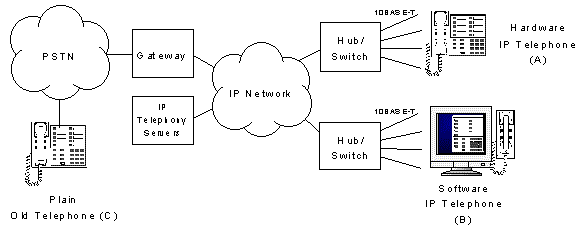
IP Telephony Solution source: Network computing magazine Standard Protocols There are two major types of standard protocols used for VoIP. For a quick comparison click here.
H.323 H.323 is a standard created by the International Telecommunications Union (ITU). H.323 is comprehensive and a very complex protocol. It provides specifications for real-time, videoconferencing, data sharing and audio applications such as IP Telephony. SIP SIP is a much more streamlined protocol and developed specifically for IP Telephony. It is smaller and more efficient than H.323. SIP takes advantage of existing protocols to handle certain parts of the process. An example would be of Media Gateway Control Protocol (MGCP) that is used to establish a gateway connecting to the PSTN system. Estimated Costs VoIP product pricing is available from Nortel Networks and Cisco (Carson, Davis): Nortel Networks
(1) Nortel
Connection Manager
$15,000
(1) Passport
4460 Gateway
$ 8,000
(25) IP Enabled phones
$ 8750
$ 350 for each.
Cisco
(1) 7 830 with Call Manager
$14,995
(25) 30 VIP (high-end) hard
phones
$15,495 $ 609.80 for each.
(1) Digital interface to legacy
PBX
$10,000
Advantages of VoIP
Potential Risks
References
Cardan, Philip. (May 8, 2000). Building Voice over IP. Network Design Manual. Retrieved on October 21st, 2002 from: http://www.networkcomputing.com/netdesign/1109voipfull.html Carlson, D. Davis, B et al. Voice over IP Product and Pricing Overview. Net@EDU. (October, 1999). Retrieved on November 2nd, 2002 from: http://www.educause.edu/netatedu/groups/ics/carlson-davis.doc Tyson, Jeff. (2000, June 14). How IP
Telephony Works? http://www.howstuffworks.com/iptelephony.htm Voice over Frame Relay. (2000). Retrieved October 29th, 2002 from: http://www.protocols.com/voip.htm Voice over Internet Protocol. Dancom Online Services. Telecom Tutorials. Retrieved November 2nd, 2002 from: http://www.excellence.com.pk/it/voip/ What is VoIP? (2001). Sirius Technologies.
Retrieved October 30th, 2002 from:
http://www.voipinfo.com
This site was last updated 11/01/03 |
||||||||||||||||||||