

Thank you for your HELP!
CATEGORIES
Rotary
Engine
Rotary Turbo
Rotary Non Turbo
4 Cylinder
6 Cylinder
8 Cylinder
Pro-Modified
Pro-Bike
Imports (FWD)
Funny Truck
ATV's (Four Track)
Street (Sportman)
History 1970's up
Ilegal Races
On Travel
Sent Photos
Sand Drag
Manatí Race Track
4 Cyilinder
& Rotaries
6 & 8
Cylinder
ATV's (Four Track)
ShowTime
Photos
G-String Contest
Ganster vs. Chupa
PUERTO RICO NEWS
Racing News
Racing Puerto Rico
Racing Chat
Special Reports
"Challenge Here &
Don't Talk"
New Projects
RACING TEAM
Team
Profiles
SPONSORS
Official Sponsors
Thanks To:
INFORMATION
Events Index
World Records
MULTIMEDIA
Action Videos
Photo Gallery
Sounds
Arcade
Games
CLASSIFIEDS
Souvenirs Shop
Parts Trader (M.B.)
Purchase and Sale
HELP
Contact Sniper
|
|
   
|
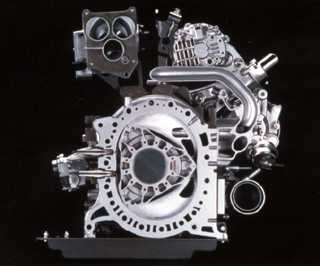
The Future of Rotary Engine !
|
For 30 years, countless of car makers tried to develop Wankel engine but they eventually gave up. The only survivor, Mazda, made the most progress but still fail to catch up with the improvement of piston engines. On the contrary, Wankel engine improved little over the years - since the late 80s, the improvement of RX-7's 13B engine concentrated mainly in the turbocharger and induction system rather than the rotor engine itself. Fuel consumption remains weak while the low volume production seems not to worth the development cost for the future emission requirement.
Worst of all, Mazda was hit by sales slump in recent years, thus resulted in cost-cutting. Apparently, the loss-making RX-7 was the first one to be eliminated. Therefore the development of RX-7 was nearly stopped - at least no next generation is developing. The concept RX-7 appeared in the 1995 Tokyo motor show might never come true.
However, in 1999 Tokyo motor show, Mazda introduced a concept sports sedan named RX-Evolv which is powered by a new generation rotary engine called RENESIS (means Rotary Engine Genesis). It will be going into mass production in early 2002. Here below is the report taken from my News report of the 1999 Tokyo motor show
The current RX-7, or any previous production rotary engines from Mazda, uses side intake ports and peripheral exhaust ports. But the new engine have side ports for both intake and exhaust. It’s not a new concept because Dr. Wankel and Mazda itself experimented it in the early years but was stuck by some technical difficulties. Benefiting by the advances of sealing and other detailed designs, Mazda is now able to make use of the advantage of side port engine. The biggest advantage is the capability to make the intake port opens earlier and the exhaust port opens later, hence eliminating the overlapping between intake and exhaust period. As a result, the expansion stroke has been lengthened and enhance thermal efficiency.
There are other improvements, such as enlarging the port area (intake by 30%, exhaust by nearly 100%), installing 3-stage variable length induction system, using a pair of 14% lighter rotors, improved fuel injectors, increased compression ratio, improved gas and oil sealing .... The combination of these changes improves the maximum rev to 10,000 rpm (more than Honda S2000!) while the much concerned fuel consumption is "greatly reduced". Emission enters the LEV territory. Mazda claims a maximum output of 280hp / 9,000rpm and 166 lbft / 8,000rpm without the help of turbocharger, the former actually equals the latest RX-7. The engine displacement is still 654c.c. x 2 rotors, so you can see how brilliant the new engine is. However, Mazda admitted that the output rating is just a target. It is still yet to be achieved. (AutoZine's News, Issue 63, dated Nov 4, 1999) see ya in Sniper Racing P u e r t o R i c o Power 100x35!
|
|
|

