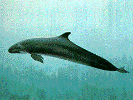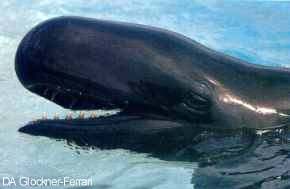
Average Size
Newborns: 5-6 feet
Weight: 175 lb
Adults: 14-19 feet
Weight: 1.1-2.2 tons
Status: Rare
Population: Unknown
Threats: The threats to this species is hunting and getting
caught and trapped in fishing nets.
Quick facts:
Other Names Used:
Group Size:Ranges from 10-50 to 1-300. There may be
several hundred at social groupings.
Behavior: The False Killer Whale is a fast and active
swimmer that will occasionally make sudden stops or sharp turn. This will most likely happen
when feeding is going on. They will approach boats to check things out, bow-ride, or even
wake-ride. This species is very susceptible to strandings. Sometimes in they will strand in huge
numbers. In one case, more than 800 were found stranded together. No one knows what exactly
cause them to strand, but the researchers and scientists do have a few ideas.
Where to look for False Killer Whales:
Calves:
Diet: The False Killer Whale eats squid, tuna, mahi-mahi and ocasionally eat a fishermen's catch.
Habitat: Offshore waters (inshore)
 The False Killer Whale is fairly common.
They will eagerly approach boats.
It is a fairly active and playful animal, especially
when you consider the size of this species.
In captivity, it tends to show less aggression than its
smaller relative, which is the Pygmy Killer Whale. In the wild it is believed that this species will eat dolphins and has been seen attacking whale calves, particularly humback whale calves.
They will sometimes swim along with Bottlenose
Dolphins and other smaller cetaceans.
False Pilot Whale
Pseudorca
The False Killer Whale is fairly common.
They will eagerly approach boats.
It is a fairly active and playful animal, especially
when you consider the size of this species.
In captivity, it tends to show less aggression than its
smaller relative, which is the Pygmy Killer Whale. In the wild it is believed that this species will eat dolphins and has been seen attacking whale calves, particularly humback whale calves.
They will sometimes swim along with Bottlenose
Dolphins and other smaller cetaceans.
False Pilot Whale
Pseudorca
This species has a uncommon
"elbow" on their flippers.
False Killer Whales are very acrobatic cetaceans.
The False Killer Whale is actually a dolphin.
It is the largest dolphin species.