
Results
All of the results from the procedures mentioned so far build upon each other. The results from one often fuel the study of another, all of which lead to a greater understanding of the mechanism behind Celiac disease. The primary understanding came from the study of the correlation between gluten intake and the occurrence of symptoms. The experiment conducted at the University of Oslo was able to determine from a set of different gliadin epitopes the primary stimulus of Celiac disease. According to their findings, the tissue transglutaminase deaminates the amino acid glutamine that is abundant within the gliadin epitopes into glutamic acid click on the thumbnail below to see the conversion..
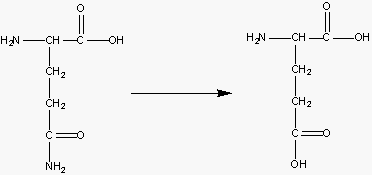
The deamination causes the epitope to have a strong negative charge that increases the affinity of the HLA DQ2 for the epitope. The binding of the epitope to the HLA causes a change in its conformation that will now generate the T-cell recognition for the inflammatory response of the immune system. In addition, to the study at the University of Oslo, Oxford University also attempted to circumvent previous challenges in identifying the toxic protein in Celiac patients by conducting the experiment in vivo, or within actual patients. From their experiments, they were able to support the findings at the University of Oslo as to the sequence of the gliadin epitopes. However, it was not until the results of the current research at Stanford University that the mechanism was most clearly illustrated.
According to their results, the gliadin epitopes known to be present in Celiac patients was digested with gastric enzymes with a yield that included a large 33-mer peptide, LQLQPFPQPQLPYQPQLPYPQPQLPY PQPQPF. This same peptide was treated with brush-border membrane enzymes from the intestinal tract and remained intact for nearly 20 hours. After determining the sequence of this peptide, it was important to test its reaction with the HLA complexes. Although deamidation occurs through a regioselective (or specific to an area of the protein) mechanism, and all glutamine residues are deamidated, there are two specific mono-deamidated products. The treatment of the 33-mer found in this study with tTG found that the kinetics and regiospecificity of its reaction with HLA to be higher than any other peptide studied so far. With its high glutamine content, regiospecificity, and large half-life, it is probable that this peptide is the primary epitope that is toxic to Celiac patients.
To read about the implications of these findings click here.
To return to the Welcome page click here.
Feel free to email me with any questions!!

Sources included on this page: 6 ,9 ,10 ,11, 13
