
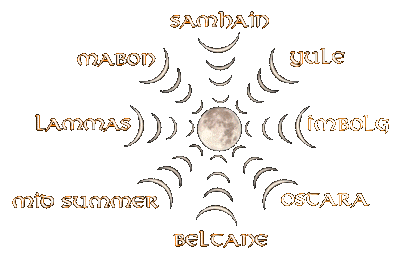
The wheel of the year
The
ancient Celts measured the Solar year on a Wheel, circle or spiral, which
symbolzed for them the whole Universe: a vast Wheel whose rolling could be seen
in the cycles of heavenly bodies and in the progression of the seasons--their
image of time was thus cyclical, not linear as we think of it now. Such wheels
were used as magical protective emblems on their shields, helmets, houses and
weapons. Celtic gods exhibited spirals on their hands, foreheads or by their
sides; altars and tombstones were decorated with them. Arianrhod was a Celtic
Goddess designated the Lady of the Silver Wheel whose hub was the Revolving
Castle, Caer Sidi, hidden in the underground spirit-land of Annwyn. Celtic
heroes of old rode upon the silver wheel, which dipped into the sea, to Emania,
the Moon's Land of Death.
There were four major divisions of the ancient Celtic Year which corresponded to
the Spring (Vernal) Equinox, the Summer Solstice, the Autumn Equinox, and the
Winter Solstice--each of these had a distinct characteristic. The celebrations
were associated with the life cycles of the Celtic dieties. God was divided into
the Masculine and Feminine: the Masculine was seen as a Great King, or a
youthful Prince, a Hunter or a Trickster--He courted the Goddess, and married
Her, so She could give birth to the new SunChild. The Mother aspect of God had
three major faces: the young Virgin, the fruitful Mother, and the wise Crone.
These dieties and their relationships played a large role in the understanding
of the cycle of Life, and so were also part of the Great Wheel of the Year.
