|
The Goan Economy during
Portuguese rule
|
Goa has a tropical climate with heavy monsoon rains during the
summer months. There is an abundance of red laterite soil, rich in iron and
manganese. Iron ore, Manganese and bauxite mining was the backbone of the Goan
economy prior to Independence in 1961. The mines are
mainly open cast mines and still run by the families or groups that were
originally granted property rights by the Portuguese government.
Shipbuilding
was an industry that went hand in hand with mining; barges were built to take
the ore to the major port of Marmagoa. Goa has a huge network of estuaries and
tributaries that eventually run into the Indian Ocean; the road network was not
efficiently developed the rivers and canals were a favored means of
transportation.
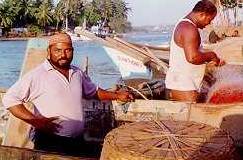
Fishing has been a traditional occupation in Goa for centuries. The canoe
shown in the picture called a “vodhe” is a traditional fishing boat used by
individual fisherman who fish on the various rivers. The bigger fishing boats
go out to sea. During the Portuguese rule there wasn’t a whole lot of white
collar employment for the local people as the Portuguese were not interested in
investing in quality educational institutions, they were there to trade and
spread Christianity. The Civil Service was run by the Portuguese and a few
elite Goans. Many of the upper class and middle class Goan’s sent their
children to Bombay, India or overseas for a higher education. Most of the
population was concentrated in rural areas where fishing and agriculture were
the main occupations. Another traditional occupation that Goa is famous for is the
making of “feni” the brew of choice that is made from coconut
and cashew plants.

For more information on
the Goan economy during the colonial period, a good source is the book “GOA,
THROUGH THE AGES” Ed. by Teotonio R. de Souza. This volume part of a
series of five deals with the economic history and contains essays on trade,
transport, communication, migration, natural resources, etc.
Photographs courtesy of Fredric
Noronha.
Website: http://www.goa-world.net/fotofolio
Next
Page

