Cylindrical Shells
This is a method of finding the volume of the object created when a line is rotated about the y-axis. As with previous methods, here we also split the oject into several parts. But instead of these parts being rectangles, they are cylindrical shells (a cylindrical shell, is a cylinder with a hole down the middle - tube).
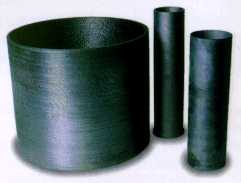
An example of cylindrical shells.
The width of each of these shells is constant, but each consecutive shell will have a greater radius, and the height will also vary. The total volume of the object is therefore
approximately equal to the volume of all of these shells added together. The area of each cylindrical shell is computed as being the area of the face, multiplied by the height, therefore it's 2Pi(x)f(x). To skip all of this work, it can be done using integrals (as you probably suspected), and the equation is:
a b 2Pi(x)f(x)dx
x stands for the radius and f(x) the height
