
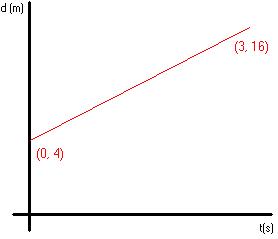
m(slope) =  d/t = (16 - 4)/(3 - 0) = 12/3 = 4 m/s = average
velocity in 0s - 3s.
d/t = (16 - 4)/(3 - 0) = 12/3 = 4 m/s = average
velocity in 0s - 3s.
Example #2:
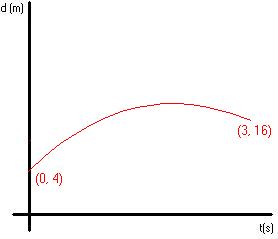
m(slope) = 4 m/s = average velocity
Instantaneous Rate of Change: while average growth
rate is the slope between two given points on a graph, instantaneous growth rate
is at an instant, ie: at a point.
Example: s(t) = -t2 + 9t + 1

Find the instantaneous growth rate (velocity) when:
2. t = 4.5s
3. t = ?, s = 0m
y/x = 0/0 =
undefined = (preferred) indeterminate
We can't use this equation as shown above. Since we are looking for the
instantaneous rate of change, then the change in both x and y equals 0. To find
an approximation allow the change (x and y) to
approach 0.
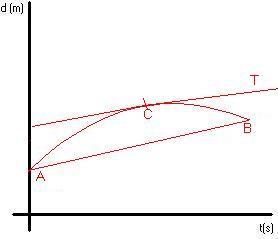
 x and y approach 0, we see that the slope of the
secant approaches 5. Therefore the slope of the tangent approaches 5.
x and y approach 0, we see that the slope of the
secant approaches 5. Therefore the slope of the tangent approaches 5.
Using this method find out what the instantaneous growth rate equals for the other three times indicated. Your final answers should be: 1. mTan approaches 9; 2. mTan approaches 0; 3. s = 0 when t = 9.11 and t = -0.11.
Here's a few helpful links:
Average Rate of
Change
Instantaneous vs. Average rate of change
Rates of Change
