|
|
|
|
Siberian Huskies History
The
Siberian Husky was developed over a period of around 3,000 years by
the Chukchi and related peoples of Siberia, the breed was developed
to fulfill a particular need of the Chukchi life and culture. In one
of the most inhospitable climates in the world, with temperatures plummeting
to (-1000F)C in winter and with winds up to 100 mph, the Chukchi relied
on there dogs for survival, as they were a remarkable tool of ingenuity.
In teams as large as twenty or more they could travel out over the
ice sometimes covering as much as 100 miles in a single day to allow
a single man to ice-fish and return with his catch, by sled dog standards
they were small the large size of the teams minimized per-dog pulling
power, while smaller frames maximized endurance and low energy consumption.
(Even today, in long races, Alaskan Huskies the Siberians cousins require
twice the amount of food the Siberians consume)
|
The Beginning - Siberia
 The Chukchi economy and religious life was centered around the Huskies. The best dogs were owned by the richest members of the community, and this is precisely why they were richest members of the community. Many religious ceremonies and iconography was centered around the huskies, according to Chukchi belief two huskies guard the gates of heaven turning away anybody that has shown cruelty to a dog in there life time. A Chukchi legend tells of a time of famine both human and dog populations were decimated, the last two remaining pups were nursed at a woman's breast to insure the survival of the breed. The Chukchi economy and religious life was centered around the Huskies. The best dogs were owned by the richest members of the community, and this is precisely why they were richest members of the community. Many religious ceremonies and iconography was centered around the huskies, according to Chukchi belief two huskies guard the gates of heaven turning away anybody that has shown cruelty to a dog in there life time. A Chukchi legend tells of a time of famine both human and dog populations were decimated, the last two remaining pups were nursed at a woman's breast to insure the survival of the breed.
Tribe life revolved around the dogs The women of the tribe reared the pups and chose what pups to keep, discarding all but the most promising bitches and neutering all but the most promising males. The men's responsibility was sled training, mostly geldings were used. huskies also would act as companions for the children and families dogs slept inside the temperatures at night were even measured in terms of the number of dogs necessary to keep a body warm eg. "two dog night, Three dognight Etc." The legendary sweetness of temperament was no accident.100 miles out on the ice, a single man with twenty dogs, if there's a dog fight , he simply does not get home (this is also one of the reasons for using geldings; the other being food consumption is lowered ). When winter came, all dogs were tied up when not working, but the elite unneutered dogs were allowed to roam and breed at will, this insured that only the very best would breed. In summer, all dogs were releasesed and allowed to hunt in packs, they would only return to the villages when the snow returned and food grew scarce. The primitive hunting instincts can still be found in the breed today. A story documented a number of years ago testifies to this Siberian bitch a family's pet was lost during an autumn hik.
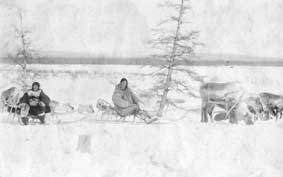 In the nineteenth century, when Czarist troops were sent on a mission to open the area to the fur trade the Chukchi faced a peril even deadlier than the Siberian winters Czarist troops attempted an all -out genocide of the Chukchi people. Again, the dogs would be the key to there survival. The Chukchi were able to outrun the Russian reindeer cavalry on their sleds, the Chukchi to evaded the invading armies for some time. The invasion culminating in a final battle were the Chukchi armed only with spears overwhelmingly outnumbered trapped and routed a heavily armed Russian Troops. This victory led to Czarist Russia signing a treaty with the Chukchi giving them independence the first tribe to do so. In the nineteenth century, when Czarist troops were sent on a mission to open the area to the fur trade the Chukchi faced a peril even deadlier than the Siberian winters Czarist troops attempted an all -out genocide of the Chukchi people. Again, the dogs would be the key to there survival. The Chukchi were able to outrun the Russian reindeer cavalry on their sleds, the Chukchi to evaded the invading armies for some time. The invasion culminating in a final battle were the Chukchi armed only with spears overwhelmingly outnumbered trapped and routed a heavily armed Russian Troops. This victory led to Czarist Russia signing a treaty with the Chukchi giving them independence the first tribe to do so.
Unfortunately in the twentieth century, the Soviets opened free trade with the Chukchi, then known as the "Apaches of the North," these invaders had a far more effective weapon smallpox! Small pox decimated the tribe. Then with a diabolical understanding of the importance of the dogs in Chukchi cultural coherence, the Soviets then executed the village leaders, who were of course the dog breeders, They then set up their own dog breeding programs these were designed to obliterate the native gene pool the soviets wanted replace it with a gene pool that would produce a much larger freighting dog thought to be more effective for their own proposed fur-trading practices in the region. The Soviets even went so far, in 1952, as issuing an official proclamation that the breed we now call the Siberian Husky never really existed. Some remnant of the breed still survives in its native territory today. The painter Jon Van Zyle has managed to bring back several from the region. If you have seen the old National Geographic Special on the Siberian tiger will have noticed that one of the two dogs used in the tracking and pursuit of one of these animals was Siberian Husky undoubtedly
|
East to Alaska
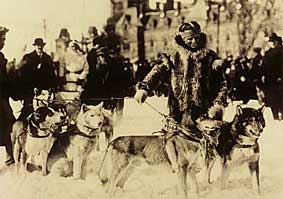 Long before the Soviets managed to relegate them to the category of "those who officially never existed." The reputation of the little Chukchi dogs had already spread throughout the world around the turn of the twentieth century, polar exploration was capturing the worlds attention and adventurers came to the yearly Markova Fair on the Siberian peninsula where tribes of the area came to trade. This gathering included the Chukchi and other dog-breeding tribes, such as the Koryak (all of whom probably had some part in the pool of animals that eventually became the Siberian Husky). Gdosak, a Russian fur trader acquired a team there in 1908 and, in 1909, took them across the Bering Strait to race in the All Alaska Sweepstakes, a 408-mile, grueling race first run in 1908.The Alaskan Gold Rush had established the sled dog as an invaluable commodity, and the race had been instituted to add excitement to an otherwise pretty grim world, to give bragging rights to the eventual winner, and to give vent to that favorite frontier boomtown passion, gambling.Nome to Candle and back,was the route of the race crossing every conceivable terrain, including a valley almost always engulfed in a blizzard. Caches of food were strategically stashed along the route by drivers. Regular checkpoints were established, but rest was at each driver's discretion. The Trade Saloon in Nome,was the betting office bets were placed on a board and betting was open until the first team crossed the finish line. School children had a holidays the four days of the race and at the start of the race in 1909 event, there was already more than $100,000 bet on the race.The siberians were about half the weight of the local sled dogs, and much smaller in stature. They were given little chance by the bookies , referred to then as Siberian Wolf Dogs. They were dubbed "Siberian Rats,"because of their small stature. But Thurstrup was convinced by Goosak to take on the team.in April 1909, the first team of Siberian Huskies to be seen on the North American continent trotted out of the town of Nome and into the annals of history. Long before the Soviets managed to relegate them to the category of "those who officially never existed." The reputation of the little Chukchi dogs had already spread throughout the world around the turn of the twentieth century, polar exploration was capturing the worlds attention and adventurers came to the yearly Markova Fair on the Siberian peninsula where tribes of the area came to trade. This gathering included the Chukchi and other dog-breeding tribes, such as the Koryak (all of whom probably had some part in the pool of animals that eventually became the Siberian Husky). Gdosak, a Russian fur trader acquired a team there in 1908 and, in 1909, took them across the Bering Strait to race in the All Alaska Sweepstakes, a 408-mile, grueling race first run in 1908.The Alaskan Gold Rush had established the sled dog as an invaluable commodity, and the race had been instituted to add excitement to an otherwise pretty grim world, to give bragging rights to the eventual winner, and to give vent to that favorite frontier boomtown passion, gambling.Nome to Candle and back,was the route of the race crossing every conceivable terrain, including a valley almost always engulfed in a blizzard. Caches of food were strategically stashed along the route by drivers. Regular checkpoints were established, but rest was at each driver's discretion. The Trade Saloon in Nome,was the betting office bets were placed on a board and betting was open until the first team crossed the finish line. School children had a holidays the four days of the race and at the start of the race in 1909 event, there was already more than $100,000 bet on the race.The siberians were about half the weight of the local sled dogs, and much smaller in stature. They were given little chance by the bookies , referred to then as Siberian Wolf Dogs. They were dubbed "Siberian Rats,"because of their small stature. But Thurstrup was convinced by Goosak to take on the team.in April 1909, the first team of Siberian Huskies to be seen on the North American continent trotted out of the town of Nome and into the annals of history.
Unfortunetly, Thurstrup was not a wise or judicious driver. At the halfway point in the race, he took a short rest period in Candle,he was overtaken by two more rested teams in the last stretch of the race. and finished in third place.The little dogs suprised everyone. This Inspired a young Scot named Fox Maule Ramsey to spend $25,000 on a freighter to transport seventy new Siberians across the Bering Sea,. He split these into three teams for the 1910 race, the results were first, second, and fourth place places.
 The legendary John "Iron Man" Johnson team finished first in this 1910 race was driven by , who completed the race in 74 hours, 14 minutes, 37 seconds. This time was never equaled, even when the race was rerun within the last decade with the benefit of modern equipment, better nutrition, and supposedly more specialized hybrid "race dogs:' The legendary John "Iron Man" Johnson team finished first in this 1910 race was driven by , who completed the race in 74 hours, 14 minutes, 37 seconds. This time was never equaled, even when the race was rerun within the last decade with the benefit of modern equipment, better nutrition, and supposedly more specialized hybrid "race dogs:'
Next few years, of the race were plagued with scandal with rumors that Johnson's dogs had been drugged near the end of the race or that the moneyed interests had actually convinced him to throw the race, and it was not until 1914 that Johnson again won the event.
|
"The Little Man with His Little Dogs"
 Born in Skjervoy, Norway, inside the Arctic Circle Leonhard Seppala came to Alaska as a young man around 1900 seeking fortune and adventure. A short man at only about 5 feet tall, Seppala had been an Arctic fisherman since he was 11years old, an apprentice blacksmith to his father, and was an accomplished wrestler and skier. Seppalla worked at various jobs in the mining camps. In 1914, Jafet Lindeberg, his employer, acquired what was left of the first Siberian imports and their offspring, around fifteen animals in all. They were to be a gift to the explorer Captain Roald Amundsen, who was planning a expedition to the North Pole. Seppala was given the job of the care and training of the dogs, and he loved it. Born in Skjervoy, Norway, inside the Arctic Circle Leonhard Seppala came to Alaska as a young man around 1900 seeking fortune and adventure. A short man at only about 5 feet tall, Seppala had been an Arctic fisherman since he was 11years old, an apprentice blacksmith to his father, and was an accomplished wrestler and skier. Seppalla worked at various jobs in the mining camps. In 1914, Jafet Lindeberg, his employer, acquired what was left of the first Siberian imports and their offspring, around fifteen animals in all. They were to be a gift to the explorer Captain Roald Amundsen, who was planning a expedition to the North Pole. Seppala was given the job of the care and training of the dogs, and he loved it.
When World War I broke out it changed Amundsen’s plans, and Seppala ended up in possession of the dogs. He entered the 1914 All Alaska Sweepstakes, but with disastrous results he had to drop out early when he lost the trail, and his dogs’ feet got badly cut.He trained hard in secret, far from town,Blitzing the field in the 1915 Sweepstakes by over and hour . He repeated this victory in 1916 and 1917, at which time the increased war effort and the lack of any real competition for him caused the race to be discontinued.
“ the little man with his little dogs,”as he came to be known, became a legend in Alaska, remaining devoted to his Siberians hauling freight and supplies, setting many new records in mid-distance races, and on several occasions being involved in truly heroic exploits he once, unarmed, chasing down an armed kidnapper, and on another occasion transporting a man mangled in a sawmill accident oVer a long distance at a speed no one thought possible.
In 1925, Seppala and his Siberians came to national prominence, with the famous "Serum Run" that saved the city of Nome from a diphtheria epidemic. Seppala and his Siberians, with his famous lead dog Togo, covered 340 miles in that race against death, with no other team traveling more than 53 miles.
 Toga, leader in the serum drive. Toga, leader in the serum drive.
Togo became permanently lame from that marathon run. Seppala credited Togo with over 5,000 miles in his running career. The teams had covered a distance of 650 miles that normally took the mail teams twenty-five days, and they did it in just five and a half days. Senator Dill of Washington state had the story written into the Congressional Record, one sentence of which reads, "Men had thought the limit of speed and endurance had been reached in the grueling races of Alaska, but a race for sport and money proved to have far less stimulus than this contest in which humanity was the urge and life was the prize.
|
A Challenge in New England
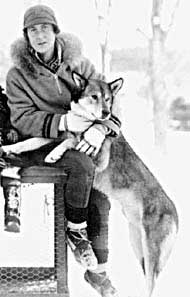 After the Serum Run Seppala was a national hero and he marched in parades and posed for glamorous photographs in his equally glamorous furs, sometimes in 900F weather.All this fame and notoritity brought a challenge from Arthur Walden the polar explorer, adventurer, and full-time blowhard,he challenged Seppala to come to New England to race against his locally famous Chinook dogs, a strain of large, Mastiff-types he had developed from a single dog. This dog, named Chinook, gained fame on Admiral Richard E. Byrd's first Antarctic expedition. Walden would become Byrd's chief dog handler on that voyage, was the president of the New England Sled Dog Club, and was generally considered unbeatable. After the Serum Run Seppala was a national hero and he marched in parades and posed for glamorous photographs in his equally glamorous furs, sometimes in 900F weather.All this fame and notoritity brought a challenge from Arthur Walden the polar explorer, adventurer, and full-time blowhard,he challenged Seppala to come to New England to race against his locally famous Chinook dogs, a strain of large, Mastiff-types he had developed from a single dog. This dog, named Chinook, gained fame on Admiral Richard E. Byrd's first Antarctic expedition. Walden would become Byrd's chief dog handler on that voyage, was the president of the New England Sled Dog Club, and was generally considered unbeatable.
Seppala accepted the challenge, As they drove their teams for three days to get to the site of the race, Seppala was careful to keep his dogs in check and letting Walden gain a false sense of confidence. Seppala figured his dogs may be out of condition from all their parade appearances and wasn't sure how they would perform on the New England trails. As the two teams lined up the Chinooks weighing in at 90 to 100 pounds, the Siberians at around half that weightthe contrast was striking . many New Englanders objected to the race on humanitarian grounds, considering the Siberians too small to compete (There were even nutters like that in them days) Dick Moulton, who would later become Byrd's chief dog handler and a two-time Congressional Medal of Honor winner (once for saving the Admiral's wife and once for his search-and-rescue missions during the Battle of the Bulge), was a teenager at the time. Moulton remembered vividly the stark contrast between the dogs as the two teams were boarded at opposite ends of a barn the night before the race. "At one end," he says, were Walden's great big Chinooks, while at the other were these sweet, little, kind of foxy Siberian dogs who stood up on their hind legs to greet you, and their heads were hardly higher than your waist."
What was not Known in 1925, was that if you double a dog's size, you only increase heart and lung capacity by about a 30 percent therefore big dogs tire much sooner than medium-sized dogs. the next day Seppala simply left Walden's team in his dust , changing the history of New England sled dog racing for all time. Admiral Byrd, himself, would learn the same lesson when he reprimanded Moulton, upon first arriving on his second Antarctic expedition, asking why in the world he had brought such little dogs. Moulton simply demurred, and Byrd then took ofin at this point in the story, a twinkle in his eyes. "You see," he says, "I knew that not only do big dogs get tired quicky, they also need a long time to rest. But I wasn't going tell HIM that!"
|
|
|