Site hosted by Angelfire.com: Build your free website today!

Whose Up for Robin's Eggs?


"Here comes Peter Cottontail
hoppin' down the bunny trail
Hippity hoppity
Easters on its way!"


Thats right, everybody! Spring is offically hear, and so is Opening Day! It took some talking down, but I finally resolved not to take this page and entirely devote that to baseball (thanks to kyle, who reminded me that easter was in april, when I could only think of April Fool's Day and Opening Day). And easter can be one of the greatest days for kids (and the plague to dentists) under the age of 12, or the one of the most religious dates in the entire Christian calendar next to Christmas. But either way, if y'all are uncomfortable with the Christian history behind this day, read it anyway, or if not, skip around it like you usually do! I'd encourage ya to read it, just so you at least know the history behind the date, but its strictly optional. However, I must say, there is an interesting incident with the easter bunny on this page, so...:-D

So, yeha, carrying on..Easter happens to be usually at the end of the month of april, or the beginning? No, wait, I've got this one: Easter occurs on the Sunday following the full moon next after the vernal equinox (see calendar); thus, it falls between Mar. 22 and Apr. 25. MAN!! thats a lot of time difference. Of cousrse ,everyone knows that the VERY best part of easter is the PEEPS!!!! Speaking of whcih, click on the peep above, and you'll be transported to the OFFICIAL PEEPS WEBSITE and you can go into Peepville and play some games. It's awesome!! :-D


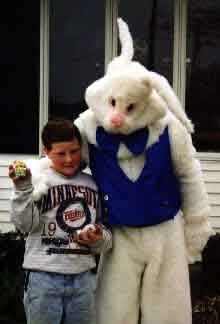
Now, whats this curious little bunny that hides in my house every once in a while??:
Maybe its just me, but getting a rabbit from this tale of Jesus and resurrection seems a bit odd. Rather, quite a bit off, so I decided to check back up on my facts, and this is what ol' Peter Cottontail had to say:

The Easter bunny has its origin in pre-Christian fertility lore, interestingly enough. The Hare and the Rabbit were the most fertile animals known at that point and they figured they'd be best served as symbols of the new life during the Spring season. The bunny would be as an Easter symbol seems to have it's origins in Germany (how, we're not sure) where it was first mentioned in German writings in the 1500s, so the Germans could be plagurists for all we know). The first edible Easter bunnies were made in Germany during the early 1800s. And were made of pastry and sugar...and actually, Mr. Heinze brought us some in when he came back from Germany (from his grandfather's funeral) and man were they GOOD!

The Easter bunny was introduced to American folklore by the German settlers who arrived in the Pennsylvania Dutch country during the 1700s. The arrival of the "Oschter Haws" (I dare you to say that 5x fast!!) was considered "childhood's greatest pleasure" next to a visit from Christ-Kindel (aka Santa Claus) on Christmas Eve. The children believed that if they were good the "Oschter Haws" would lay a nest of colored eggs...or in our case, a bunch of goodies.

The children would build their nest in a secluded place in the home, the barn or the garden. Boys would use their caps and girls their bonnets to make the nests . The use of elaborate Easter baskets would come later as the tradition of the Easter bunny spread through out the country, where its now the most commerical holiday for candy next to Christmas...and that my friends, is how the easter bunny came to town!


Easter [A.S. Eastre, name of a spring goddess], chief Christian feast, commemorating the resurrection of Jesus after his crucifixion. In the West, Easter is celebrated on the Sunday following the full moon next after the vernal equinox (see calendar); thus, it falls between Mar. 22 and Apr. 25. The Orthodox Eastern Church calculates Easter somewhat differently, so that the Orthodox Easter usually comes several weeks after that of the West. Many dates of the Christian calendar are dependent on Easter. For most Christians there is a preparatory period of penitence, beginning (in the West) with Septuagesima Sunday, 17 days before Lent, and ending in Holy Week. With Easter begins the paschal season, liturgically marked with rejoicing; Alleluia is often said, and the paschal candle is set up. The five Sundays of this time begin with Low Sunday. They are followed by Ascension Day (Thursday; see under Ascension) and, 10 days later, by Pentecost. The Sunday after Pentecost is Trinity Sunday. Until Advent the weeks are counted from Pentecost or Trinity. A feature of Roman Catholic life is the Easter duty, by which every member is required to receive communion sometime between Ash Wednesday and Trinity Sunday. Painting and rolling eggs and wearing new clothes are Easter customs; there is no development of social festivities comparable with those of Christmas.


Y'all happen to be in some luck today! I've decided no one should be without the proper knowledge to know how to make good ol' fashioned traditional Urkranian Easter Eggs!! Simple, beautiful pysanky or Ukranian Easter Eggs are within the reach of any beginner! These elegant eggs make great gifts for family and friends. You will need:
  • Smooth, fresh eggs at room temperature
  • Writing tools (straight pins stuck into a dowel, cork, or pencil eraser)
  • Wax (equal amounts beeswax and paraffin)
  • Wax warmer (candle heated container)
  • Egg dyes (prepared according to package instructions in containers large enough to submerge eggs)
  • Paper tissues or soft absorbent cloth

Prepare the eggs by "blowing" your eggs before painting. Use a long pin to make a tiny hole at each end; the hole should be a bit larger at the bottom. Pierce and break the yolk with the long pin. Shake to mix the inner contents. Over a bowl or sink, blow through the smaller hole to force the contents out of the larger opening. Rinse the shell and prop on an egg carton to dry.
  1. Create the design. First practice your design on paper before applying wax to the egg.
  2. Melt the wax. Working quickly to prevent the wax from hardening, dip the pinhead into melted wax and touch it to the egg to create your design. The pinhead touched to the egg will form a small dot. To make a tear drop shape, draw the pinhead along the surface of the egg. These two shapes may be used in different combinations to make a variety of designs.
  3. One to three colors are usually used for each egg. Always progress from the lightest to the darkest dye color. When the complete wax design has been applied, place the egg in the first dye solution several times until desired color is reached (10-30 minutes). The longer the egg remains in the dye, the deeper the color will be. Remove the egg and blot dry with tissue or cloth. Once the egg is dry, add additional wax designs and repeat color process with darker dye.
  4. To finish, after the final dye bath, remove the wax by holding the egg, a small section at a time, against the side of the candle flame for no more than five seconds. As soon as the section appears wet, blot with a clean, soft cloth. Continue until all the wax is removed. do not hold the egg over the tip of flame, as carbon will collect and darken your design.
  5. Eggs may be preserved with varnish. Use a clear type of varnish and 2 or 3 light coats.


Click below for some information on rabbits, because a lot of parents buy kids bunnies for easter and then discard them. It's really sad, so when you click on the picture, you can find out how you can help these poor bunnies/rabbits/hares from being destroyed...in their cages. (There's a poem on there about it, really sad.)
HAVE A HAPPY EASTER!!
Back to the Hillbilly Home!