| Grumman F-14 Tomcat | ||||||||||||||||||||||||||||||||||||
Site Content HomeUS Navy & Marine Aircraft HomeUS Navy & Marine Aircraft
US Air Force Aircraft
Foreign Aircraft & Others
Credits & Bibliography
|
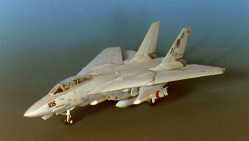
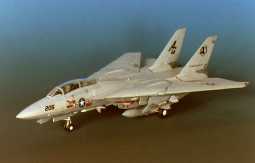
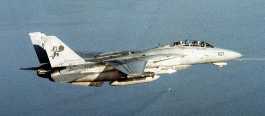
About the models: Since these two, I've gone on to build quite a few more Italeri Tomcats (and copies of them). The kits themselves are pretty straightforward, and are typical of Italeri. Currently, the Italeri F-14A is only available in their F-14 Bombcat kit. Good points: The detail is very good, the engineering is OK, the instructions are clear, and the decals are superb. They build easily and look great when they are done. They can be easily built either gear up or gear down without any door fit problems. And theyare about the only kit I've seen with AIM-9Ls Problems: the nose is split into upper and lower halves, and radome. These pieces rarely fit properly, so some putty work is required here. the intake tunnels don't always fit right. The kit includes wing glove vanes, and filler pieces to fill the vane slots if you want the vanes closed. These filler pieces don't fit at all, and are extremely fragile. Putty is required to close the wing glove vanes. Special note: Most seriously, the mounting holes for the main landing gear struts go all the way through plastic and are open at the other end. If you install the wings before installing the landing gear, MAKE SURE to sweep the wings full forward! If you don't, then you WILL cement to the landing gear directly to the wings, and will jam the wings aft. If you try and break the wings free, you WILL destroy the thin strip of plastic that links the wings, and they will no longer sweep together. Overall though, Italeri makes about the best value Tomcat kit. About the Grumman F-14 Tomcat: Possibly the most complete fighter in the world today, rivalled only by the F-15 Eagle and the Russian Su-27 Flanker, the Grumman F-14 Tomcat first entered service in 1975, and has since taken its place among the best aircraft ever. Armament consists of an M61A1 20 mm rotary cannon plus AIM-9L Sidewinder short-range, AIM-7M Sparrow medium-range, and AIM-54C Phoenix long-range air-to-air missiles. A combination of all of these missiles can be carried at one time, making the F-14 capable of shooting down any flying intruder at any range up to 125 miles. The Phoenix missiles are operated in conjunction with the Tomcat's AWG-9 radar (AWG-15 on the F-14B (A+), and AN/APG-71 on the F-14D), and can hit targets at any altitude from ground level to over 78,000 feet. The aircraft itself is extremely fast, reaching speeds up to Mach 2.34, and for dogfighting the wings adopt optimum angles of sweep automatically to extract maximum agility. For the F-14D Super Tomcat, the older TF-30-P-414A engines were replaced with significantly more powerful F-110-GE-400 afterburning turbofans. The -D also has all-new avionics, NACES ejection seats, and onboard oxygen generating capabilities, which make the D an even greater fighter than the -A and -B (A+) versions. The US Navy will fly its Tomcats until 2010, when the last of these great fighters will be replaced by the F/A-18E. Apart from the US Navy, Iran is the only operator, although only 15-20 of their aircraft are airworthy.
|
|||||||||||||||||||||||||||||||||||
|
Copyright ©2003 David Jong [Jong Productions, Ltd.], All Rights Reserved. | ||||||||||||||||||||||||||||||||||||
|
|
Updated: December 8, 2003. | |||||||||||||||||||||||||||||||||||