
Other architects have also carried organic architecture into interesting directions. A number of Japanese architects still pursue this design area and have advanced the technology for their construction with new composite shell materials. The famed architect Eugene Tsui specializes in the more hand sculptured styles, mixing them with a richer blend of materials including steel, wood, and glass. He has planned for its use in his own floating marine community called Nexus. Architects Mr. A. Alberts and Mr. M. van Huut in the Netherlands have explored a new area in the form of an organic-crystaline form. Their amazing ING Building complex in the Poort Amsterdam appears to have merged both free-form organic architecture with the organic architecture of Frank Lloyd Wright. The potential of free-form organic architecture is tremendous but to date remains barely explored. Part of the problem may be that the conventional architecture tradition is rooted in two dimensional design, individual floors stacked one upon the other. Architects have rarely needed to think about the design of the home as a volumetric, truely three dimensional, structure. Further complicating things is the still very limited capabilities of computer modeling. CGI has become nearly standard in the field of architecture but to date no computer modeling package has successfully modeled the non-Euclidean forms of free-form organic architecture. Such organic shapes, as natural and fundemental as they are, remain the most doffocult forms for the computer to deal with.
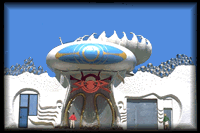

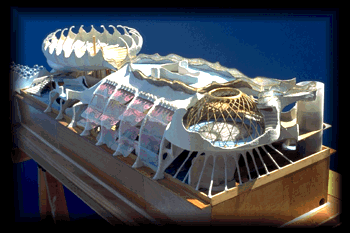
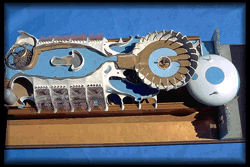
[front, interior, and model views of Tsui Design Research Headquarters, California by Eugene Tsui]
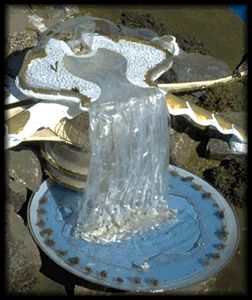
[Aquaterra concept model for residence by Eugene Tsui. (note pond skylight and structural support/entryway arms)]
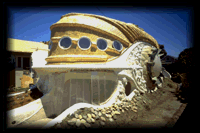
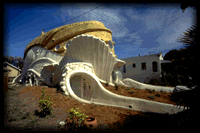
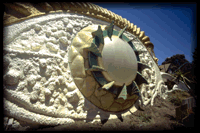
[Tsui beach house, California by Eugene Tsui]
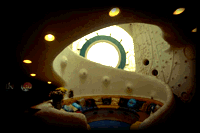
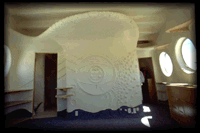
[interior views of beach house showing rampway to living room and master bedroom]
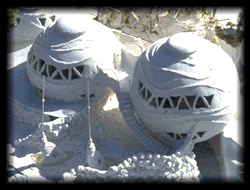
[concept for resort complex by Eugene Tsui]
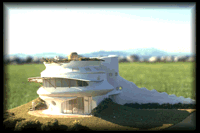
[Primetempera design for California residence by Tsui]
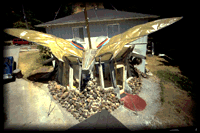
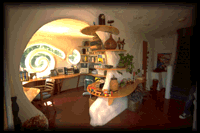
[Reyes house, a studio/bungalo design by Tsui. (note polymer fabric wings and spiral eye window)]

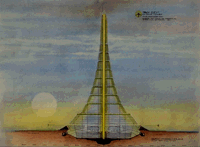
[concept drawings for Nexus mobile sea colony and Ultima 1 tower shaped arcology by Eugene Tsui]

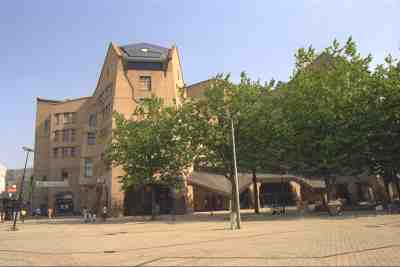
[exterior views of ING Building, Netherlands]

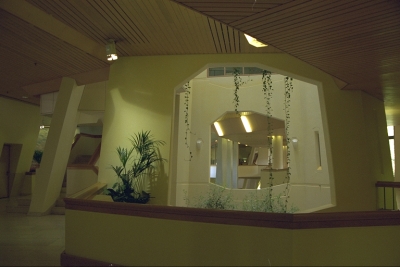

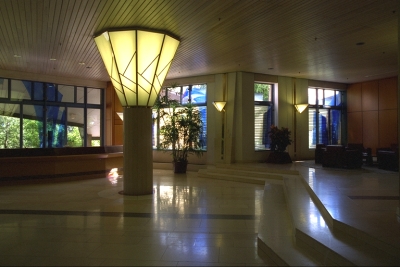


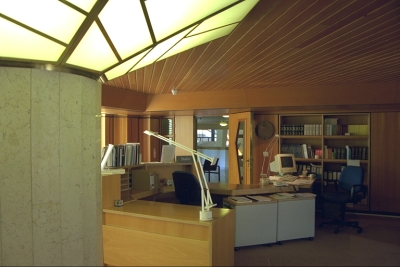
[various interior views of ING Building]
Organic Architecture and The Millennial Project:
In "The Millennial Project" author Marshal Savage describes the use of free-form organic architecture on the marine colony Aquarius. But exactly what kind architecture is he describing? The one rough sketch and the short description suggest that Savage is referring to the third form of organic architecture as described above. This is an appropriate choice for many reasons. The use of built-in furniture and fixtures helps promote a minimum consumption culture which is important for self-sufficiency. Aesthetically, it is matched to the marine location of Aquarius and the ecological sensibilities of its founders because its organic forms are reminiscent of plant and animal life, creating the impression of a community as organism in tune with the natural life and environment of the sea. Aquarius is a structure grown from the sea so it is appropriate that it look like something which came from the sea.
But the potential for this form of organic architecture goes far beyond Aquarius, and beyond what Marshal himself has described. Organic architecture is the first and only truly 'volumetric' architecture human beings have invented. In other words, it is an inherently three dimentional form of architecture unconstrained by the limitations of the two dimensional floor plan. Thus it is the only form of architecture we have which is truly suited to the zero-gravity environment of space. As human beings move into space, as The Millennial Project moves toward the construction of permanent space habitats, it is critical for their well-being that they be provided with a habitat they can truly be at home in. To date the environments inside spacecraft and space stations have afforded a very crude industrial vernacular architecture, an architecture whose aesthetic is defined purely by the functional engineering of the systems of transportation and survival. These habitats are not designed to be homes, are not designed to be more than temporarily comfortable, because they are not intended to be inhabitted for any great length of time or by people who are not trained to cope with severe living conditions. They are like the survival huts of arctic explorers, the bunkers of military compounds. They are purely functional, devoid of the human element in their structure even if they are designed for optimal ergonomics and therefore impossible to call home, impossible to be at home in.
Free-form organic architecture offers us a robust, beautiful, and comfortable architectural aesthetic that is also uniquely suited to the zero-gravity environment. Even if current examples of this architecture are limited to the use of materials like sprayed concrete, the architecture itself is not so limited and can be realized in any number of different materials. In their work on interior design, the Dean brothers demonstrated the use of their tectonic architecture as a form of functional soft sculpture. They crafted fanciful lounges where soft composite foam structures looking like beds of coral fill the space and serve as both sculpture and seating. This suggests a means by which a gravity-free residence might be constructed.
Let us imagine a space habitat, a home in space, formed of such nested organic chambers carved in layers of foam and covered in fabric. The design of rooms is not focused on orientation to a floor but rather on the orientation to 'weigh points' of human activity, the places where people reach for or float to hand-holds, stop to rest, or perform work. Lighting takes the form of networked fiber optic cables feeding spot lights and 'leaky' fiber flex panels emitting a soft glow. Fiber optics replaces most electrical cable, serving even for wall switches and environmental sensors. Open cell foam layers allow the whole structure to be permeable and ventilated by flexible ductwork. Flexible polyethylene tubing secluded in ducts under the lowest foam layers serve for all plumbing, heating, and cooling. Soft seating alcoves with hard-top counter surfaces serve as tables, desks, workspaces, and control panels. Recessed cabinets and net-covered alcoves serve for storage. Womb-like alcoves serve as bedrooms. Cylindrical chambers with spray and vacuum nozzles and water-tight cabinets in the walls serve as shower and bath. Spherical rooms serve as lounges. Flattened spheres or ovoid spaces serve as workrooms. Spherical lounges, one half window and one half loung with a tunnel entrance at the center serve as observation lounges. A single large room, its walls covered with extra thick foam, might serve as a recreation space. Just bounce and spin to your heart's delight. Varying colors and surface textures combine with smooth sensuously flowing walls and tunnels to create a complex stimulating and yet protective environment whose organic forms constantly remind the inhabitants of the natural environment of Earth.
Such architecture would also have its place on the colonies of the Moon and Mars where lesser gravity can likewise create a need for more volumetric interior design. Marshal Savage describes a titanic lunar grown tree serving as a residence, its huge trunk and branches festooned with clustered dwellings and terraces like the nests of weaver birds. What better approach to the interior design of sch a structure?
Clearly, the future may belong to this unique and elegant form of architecture.
Eric Hunting (hunting@tigger.jvnc.net) 1997
Bibliography:
Fallingwater - Frank Lloyd Wright's Romance with Nature: Lynda S. Waggoner. Universe Publishing.
The Healthy House: Sydney and Joan Baggs. Harper Collins Publishers.
Fantastic Architecture - Personal and Eccentric Visions: Michael Schuyt, Joost Elffers, George R. Collins. Harry N. Abrams Inc. Publishers, New York
Earth Sheltered Housing Design -guidelines, examples, and references: The Underground Space Center, University of Minnesota, Van Noststrand Reinhold Book.
Views, Magnetic Storm: Roger and Martyn Dean, Pomegranet Art Books.
Halifax EcoCity Project, Adelaide Australia: http://www.eastend.com.au/~ecology/ecocity/
Virtual Tour of ING Building, Amsterdam: http://tour.ing.nl/uk3/homepage.html
Tsui Design Research home page; http://www.tdrinc.com/index.html
