Kismet Design
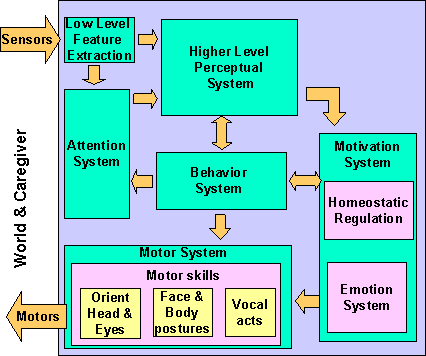
The Low-Level Feature Extraction System
The low-level feature extraction system is responsible for processing the raw
sensory information into quantities that have behavioral significance for the
robot. The routines are designed to be cheap, fast, and just adequate. Of particular
interest are those perceptual cues that infants seem to rely on. For instance,
visual and auditory cues such as detecting eyes and the recognition of vocal
affect are important for infants.
The Attention System
The low-level visual percepts are sent to the attention system. The purpose
of the attention system is to pick out low-level perceptual stimuli that are
particularly salient or relevant at that time, and to direct the robot's attention
and gaze toward them. This provides the robot with a locus of attention that
it can use to organize its behavior. A perceptual stimulus may be salient for
several reasons. It may capture the robot's attention because of its sudden
appearance, or perhaps due to its sudden change. It may stand out because of
its inherent saliency such as a red ball may stand out from the background.
Or perhaps its quality has special behavioral significance for the robot such
as being a typical indication of danger.
The Perceptual System
The low-level features corresponding to the target stimuli of the attention
system are fed into the perceptual system. Here they are encapsulated into behaviorally
relevant percepts. To environmentally elicit processes in these systems, each
behavior and emotive response has an associated releaser. As conceptualized
by Tinbergen and Lorenz, a releaser can be viewed as a collection of feature
detectors that are minimally necessary to identify a particular object or event
of behavioral significance. The function of the releasers is to ascertain if
all environmental (perceptual) conditions are right for the response to become
active.
The Motivation System
The motivation system consists of the robot's basic "drives'' and "emotions''.
The "drives'' represent the basic "needs'' of the robot and are modeled
as simple homeostatic regulation mechanisms. When the needs of the robot are
being adequately met, the intensity level of each ``drive'' is within a desired
regime. However, as the intensity level moves farther away from the homeostatic
regime, the robot becomes more strongly motivated to engage in behaviors that
restore that "drive''. Hence the "drives'' largely establish the robot's
own agenda, and play a significant role in determining which behavior(s) the
robot activates at any one time. The "emotions'' are modeled from a functional
perspective. Based on simple appraisals of the benefit or detriment of a given
stimulus, the robot evokes positive emotive responses that serve to bring itself
closer to it, or negative emotive responses in order to withdraw from it. There
is a distinct emotive response for each class of eliciting conditions. Currently,
six basic emotions are modeled that give the robot synthetic analogs of anger,
disgust, fear, joy, sorrow, and surprise (after Ekman). There are also arousal-based
responses that correspond to interest, calm, and boredom that are modeled in
a similar way. The expression of emotive responses promotes empathy from the
caregiver and plays an important role in regulating social interaction with
the human.
The Behavior System
The behavior system organizes the robot's task-based behaviors into a coherent
structure. Each behavior is viewed as a self-interested, goal-directed entity
that competes with other behaviors to establish the current task. An arbitration
mechanism is required to determine which behavior(s) to activate and for how
long, given that the robot has several motivations that it must tend to and
different behaviors that it can use to achieve them. The main responsibility
of the behavior system is to carry out this arbitration. In particular, it addresses
the issues of relevancy, coherency, persistence, and opportunism. By doing so,
the robot is able to behave in a sensible manner in a complex and dynamic environment.
The Motor System
The motor system arbitrates the robot's motor skills and expressions. It consists
of four subsystems: the motor skills system, the facial animation system, the
expressive vocalization system, and the oculo-motor system. Given that a particular
goal and behavioral strategy have been selected, the motor system determines
how to move the robot so as to carry out that course of action. Overall, the
motor skills system coordinates body posture, gaze direction, vocalizations,
and facial expressions to address issues of blending and sequencing the action
primitives from the specialized motor systems.

