|
Bates - McLean Family Tree - More details of our ancestors |
||
|
The notes below are set out in alphabetical order by family name then by first name, most recent birth date first |
||
|
A to Z of notes A, B, C, D, E, F, G, H, I, J, K, L, M, McL, N, O, P, Q, R, S, T, U, V, W, X, Y, Z |
|||||||||||||||||||||||||||||||||||
|
George BODLE |
George BODLE was baptised in 1854 in Ringmer, Sussex, he had two sisters, five step sisters and three step brothers. George's father Henry Jarrett BODLE or BODEL appears in the parish records as early as 1813-4 when he was amongst many poor parishioners who received boots made by a village bootmaker at the parish expense. Henry BODEL also appears on an 1825 list of Ringmer men of military age as a labourer aged 22 with no children. George came, therefore, from a poor family.
Henry married Maria Pelham on 9 December 1850 in Ringmer (Registration District of Lewes). George appears to have been their second child, born in 1854 some two years after Emily, although they were baptised together; probably to save money.
George is recorded in the 1881 census as a Mariner and Lodger at Sea Bank Cottage Old Hendon Rd in Sunderland. This house still stands. Also staying there, but as a Servant was Isabella McNeal - later to become his wife. Presumably they must have met here.
It is likely that George was sailing on the brigantine the "Wensleydale" out of Southampton. This ship was moored in Sunderland harbour [I will add details of the boat later]. The Master was Henry Lonnnon on this occasion.
George Married Isabella McNEIL (or McNEAL) on 06 July 1882 at St Barnabas CofE Church in Sunderland, County Durham. He must have gone straight back to sea to complete the current contract and at least another 6-month contracts. The Discharge Certificate dated 02 December 1882 is the last sea record we have. He had been sailing on the brigantine the "Laura" on the Southampton to Sunderland route, under the Master Robert Wilkinson. (See details below and opposite)
After that George had four children
It is not clear what George's occupation was during this period. However, on 14 March 1890, aged 37, George Bodle died at 621/2 Moor Street, Sunderland of Dilirium tremens, still noted as a Seaman Merchant Service. No record has yet been found of his burial. It is not clear, yet, that he saw his last child, Maria. LAURA
- 1875-85
WENSLEYDALE - 1881/82 Lloyds Register
Code letters: JNCK Official Number: 6332 |
ADDITIONAL SIDELINE NOTES
LAURA - On night of 1881 Census at Southampton Robert Wilkinson - Master not onboard , - at home, see below William
HAWCALL: Married 59, Chichester, Sussex, Mate Robert
H Wilkinson - son of Master -
1881 Dwelling; 17 Chantry Road, Southampton St Mary, Hampshire, England Robert
WILKINSON: Head, Married 43, Spalding, Lincoln,
England, Mariner and Master of the Laura moored in Southampton - see
opposite Charlotte
WILKINSON: Wife Married, 39, Portsmouth, Hampshire,
England Robert
H. WILKINSON: Son U 19, Sunderland, Durham, England, Mariner
Frances
WILKINSON: Dau U 16, Sunderland, Durham, England, Scholar Joseph
WILKINSON: Son U 14 , Sunderland, Durham, England, Scholar Sarah
Eva WILKINSON: Dau U 11, Sunderland, Durham, England, Scholar Charles
Wm. WILKINSON: Son 9, Sunderland, Durham, England, Scholar Thomas
WILKINSON: Son 6, Sunderland, Durham, England, Scholar Albert
WILKINSON: Son 3, Southampton, Hampshire, England Laura WILKINSONL: Dau 11 m, Southampton, Hampshire, England - named after the ship the Laura
WENSLEYDALE - On night of 1881 Census - at Sunderland Henry
LONNON: Married 26 Portsmouth, Hampshire, Master
Mariner John
LONNON: U 21, Portsmouth, Hampshire, Mate John
CROCKER: U 20, Pembray, Wales, OS James
NELSON: U 20, Glasgow, Lanark, Scotland’ OS Joseph WHALEN: U 18, Manchester, Lancashire, OS George BODLE not onboard
|
|||||||||||||||||||||||||||||||||
|
Hannah GREENER |
Hannah GREENER's life reads like the plot from a historical novel. She was born on 27 October 1839 in Walbottle, a few miles to the west of Newcastle upon Tyne and in Cathrine Cookston Country. Her father John married Margaret LEDGER but we do'nt know when - as yet. He was a coal miner, possibly at Walbottle Colliery, Northumberland. Hannah appears to have been close to her brother Samuel, born about 1836 also in Walbottle. Samuel was found lodging with Hannah and her second husband Edward SPINKS in the 1881 census. He may have been providing support to his wee sister. There may have been an older brother John, born about 1832 in Walbottle. In the 1881 census a John Greener, coal miner, is noted as living in Wylam, Northumberland, a few miles west of Walbottle. Also, there is a witness John GREENER on Hannah's marriage certificate, this may have been her brother and not her father. Hannah married Robert McNEIL, also a coal miner, on 30 November 1857, she was just 18 and he was almost 21. The spelling of McNeil varies between McNeal, McNeill and O'Neill; mainly due no doubt to many peoples' inability to read and write, common in that period. John and Hannah were wedded at the Parish Church of St John in the County of Newcastle upon Tyne. Another witness was John Findley. There are several options in the 1881 census as to whom this might have been. Over the next 18 years the couple had 5 sons and 4 daughters. 2 of the children died when young - Isabella [b. 1857 and died soon after] and John [b. 1858, death not found yet]. Later children were given these names, as was the tradition in those days. All the children were born in Tanfield, a few miles south of Walbottle. In 1881 they lived at No 65 Tanfield, County Durham. Robert worked at the Hobson Colliery, County Durham, where he had progressed to Deputy Overman; see the notes. It must have come as shock when Robert died on the 2 March 1874 aged only 36. The cause was Hypertrophy of the heart and Asphixia. Daughter Hannah was christened on 20 May 1874. So poor Robert never saw his last child. For widow Hannah the future must have looked bleak. At some point she met Edward SPINKS, another coal miner, far from the town and county of his birth, Alysham, Norfolk . Perhaps he also worked at the pit. They married in early 1877 at Lanchester. Hannah was 38 but Edward was about 26 , younger by some 12 years. In 1878 they had a daughter Elizabeth named after Edward's mother Elizabeth BARNEY. There appears to have been a mass migration of the SPINKS' family to the Durham area. Probably linked to the industrial revolution that led to people moving from the land in the early 1800's. On 24 December 1882 Hannah died. A painful Christmas for the family. Hannah had been suffering from cancer, discovered some 4 months earlier. She died at Spen, Chopwell, Blaydon, not far from Tanfield. At the age of 31 Edward had been widowed and left to bring up 8 children, only one of whom was his own. Three of the sons were already working; George and John were miners {aged 16 and 14] while Thomas [aged 12] was a labourer in the Fire Brick Works. George, a hewer, was to be killed at the Burnopfield Colliery, Durham in 1888. In 1901 Robert McNEIL (SPINKS) had become a hewer like his father in Wickam colliery not far from Tanfield. John was still in Tanfield, while Thomas was at Lamesley. Epilogue An Edward SPINKS married between July-Sep 1888 at Tynemouth. But sadly Edward's daughter by Hannah died in 1890 at Lanchester. On a happier note, marriages of the other children are as follows - Mary in 1884 at Lanchetser, John in 1890 at Newcastle upon Tyne, Thomas in 1891 at Lanchester, Hannah in 1897 at Lanchester. George married in 1885 at Lanchester, three years before he was killed - cause by a 'fall of stone in a jud'. A Robert McNeal was married in 1884 at South Shields . |
Walbottle map etc - 1861 to 1865 - click <place name circle> insert into the box the place name shown in blue opposite then click <search>
Map of Walbottle and surrounding area as it is now.
For the 1881 British Census click blue hyperlink then add your search details
For mining history details see here and below
|
|||||||||||||||||||||||||||||||||
|
Jane Ann JOHNSON nee LEES |
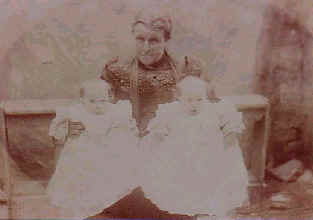
This photograph, taken about 1908/09 shows Jane Ann MARTIN and Agnes MARTIN in the arms of their grandmother Jane Ann JOHNSON [nee LEES] She was a was a Fish Hawker, on her own account as recorded in the 1891 census. She used to collect the fish, crabs etc at Sunderland station and sell them in colliery villages using a brightly painted green cart. In the 1901 she is also recorded as a costermonger painter. This suggests she also painted the carts.
|
|
|||||||||||||||||||||||||||||||||
|
JOHNSTONE, family |
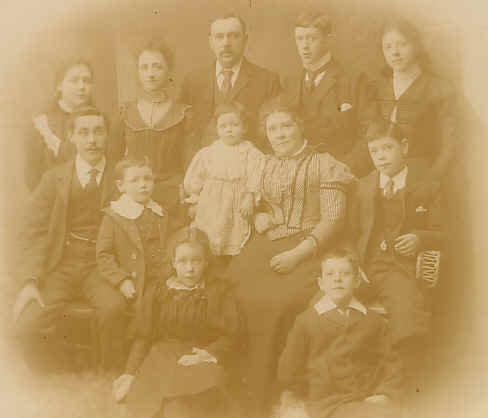
The Johnstone Family taken about 1900 when Jean Johnstone was about 3. From left to right and top to bottom we have Peggie Miller, Maggie Johnson (Robert's Sister), Robert Johnstone, Davy, Johnstone, Isa Bobby, George (see below), Jean, Elizabeth (nee Oliphant), Jock, Peggy and James
For JOHNSTONE Family details click here For OLIPHANT Family details click here Robert Johnston, (born 1853), had Joiners business in Glasgow, possibly in Mungo Street, off Stirling Road in the Townhead area of Glasgow. . Robert
Johnstone’s Business history - known to date
|
|
|||||||||||||||||||||||||||||||||
|
Return to A to Z |
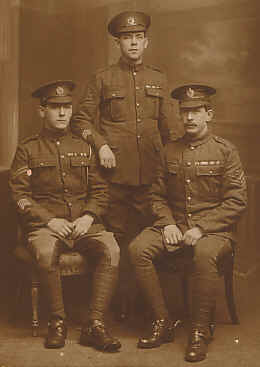
George Johnstone killed at the Somme in the 1st World War is probably the “George Johnstone”, Sapper, RE (Royal Engineers)” noted on the Role of Honour in Glasgow Cathedral, as one the parish killed in the war (note “e” now on the Johnstone. The photograph (probably after 1915/16) of the three soldiers shows Davy, Jock and James all in the Royal Engineers according to the cap badge. There was a family photograph of the four brothers photograph.
In Memory of GEORGE
JOHNSTONE Private 14190 Commemorative Information
Memorial:
THIEPVAL
MEMORIAL, Somme, France Grave
Reference/Panel Number: Pier and Face 15 C Location:
The
Thiepval Memorial will be found on the D73, off the main Bapaume to Albert
road (D929).
Historical Information: On 1 July 1916, supported by a French attack to the south, thirteen divisions of Commonwealth forces launched an offensive on a line from north of Gommecourt to Maricourt. Despite a preliminary bombardment lasting seven days, the German defences were barely touched and the attack met unexpectedly fierce resistance. Losses were catastrophic and with only minimal advances on the southern flank, the initial attack was a failure. In the following weeks, huge resources of manpower and equipment were deployed in an attempt to exploit the modest successes of the first day. However, the German Army resisted tenaciously and repeated attacks and counter attacks meant a major battle for every village, copse and farmhouse gained. At the end of September, Thiepval was finally captured. The village had been an original objective of 1 July.
Attacks north and east continued throughout October and into November in increasingly difficult weather conditions. The Battle of the Somme finally ended on 18 November with the onset of winter. In the spring of 1917, the German forces fell back to their newly prepared defences, the Hindenburg Line, and there were no further significant engagements in the Somme sector until the Germans mounted their major offensive in March 1918. The Thiepval Memorial, the Memorial to the Missing of the Somme, bears the names of more than 72,000 officers and men of the United Kingdom and South African forces who died in the Somme sector before 20 March 1918 and have no known grave. Over 90% of those commemorated died between July and November 1916. The memorial also serves as an Anglo-French Battle Memorial in recognition of the joint nature of the 1916 offensive and a small cemetery containing equal numbers of Commonwealth and French graves lies at the foot of the memorial. The memorial, designed by Sir Edwin Lutyens, was built between 1928 and 1932 and unveiled by the Prince of Wales, in the presence of the President of France, on 31 July 1932. The dead of other Commonwealth countries who died on the Somme and have no known graves are commemorated on national memorials elsewhere.
|
Extract from Commonwealth War Graves Commission
George's three surviving brothers Davy Jock and Bobby
|
|||||||||||||||||||||||||||||||||
|
MARTIN / GILMARTIN family
|
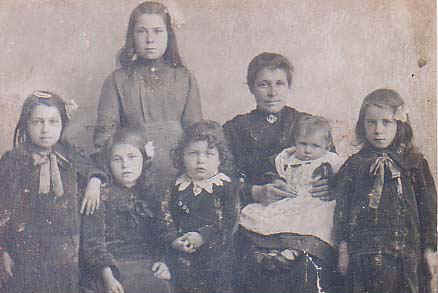
Above Jemima MARTIN [nee JOHNSON] with her children about 1915 Cathrine (Katy) Jane Ann (Jenny), Sarah, John, Mary (in arms), Christiana |
Above
|
|||||||||||||||||||||||||||||||||
|
|
Left John MARTIN at some point during the 1914/18 war Right Michael MARTIN (GILMARTIN) may have been taken about 1927 when Michael was a 76. He is
reputed to have walked across Ireland from Sligo when he was 13 (ie about
1865). He worked in the
shipyards at Liverpool where it is said he held the record for rivet
catching. It is not clear at what
point he changed his name from Gilmartin to Martin, or why. The
first record we have of him in Sunderland is on his marriage certificate dated
1874
when he married Cathrine CRANNAGH. He probably moved to
Sunderland to continue work as a riveter in the shipyards . |
|
|||||||||||||||||||||||||||||||||
|
McLEAN family |
The earliest McLean for which we have background information is Alexander McLean born 1814 in Cowall, Argyle, according to the parish records. He is not recorded in the Inverchaolain census of 1841, indeed none of the family could be found. Alexander was found in the Port Glasgow when he married Janet McNICOL in 1848. He is noted in the 1851 and 1861 census as a mason. In 1851 he was living at 3 Salmon Street Greenock with Janet, 2 young sons and a visitor Gilbert Ferguson [shoemaker from Cowall, Argyle]. However, in his death certificate of 1865 his occupation had changed to a 'Spirit Dealer', that is he bought and sold alcohol. He died of the 'Phthisis' , ie tuberculosis of the lungs. At that point he lived at 36 Inverkip Street Greenock. In the 1881 Janet his widow is noted as a 'Annuitant', perhaps he had earned a reasonable sum as a spirit dealer. She had moved to 6 Kilblain Street, Greenock by then.
|
For Janet McNICOL click here |
|||||||||||||||||||||||||||||||||
|
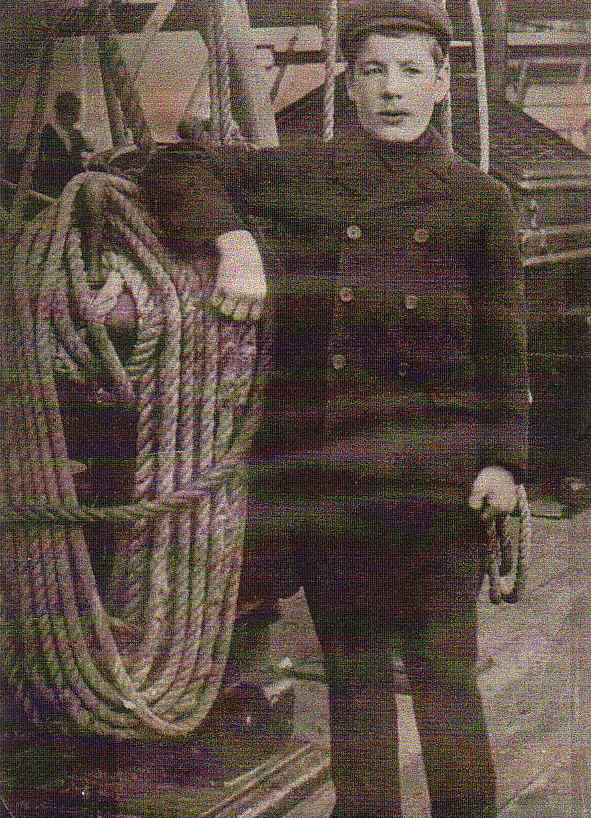
Alexander (Sandy) McLean, aged about 15. Taken on a sailing ship moored at Govan, Glasgow about 1903.
Alexander McLean, appears to have had an interesting life. Born about 1888 in Govan, he ran away to sea at the age of 12, apparently from a borstal, where he had been put for running away (or not attending school). By 15 he had been round the world 3 times ‘before the mast’ in sailing ships. He was later known on the Clyde as “Boson McLean”. In the Glasgow voters role of 1918 he is noted as a soldier. He later worked in the Cremola factory in Glasgow till he was 76 when he could still lift and carry a 2cwt (hundred weight) sack of sugar (that is 224 pounds).
|
|
||||||||||||||||||||||||||||||||||
|
McLEAN, Duncan
Return to A to Z
|
In Memory of DUNCAN
McLEAN Private 11212 Commemorative Information Memorial: LE
TOURET MEMORIAL, Pas de Calais, France Grave
Reference/Panel Number: Panel
37 and 38 Location: Le Touret Memorial is located at the east end of Le Touret Military Cemetery, on the south side of the Bethune-Armentieres main road.
From
Bethune follow the signs for Armentieres until you are on the D171.
Continue on this road through Essars and Le Touret village. Approximately
1 kilometre after Le Touret village and about 5 kilometres before you
reach the intersection with the D947, Estaires to La Bassee road, the
Cemetery lies on the right hand side of the road. The Memorial takes the
form of a loggia surrounding an open rectangular court. The court is
enclosed by three solid walls and on the eastern side by a colonnade. East
of the colonnade is a wall and the colonnade and wall are prolonged
northwards (to the road) and southwards, forming a long gallery. Small
pavilions mark the ends of the gallery and the western corners of the
court. The names of those commemorated are listed on panels set into the
walls of the court and the gallery, arranged by Regiment, Rank and
alphabetically by surname within the rank. Over 13,000 names are listed on
the memorial of men who fell in this area before 25 September 1915 and who
have no known grave.
Historical Information
The Memorial in Le Touret Military Cemetery, Richebourg-l'Avoue, is one of those erected by the Commonwealth War Graves Commission to record the names of the officers and men who fell in the Great War and whose graves are not known. It serves the area enclosed on the North by the river Lys and a line drawn from Estaires to Fournes, and on the South by the old Southern boundary of the First Army about Grenay; and it covers the period from the arrival of the II Corps in Flanders in 1914 to the eve of the Battle of Loos. It does not include the names of officers and men of Canadian or Indian regiments; they are found on the Memorials at Vimy and Neuve-Chapelle |
Extract from Commonwealth War Graves Commission |
|||||||||||||||||||||||||||||||||
|
McNEIL, XXX |
Overman The person who, beneath the viewer, has the charge of the workings of a colliery where there is no under-viewer. He sets the pit to work each morning, and attends to all the detail of arranging the work, and getting the coals each man works to the shaft bottom. It is also his duty to see that each working place is properly ventilated and in a safe state. He also keeps a daily account of the work wrought, and of the whole of the underground expenses and wages, and gives the colliery office a fortnightly account of the same, the bill containing the amount earned by each man, or set of men if in partnership, and boy during that time. There is one overman to a pit, so that if there are two or three pits at a colliery, there are two or three overmen. An overman is almost invariably a man who has passed through all the graduations of pit work, from the trapper upwards, and who has been raised to his situation on account of his ability and steadiness. His wages in 1849 were 26s. to 28s. per week, with house, garden, and coals gratis. |
||||||||||||||||||||||||||||||||||
|
McNUIR, Elizabeth and Weir, Elizabeth same person
|
See Weir, Elizabeth |
||||||||||||||||||||||||||||||||||
|
NICOL Larry and Norrie |
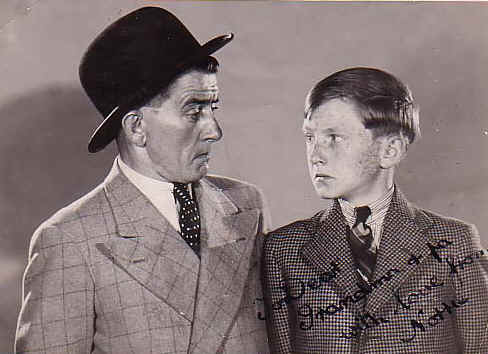
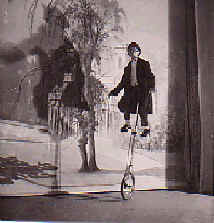
Larry (Lawrence) and his son Norry (Norman) NICOL were both comedy trick cyclists [Specilaist Acts in stage speak], although Larry was more of a comedian. They acted on the Empire, Glasgow. It is thought their stage name was Kemble and Norton. Larry eventually became an actor's agent in London. |
|
|||||||||||||||||||||||||||||||||
|
Return to A to Z |
Randalph (Ronny) Nicol on the stage with his comedy unicycle act.
Ronny (Randy) Nicol, born 1896, was baptised in St Andrews RC Church, Glasgow when the family staying at 106 Florence Street. He
was an ambulance driver and drove officers to and from the airfields in
France during the 1st World War where met his brother Larry
on at least one occasion. Larry
was a translator and helped to interrogate prisoners of war.
Ronny Nicol was in the RAC – Royal Air Corps, precursor to the
Royal Air Force. There is a
story that Ronny used to tell his Nicol grand children, apparently when
an ambulance driver he was the first to reach the WW1 air ace James
McCudden when his plane crashed and he was killed.
This places Ronny Nicol at a time and place at the time of the
crash. 9
July 1918 - British ace pilot Major James T.B. McCudden, RAF, was killed
at Auxi-le-Château, France; credited with 57 victories, he died in a
crash landing when the engine failed on his Royal Aircraft Factory
S.E.5a.
Ronny was living at 53
Sauchiehall Street when got married to Jean Oliphant Johnstone in 1920.
Jean is recorded as living at 126 Stirling Road.
The witnesses were John Johnstone (Jean’s brother) and Agnes
Sandilands Simpson. He obtained his Corporation of the City of Glasgow ‘Stage Carriage Driver’s Licence – No 578/1108’ on 10 January 1927 but did not start driving with Ballie Bros. Ltd till 25th July 1929. Possibly during this the period he and Larry ran their own buses. He worked with Ballie Bros till 31st May 1936 when the company merged with Central SMT.
In
his marriage certificate Randolph is recorded as a Music Hall Artiste.
His stage diary of 1949/50/51 shows him with a variety of dates
doing a trick and comedy cyclist act.
At this time he was living at 159 Buccleuch Street where he and
Jean had been living for some time.
The uni-cycles were kept in the work room off the big bedroom.
At one point he ran a bicycle repair shop.
He used to transport the family around in a motor bike and side
car.
|
|
|||||||||||||||||||||||||||||||||
|
WEIR, Elizabeth and McNuir, Elizabeth same person
Return to A to Z
|
1.
Kilmoden Parish Marriage Record for 10 September 1808 “Duncan McLean Parish of Inverchoalain
and Elizabeth Weir of this parish” 2.
Inverchoalain Parish Marriage Record for 10 September 1808
– “Duncan
McLean of Taunich of Inverchoalain parish proclaimed marriage to Elizabeth
McNuir of Glendaruel on 20 September.”
The book “The surnames of Scotland”
records the following about the name McNair, MacNayer, McNuir, MacNuyer. “This surname is generally considered
to have at least three different origins: 1)
The Macnairs of Ross-shire (Gairloch) are supposed to derive their
name from a Mac-Iain –uidhir,
‘son of dun (odhar)
John,’ through Mac-an
uidhir, condensed into M’In-mir,……. 3)
The late Prof. Mackinnon suggested Mac-an-fhuibhir,
‘son of the smith,’ and Dr Macbain added another possible derivation
from Mac-an-fhuidhir,’the
stranger’s son,’. The
latter two names are pronounced Mac-an
–ewar, with dh and fh mute.
The Macnairs of Lennox, some
of whom go by the name of Weir, are reckoned a sept of Marfarlane,
Argyleshire (Cowal) sept are comnected to the Macnaughtons;……”
|
||||||||||||||||||||||||||||||||||
|
Not all of these records have been verified. The information sources include birth, marriage and death certificates, parish/church records and data from the IGI FamilySearch site. If you know of any errors or have additional information please contact me at ray_mon5@hotmail.com © 2004 BATES and McLEAN Family Tree
|
Last updated 26 January 2004 |
||||||||||||||||||||||||||||||||||
|
|
|||||||||||||||||||||||||||||||||||
|
We are pleased to include advertising banners in the area below |
|||||||||||||||||||||||||||||||||||