
Standard Transit Time (STT)
by Cobalt Blue
The following is a method of expressing a standard time it takes to cross (1) a sector, (2) one of the 8 subsectors represented by the Key Pad layout on the computer keyboard, and (3) one of the four divisions of a subsector.
The purpose of this Standard Transit Time (STT) is to provide a quick way of estimating time to transit a given area for all types of aircraft, especially bombers. This STT is intended to be used in communications and battle planning. It is not intended to express exact measurements.
The section of the Flanders map below shows the C3 sector with the typical 9 keypad subsectors, and each subsector further divided into 4 squares.
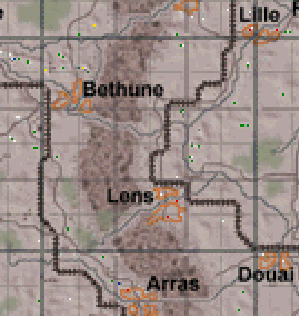
This sector was used in determining the results detailed below.
Transit times measurements for these divisions were accomplished in the EIII, Morane Bullet, Halb DII, NP11, Alb DII, NP17, Pfaltz DIII (or P3), and Pfaltz D12 (or P12), with the following conditions and assumptions:
1. Measurements were taken in NFM at 1000m (3000ft), Flanders map.
2. All cruise times were taken in Autopilot mode.
3. Sectors and subsectors are assumed to be square in shape.
4. Cruise speeds will vary somewhat with network connection quality.
5. Times are given in minutes per side/diagonal of a sector and of a square. Transit of a subsector would then take 2 x the square flight time.
6. Diagonal times are approximately 1.4 times longer than the sides.
The results are as follows:
Flying time of EIII: Sector: 14/19.6 Square: 2.3/3.2
Flying time of Morane: Sector: 12/17 Square: 2.0/2.8
Flying time of Halb DII: Sector: 14/19.6 Square: 2.3/3.2
Flying time of NP11: Sector: 10/14 Square: 1.6/2.3
Flying time of Alb DII: Sector: 10/14 Square: 1.6/2.3
Flying time of NP17: Sector:
10/14 Square: 1.6/2.3 Flying time of Pfaltz DIII: Sector: 12/16.8 Square: 2.0/2.8
Flying time of Pfaltz DXII: Sector: 10/14 Square: 1.6/2.3
Total average of all planes: Sector: 11.5/16.1 Square: 1.9/2.7
The average sector side/diag flying time is 11.5/16 min; the average square side/diag flying time is 1.9/2.7 min. Subsector flight time would be 2 x the average square flight time.
Each sector is divided into 9 subsectors according to the keypad layout (3 subsectors on a side). Each subsector is then divided into 4 squares, for a total of 36 squares (6 on a side).
Assuming a Standard Transit Time (STT) of 3 min to cross a square, it will then take approximately 6 minutes to transit a subsector, and 18 minutes to transit a sector. Naturally, this will vary slightly depending on the type of plane being flown. While there is also an obvious disparity between the flying time along a side vs the flying time along a diagonal, most flights rarely follow a sector side exactly, but fall somewhere in between, so in the interest of simplicity, the difference can be ignored.
Island Map:
The Island map is divided into sectors that are approximately the size of squares (one of 4 divisions of a subsector in the Flanders, Alsace, and Verdun maps). It therefore takes approximately 3 minutes to fly across an Island sector.
Using the STT:
Since it takes approximately 3 minutes to fly 12,000ft (4000m), the radius of the N-key detection sphere, The Standard Transit Time also gives a rough idea of when you will make visual contact with other planes, and how far you are from them. For example, if you suddenly get an N-key contact, you know that you are approximately 3 min flying time away from the contact. Time enough to finish that flask of rum :-)
Summary:
The sector diagram below summarizes the Standard Transit Time values for the Flanders, Alsace, and Verdun map sectors. The Island Map sector is equivalent to one square in the other maps:

