
STEALTH PENETRATION PROCEDURE
Sby Cobalt Blue
Updated 1/6/03
This paper describes methods of anticipating, avoiding, and defeating enemy contacts while enroute to, or exiting from, a target.
Getting to an enemy target without being detected requires the following skills:
RB3D DETECTION CAPABILITIES
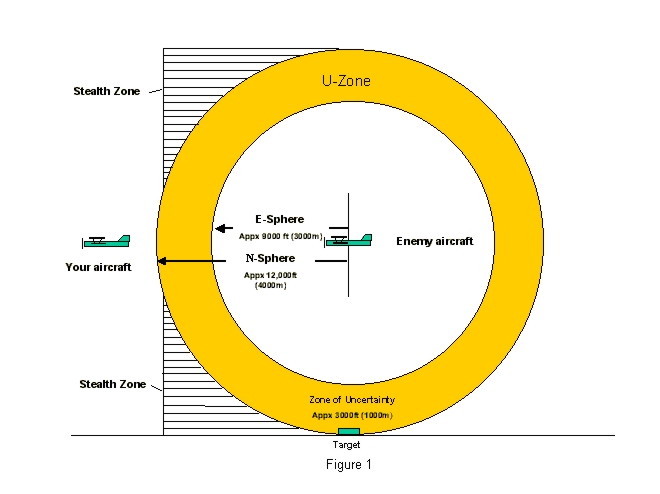
Each aircraft can be thought of as having two threat detection spheres surrounding it, one within the other. The first, or inner threat sphere, is the E/F sphere, which extends out approximately 9000ft (3000m) from the aircraft. This is really two spheres, since they are activated by either the E or F key. However, they extend approximately the same distance, so for this discussion, I will assume that the other aircraft is enemy, and refer only to the E-sphere. The other threat sphere is the N-sphere, which extends approximately 12000ft (4000m). Figure 1 shows the two threat spheres and their relation to each other and to your aircraft.
E Sphere Information:
Contact within the E sphere provides the following information to the enemy:
N Sphere Information:
Contact within the N-sphere provides much less accurate information to the enemy:
Zone of Uncertainty (U-zone):
Between these two spheres is a Zone of Uncertainty, or U-Zone, that is approximately 3000ft (1000m) in distance. Within this zone, the enemy plane cannot positively identify you as friend or enemy, and cannot get accurate information as to your true heading or attitude. Depending on your location relative to your target, the enemy plane may not approach because he may think you are friendly, or he may not immediately see you on his N-key. If you are picked up in this zone, you must act quickly and do everything you can to get out of it and avoid entering the enemy E-sphere.
Stealth Zones:
These are the areas above and below the N-sphere within which you have the best chance of getting close to your target without being detected, or to which you can escape from enemy detection.
AVOIDING ENEMY CONTACT ENROUTE
Being able to avoid enemy contact and detection while enroute is the first priority. To do this, you must constantly use your own N-key to detect enemy aircraft first. You must also assume that ALL contacts are enemy, and react quickly to avoid detection.
On occasion, you may be enroute to rendezvous with a friendly aircraft, so you may have to remain in the U-zone until the unknown plane enters your E/F sphere and you can get positive identification. In this case, you should fly a course that is at an angle AWAY from the approaching unknown aircraft, so that you will maintain as much separation as possible until you get positive identification.
Once you are aware of the detection capabilities of the enemy plane and the relative position of his detection spheres, you can plan your attack approach or escape. For example, if scouts warn that there is an enemy cap over the target at approximately at 7000ft (2500m), you may want to dive to the deck to approach in the stealth zone under the curve of his N-sphere. If, however, he is just taking off, or is only at 3000ft (1000m), a low approach will place you well within his N-sphere early on, and reduce your chances of getting in undetected. In this case, you may want to climb higher and get into the stealth zone above his N-sphere prior to your attack.
As a rule of thumb, the N-sphere distance (12,000ft or 4000m) represents about 3 minutes of flying time, so for a low-level attack, you should be on the deck at least 5 minutes before you reach the target. When you reach L-key range of the target, you will be approximately 1.5 minutes out.
BREAKING N-KEY CONTACT WITH THE ENEMY
Assume that you are inbound to your target, which is to the southeast of you. Suddenly you detect a contact at N-key range to the north. What do you do? There are three important things you DON’T know at this point:
(1) Is the contact an enemy?
(2) Has he seen you?
(3) If he hasn’t seen you, is he heading in your direction or away from you?
Your first reaction must be immediate--assume he is an enemy and turn directly away at your fastest possible speed. If you are on the deck, head directly away while monitoring him with your N-key. If he is higher and you are not already on the deck, dive at a 45-degree angle to seek the stealth zone under his N-sphere. If you are higher than he is, and you are in an aircraft with a good climb rate, such as the N11 or N17, you may want to climb at your best rate to seek his upper stealth zone, which will also give you some altitude advantage. At the same time, head away from your previous course at a 45-degree angle. Keep in mind that your speed will decrease while you are climbing, so you need to keep a good rate of climb to keep above his approaching N-sphere. Once you break lock, turn again at a 45-degree angle away from your present course.
In this scenario, if the contact is north of you, and your target is to the southeast, turn and head south. As soon as you break N-sphere contact, you may want to continue south or turn southwest, a direction he will most likely not suspect you of taking. This may be advisable, especially if the enemy has Spads or SE5’s available. Your decision will depend on how much time you have available to approach the target. Once you are heading away from the enemy, make any future turns at 45-degree angles. This will keep you heading toward the outer edge of his N-sphere while taking you away from his flight path as quickly as possible.
If the enemy suspects you are heading to the target southeast of you, he will probably alter course toward it as soon as he loses N-sphere contact. If you manage to break lock, you want to plan your approach so that you avoid his N-sphere as much as possible. This may mean continuing south until you can turn and approach the target from the south or southeast. Be aware that he, and any target defenders he may be talking to, will likely expect you to attack from the southwest now, since that was the area you were heading for when you were last detected. In this case, and if you have time, you should swing around to the south or southeast, or even the east, for your attack.
If you are picked up by the same enemy for a second time, it’s time to do some serious evasion. You can assume that this pilot is anticipating your moves, or that he has a faster plane than you. In this case, do the unexpected. Head directly away until you break lock, then head 45 degrees away from your previous flight path, in a direction away from your intended target. In this example, you might even circle around northwestward to get in behind him and make your approach from the northeast or north, while he looks for you to the south.
MAKING THE FINAL APPROACH TO THE TARGET
Plan your approach to take advantage of the enemy’s most likely placement of defending aircraft. For example, in wars, and in daily server play, the cap usually orbits in the direction of the most likely enemy approach. This means that even if they are at lower altitudes, say 4500ft (1500m), the slant-range to your aircraft, approaching from the opposite direction, can exceed their N-sphere ranges, and give you precious seconds to get closer to the target.
Once you are committed to the attack, use your E-key to monitor only those enemy aircraft that are immediate threats to your flight path. Once you are close to the perimeter of the target, lock the target with your L-key and concentrate on killing the target.
