Flat Foot /Fallen Arches
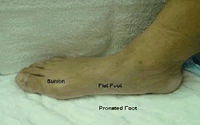 There
is a range or continuum of types of "flat foot." This is the flattening
of the inside part of the foot at the arch. Several causes included
pronation, dysfunction of the posterior tibialis muscle, congenital
problems, injury, fusions of bones that are not normally fused or, results
of a collapsed arch from certain disease processes.
There
is a range or continuum of types of "flat foot." This is the flattening
of the inside part of the foot at the arch. Several causes included
pronation, dysfunction of the posterior tibialis muscle, congenital
problems, injury, fusions of bones that are not normally fused or, results
of a collapsed arch from certain disease processes.
This problem can be flexible or rigid. The flexible type can be helped
with a rigid custom orthotic. If this problem is not addressed early
on it can lead to a rigid flat foot that comes with a whole multitude
of problems including bunions, hammertoes, heel pain, hip, knee and
back pain. The rigid or "spastic" flat foot can be from other more serious
problems and needs to be addressed with your podiatric physician.
Children often appear to be "flat footed" until their foot develops
sufficiently. If however, when they become school age and still have
a flat appearance to the foot then the problem should be addressed with
their Podiatrist.
 Custom
functional orthotics:
Custom
functional orthotics:
Custom function orthotics can address several components of the problem
at the same time including protection and control of the dysfunction
of the way you walk. However, your feet may still need surgery and this
will need to be assessed by your Podiatrist. In addition, good fitting
shoes will be needed to help decrease the pain and to allow for a more
normal walking pattern. Flat foot often needs other treatments including
ankle foot braces. The sooner the problem is addressed the better the
outcome with custom orthotics. Be sure to write on the order form if
your foot is flexible or rigid when ordering custom orthotics from our
site. Rigid flat foot is best addressed with your podiatrist.
 Prolabs:
Prolab inserts are good to help control the dysfunction of the way you
walk but do not provide "protection" or cushioning. These
are not for Rigid flat foot problems.
 Spenco
Cross Trainer:
Spenco
Cross Trainer:
Spenco inserts provide extra cushioning and support. This device is
especially good for the aging foot. It does not provide a large degree
of foot control. They provide comfort and are long lasting.
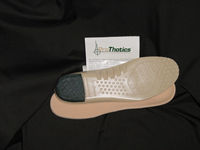 Prothotics
therapeutics:
Prothotics
therapeutics:
These shoe inserts offer support and cushioning. This is a good over
the counter type of insert for people with poor circulation and or diabetes
that need protection for their feet. It does not provide a large amount
of foot control.
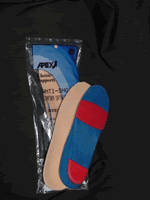 Apex
Anti-shox:
Apex
Anti-shox:
This is a high quality supportive type over the counter insert. It is
recommended especially for people with poor circulation or diabetes
as they offer excellent cushioning. They do not provide a large amount
of foot control.
All people with diabetes, poor circulation, burning or numbness
in their feet or who have had previous ulcers absolutely need to see
their foot doctor before and after obtaining any type of foot device
including diabetic custom orthotics to prevent injury to their feet
that could lead to loss of their feet.