The Home Page · The Integral Worm · My Resume · My Show Car · My White Papers · Organizations I Belong To


Technical Writing · Exposition & Argumentation · Non-fiction Creative Essays · Grammar and Usage of Standard English · The Structure of English · Analysis of Shakespeare
Analysis of Literary Language · The History of the English Language · First Internship: Tutoring in a Writing Workshop · Second Internship: Advanced Instruction: Tutoring Writing
Visual Literacy Seminar (A First Course in Methodology) · Theories of Communication & Technology (A Second Course in Methodology) · Language in Society (A Third Course in Methodology)
UMBC'S Conservative Newspaper: "The Retriever's Right Eye" · UMBC'S University Newspaper: "The Retriever Weekly" · Introduction to Journalism · Feature Writing · Science Writing Papers


Advanced Professional Paper 1 · Advanced Professional Paper 3
"Captain, I’ve got to have more power!"
Scotty of the Starship Enterprise, Star Trek

Samuel Brainsample is a pampered college student. He has unlimited financial support from his parents. Samuel is busy in his townhouse right now doing his studies. Samuel has his headphones on and is listening to CD’s on his 120-watt surround sound home entertainment system while he’s heating dinner in a 1200-watt microwave oven. At the same time, Samuel is busy cruising the web on his new 3.4 GHz computer, which he had custom built. The power supply of his computer is rated at 400 watts and with 4 hard drives, he needs it. At the same time he’s charging the batteries for his MP3 player and his cellular telephone for the next days use. It’s a hot humid night so Samuel has his 12,000 Btu air conditioner running on high. He’s flipping back and forth between the 21” flat screen monitor, a 17" monitor, and every available light in the house is on. Outside, the electric meter is spinning like a top. And then…
Click! Everything goes black. After a few four letter Anglo-Saxon words not found in Webster’s dictionary, he finds the circuit breaker with a flashlight. To his surprise he finds none of the circuit breakers have been tripped. Scratching his head, Samuel pokes his head out the window. He lives on top of the hill and can see the whole valley below. Normally, the valley would be filled with twinkling lights. Tonight, it’s pitch black. The towns he can normally see in the distance are dark also. He opens the window to let in the cool night breeze as a cyclist passes down the street. The cyclist hears the window open and shouts,
“Hey Samuel!”
“Hey what!”
“Welcome back to the Stone Age!”
Power brownouts and blackouts are becoming more prevalent across the country in recent years. In the summer of 2000, the country witnessed rolling blackouts throughout the state of California, which was blamed on legislation passed back in 1996, which deregulated the electric power utilities. Recently, during the summer of 2003, we all witnessed a blackout of the Northeast region of the U.S. including New York City, Ohio, and Pennsylvania. Are these two incidents somehow related to each other? Is government deregulation of power companies a bad idea? Does the problem lie with the Bush administration and the absence of a clearly defined energy policy? Could it be our wants and needs to have the latest and greatest electric gadgets that claim to make our lives easier? "Why, just set it, and forget it!" In the news we keep hearing about the power grid. What is a power grid and what does it have to do with supply and demand of electricity? Would retiring select aging fossil fuel power plants be in order and replacing them with nuclear power plants? Are alternative energy sources a possible solution?
Conventional methods of creating electricity are either by utilizing water flow from natural sources such as waterfalls, rivers, dams or by utilizing gas turbine engines powered by coal, natural gas, oil and in smaller applications, diesel engines. Steam turbines are used in nuclear reactor plants. Electricity at this time cannot be stored therefore; electrical power companies must create electricity according to consumer demand. When there is low demand for electricity, the electric company conserves energy and produces less electricity. When demand increases, the electric company increases the amount of electricity it creates. Electricity is produced in real time and consumed in real time.
Electric power stations are interconnected throughout the United States in a system called power grids. Electricity can be produced in one state, as an example in Ohio and can be shipped over high current carrying wires to another region of the country such as Western Pennsylvania. Connecting power plants through the grid also allows distant power generation stations to provide electricity for cities and towns whose power generators may have failed or cannot meet the current demand for electricity. Within the U.S. there are more than 6,000 electrical power generation units. From these power stations, almost a half-million megawatts of electricity is transported over bulk transmission lines carrying charges of high voltage electricity. If you’ve ever ventured thought the mid-west you’ve probably seen huge transmission towers and wires running across the landscape. These transmission towers are prevalent throughout the U.S. In the mid-western states the towers are more obvious due to the flat, open terrain of the plains. The high voltage electricity passes through more than one hundred control stations across the country. Within these control stations the distribution of electrical energy is monitored and rerouted from areas of low demand to areas of high demand. Quite often automatic switches are used to reroute electricity to where it is most required. The high voltage electricity flows through the lines to regional and neighborhood substations. At the regional and neighborhood substations, the electricity is passed to step down transformers where the electricity is reduced from high voltage to a voltage that can be shipped off to residential and commercial applications.
When sudden demand for electricity exceeds the energy being produced the smooth distribution of power in the electrical grid is affected. According to C. D. Sigwart in his report “The Great Northeast Blackout of 1965,” “Power grids are designed for minute to minute adaptation to demand and will adjust to excess demand, but not excess supply. When one power company has insufficient generating capacity, it draws power from the grid. If the current load increases on the grid, the voltage begins to decline. This high or unbalanced demand can cause a blackout in one section of the grid or may create a ripple effect throughout the entire grid causing a sequential shut down of one section after another.”
Once large sections of the power grid begin to shut down it becomes difficult to impossible to restore the power from other grids. Prolonged heat waves during the summer months can substantially increase the demand for electricity placing neighborhood grids under stress to supply additional power they cannot spare. In effect a chain reaction occurs that cannot be stopped or controlled. Essentially what you have is a runaway train. In extreme situations, some power stations will refuse to stay on line in order to prevent stressing their own generators; hence a cascading effect of decreased supply occurs resulting in a blackout. When electrical power is restored, a sudden surge in demand occurs that the system may not be able to accommodate. When electric motors, transformers and other electrical devices are all energized at once, they can draw many times the normal load placed on the power grid, which can set off a secondary shutdown. Due to this phenomenon, engineers will restore power in stages after a massive blackout one section after another. This is done in order to reduce the possibility of a sudden overwhelming demand.
Interestingly, there is no correlation between the California rolling blackouts of 2000 and the Northeast Blackout of the summer 2003, but both are exemplary models of what may happen across the country.
The interest in California, according to CNN correspondent Charles Feldman, Governor Pete Wilson in 1986, signed legislation that deregulated and dismantled California’s electric utilities to reduce consumer power bills. California became the first state in the union to deregulate its power companies. Therefore, California became the test bed to determine if deregulation was a viable solution. Under deregulation the state’s investor-owned utilities sold most of their power generating plants. In the meantime, neighboring states to California were buying surplus electricity thereby boosting the price of wholesale energy.
The former California governor, Gray Davis told CNN, “They, referring to the voters, insisted on deregulation in 1996, but no one anticipated the huge economic recovery California experienced and the needs of the tech companies here in California. Secondly, there was no effort to build new plants to meet the demand.
Counter to this point, deregulation has made it financially difficult for power utility companies to attract new investors, which decreases their solvency and prevents them from upgrading and building new and more fuel-efficient power plants. Therefore power plants either shut down or operate at lower efficiencies and purchase electricity from power plants as far away from Canada because they are operating on cheaper forms of energy such as coal and natural gas. According to Charles Feldman of CNN, "electric power wholesalers in California claim rate increases are justified and say the increases are necessary due to shortages of power and uncertain finances of California’s two major utilities, Pacific Gas and Electric Co. & Edison International." Surprisingly, the demand for electricity rose a mere 4% from 2000 to 2001 in California, yet wholesale prices rose 266% and the profits for these companies rose on average 508%, according to California Senator, Joe Dunn. According to David J. Manning’s analysis," deregulation should not have only deregulated the wholesale price of electricity, but also the purchase price of electricity. His claim is that only one side of the price equation has been deregulated and not the other which has caused the economic imbalance."
Another reason for the problem in California, cited by Charles Feldman, is an increase of computer usage and other appliances in addition to the lack of new adequate power plants. David Manning cites another cause that other investigative journalists have overlooked. California had a hot and dry summer in the year 2000. This reduced the water levels in the dam reservoirs, so hydroelectricity’s contribution to the power grid disappeared. This in combination with an increased demand for electricity by consumers turning on their air conditioners placed more stress on the power grid.
New York and the northeast are the other exemplary models in the United States, not because of the blackout of 2003, but because New York and the northeast are the highest electricity consumers in the United States. According to CNN, August 17, 2003, NERC's Michael R. Gent said he was "fairly certain at this time that the disturbance started in Ohio. We are now trying to determine why this situation was not brought under control after the first three transmission lines relayed out of service. We will get to the bottom of this." As of this date, November 5, 2003, there is no new information as to what was the root cause for the blackout of 2003.
The northeast is in the spotlight and also being carefully monitored because the whole region’s power grid is no longer able to meet the demand for electricity. A significant number of power plants in the northeast have been on line for approximately 50 years and are of a single-cycle nature in dire need of upgrading to significantly more efficient combined-cycle power generation. In addition, power companies are hesitant to issue bonds to generate the necessary funding to build new power plants not because of financial uncertainty, but because of indecision by the federal government in deciding whether to deregulate or not. A significant number of power plants in the northeast have been on line for approximately 50 years and are of a single-cycle nature in dire need of upgrading to significantly more efficient combined-cycle power generation. In addition, power companies are hesitant to issue bonds to generate the necessary funding to build new power plants not because of financial uncertainty, but because of indecision by the federal government in deciding whether to deregulate or not.
As consumers, the American public has placed a great strain on the national power grid. In the mid 80's it technologically became possible to develop a wireless telephone system or cellular telephones. Through the use of microwave technology typically used in military applications and placing transmission towers across the country every 20 miles, it became possible to reach anyone, anywhere with this new way of communicating.
The real boom began in 1995 when cellular service providers, such as Cellular One, in an effort to increase their customer base combined forces with Motorola Inc. offering free cellular telephones with a 3-year service contract with Cellular One. So began the consorted effort to equip everyone in America with a cellular telephone. Before this, corporate salespeople or road warriors mainly used cellular telephones in order to keep in touch with the corporate office. Today, everywhere you look, in retail stores, city streets, college campuses, and grocery stores, nearly everyone has a cellular telephone strapped to their side. Even people who can't afford to own a car and use public transportation have them.
One could argue that the current draw required to charge cellular telephone batteries is small and would have a negligible effect on increasing the demand on the national power grid, but then one is underestimating the increase in their numbers and their infiltration into the consumer sector. Yes one cellular telephone has a minimal draw of current on the national power grid, but when multiplied by millions of cellular telephones requiring to be charged daily, this becomes yet another burden on an already outdated, antiquated, and over-stressed electrical power delivery system.
|
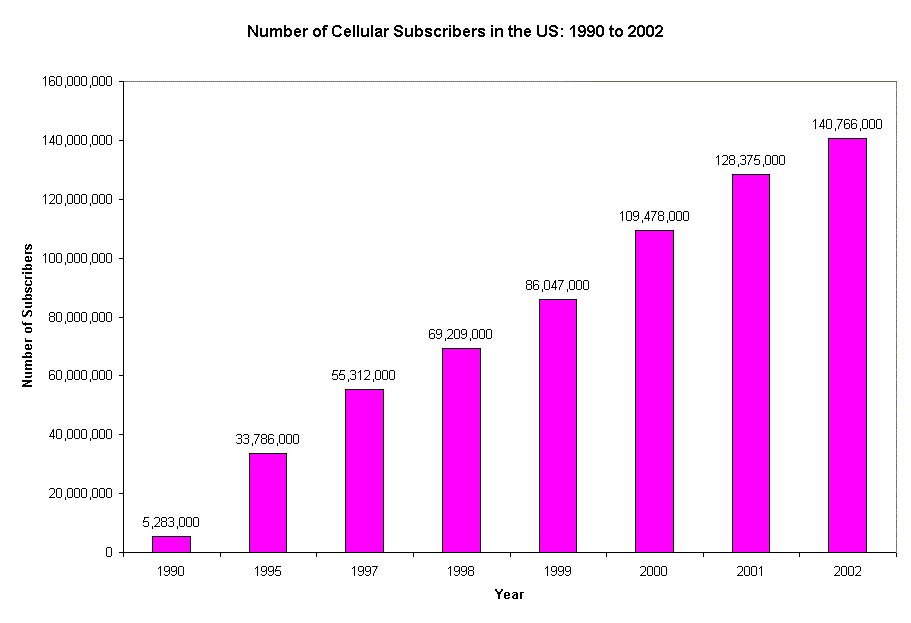
Looking at chart 1, according to the Cellular Telecommunications and Internet Association's semiannual wireless survey, for the years between 1990 and 1995, a five year period, there was a 12% increase in subscribers. For the period between 1995 to 1997, only two years, there is also a 12% increase. When we look at the time period of 1997 to 2002, the increase in subscribers is now 12% each year! In the year 2002, there were over 140 million cellular subscribers plugging cellular telephones into the national grid for the purpose of recharging their cellular telephones. This supports the fact that this new technology is partially responsible for the added strain on an antiquated power delivery system.
Then there is also the personal computer boom. In 1979, the personal PC was created and all through the 80's, businesses were switching over slowly to this new technology. In the nineties with the advent of networking technology it became possible to link and share information across personal PC's making them a more viable and less expensive solution for business computing creating a switch from mainframe computing to corporate network solutions. Even so, this did not create the strain on the national power grid we see today. In 1996, Internet browsers significantly improved their GUI or graphical user interfaces making it easier for novice and first time computer users to cruise the web. In addition PC manufacturers realized there was only one area of the private sector that they had not infiltrated, that of the general public. In 1996, the fastest CPU or central processing unit, one could purchase was a Intel Pentium I with a clock speed of 133 MHz. In the summer of 1996, Intel began to release faster processor speeds of 200Mhz. At that time the ongoing joke in the industry was, "What are you going to do with all that processing speed anyway? Watch the light meter spin?" The problem here is that as processor speeds increase and as hard drives become larger and cheaper, software companies are provided with the means to write larger and larger software programs with vastly improved GUI's which in turn require faster and faster processor speeds to drive the programs. The faster the processor the greater the demand for electrical current and thereby the greater demand for power from the national power grid creating a vicious cycle. As of 2004, the American consumer can purchase an Intel Pentium 4 processor with clock speeds of 3.4 GHz.
American business has come to the realization that networking all these PC's may not be the best way to conduct business because the cost in maintaining daily operations and increasing energy costs is cutting into profits. They are now considering alternative solutions and so is President George W. Bush. The new technology on the horizon is thin-client which is basically a reversal back to mainframe technology. In thin-client, most of the processing is done on a central computer instead of having all the applications on the personal PC. The PC is once again functioning as a dumb terminal as it did in the years of main frame computing, but thin-client servers are considerably less expensive than mainframe computers, around $25,000 and can service the needs of hundreds of users, while at the same time reducing operating costs by using less electricity than standard networked personal PC's.
There has been a clear resounding objection by the American public for the building of any more nuclear power plants. According to a telephone poll conducted by ABC News and the Washington Post between June 1 and June 3, 2001, out of 689 adults selected from across the nation, 46% support the building of new nuclear plants. Of this 46%, only 26% strongly support nuclear power as an option. This means that 54% of the population still opposes the building of new nuclear power plants. ABC News does not report the percentage of how many polled were strongly opposed.
To demonstrate the opposition to nuclear plants let’s take a look at the shared fates of two nuclear plants in New York State; one being Shoreham, L.I. and the other located at Indian Point, N.Y. The shared fate of these two plants was the inability to provide an effective evacuation plan in the event of a catastrophe. I 1990, the Long Island Lighting Company (LILCO) built a nuclear power plant on the northeastern part of Long Island. The Shoreham plant cost $5 billion dollars, and ran for one day. LILCO had to turn on the power plant to get into the rate base, and from then on, Long Island enjoyed the highest power rates in America until LIPA was created to share that debt across New York State with the issuance of a bond. The reason for the plant shut down was LILCO could not devise an effective emergency evacuation plan in case of a nuclear accident. The problem was that in the event of an emergency there is only one way for most residents to evacuate Long Island. Everyone would have to travel west towards New York City and that would be by automobile. LILCO could not guarantee a safe and successful evacuation even after several different proposals. As a former Long Island resident during this period of time, these were the issues we grappled with thanks to the daily newspaper Newsday keeping us informed on the problems and issues.
The newest problem to arise from nuclear plants is not the Chernobyl of 1986, but the Indian Point, New York nuclear plant twenty-four miles north of New York City, which had corrosion problems in February 2000. Indian Point reactor number two released a small amount of radioactivity when a tube carrying pressurized water ruptured inside the plant. The rupture occurred in the unit's steam generation tube, which was designed to carry heat away from the reactor core and supply steam to the turbine, which in turn generated electricity. Repairs were made, but in December 26, 2000 two small fires broke out within the plants. Indian Point reactor number one was a very early design, which went on line in 1962 and was in operation until 1974, when it was taken off line and put into safe storage. That same year reactor number 2 came on line and two years later, reactor three came on line. Both of these reactors were placed dead last on the Nuclear Regulatory Commission’s plant performance list. A report commissioned by New York Governor George Pataki in 2003 stated that Indian Point evacuation plans were inadequate and that the security plans failed to contemplate a terrorist attack. This report galvanized opposition to the plant, spurred New York State and the four counties closest to the plant to deny annual certification of the plant’s evacuation plan. Judging from the fate of the Shoreham and Indian Point facilities, it appears the northeast has washed its hands of utilizing nuclear power plants to alleviate its hunger for electricity.
In the early 60’s my parents took my sister and I to Indian Point for a day trip and part of that trip became visiting the nuclear reactor. At that time, I was a young child, but I do remember Disney Productions showing children’s science films on Sunday nights telling us how wonderful nuclear energy was. Disney and government agencies threw their best sales pitch in trying to convince the American public that nuclear energy was the way to go. Nuclear energy was toted as being the panacea for our desire for more power since the first nuclear power plant came on line in 1955 according to Poughkeepsie Journal.com. Since then we had trouble with Three Mile Island in 1979, Chernobyl in 1986, Indian Point in 2000, and who knows how many other nuclear plants that never made headline news.
The other problem with nuclear plants is the radioactive waste. At this time the government has come up with a quick fix where all nuclear radioactive waste from around the country is trucked into a waste facility deep within Yucca Mountain. The problem with this is the similar quick fix solution on Long Island in the disposing of trash in landfills. When the landfill is full or in this case, once Yucca Mountain is full, then what do we do? No one has the answer. This is why nuclear fission has become a dead end to solving the power grid crisis.
Counter to all this reasoning there are alternative power solutions that do exist and I will touch on them briefly. I have familiarity in this area from my automotive engineering studies back in the early eighties when I was highly interested in alternative power sources for automobiles. The current problem with alternative power sources has nothing to do with them being nonviable solutions. Wind generator farms would be an exception. The problem is the turning blades that cannot be seen by flying birds. Most likely they would be constructed within the plains of the U.S. which would place them in the flight path of many migratory birds. The problem with alternative power sources is both economic and political. The entire power industry cannot be changed overnight because on one side of the equation, millions of jobs would be lost and on the other side, millions of new jobs would be created, but people would need to be trained for these new positions. As it was with the gradual growth of the automobile industry and the gradual phasing out of the horse and carriage, the same would be true of electrical generation.
Currently on the national level the big fight going on in terms of legislation is whether to decide on allowing for state or regional control of the national electricity grid. The question is whether the regional unit will be more efficient, and whether those regional transmission organizations will extend into Canada as they currently do today.
There is also a problem of opening the national power grid to outsiders, which would allow old coal plants such as Ohio Valley and others to sell very inexpensive power. Areas such as Alberta, Canada have relatively low-sulfur coal. The advantage of low-sulfur is wear. The higher the sulfur content, the higher the wear, which results in more frequent overhaul of the combustion systems driving the generators. Therefore the combustion systems driving the generators require more frequent overhaul. All of this was information is taught in Internal Combustion Engines 101. Conceivably, in Alberta one could build a power plant directly on top of a coal bed. The plant stays put, but the digger just moves around the plant digging up coal creating a relatively inexpensive of power generation. This makes it harder for other power plants to compete and would threaten power generators further south, in the U.S., which are using Wyoming coal, which is much more expensive.
There is also the issue of open-access tariffs and trying to develop improved service. The key challenge is how to balance the need for standardization with the need to allow for regional differences. This can become highly politicized amongst various states. The overall objective is to establish a common market framework where one can mitigate market power and reduce some of the electrical transmission issues.
According to David Manning, there is a tremendous reluctance by power companies to invest in building new power plants due to current stock market returns. “The stock prices have been falling steadily. Mirant, one of the more aggressive companies in building new plants, has seen its stock fall from a high of $47 to a low of $7; currently its stock is selling for about $13 per share.”
According to Environment and Energy Daily, October 21, 2003,
“The final energy conference vote has been put off until next week because tax-writing lawmakers made little progress Monday, effectively scuttling House Speaker Dennis Hastert's plans for a final House vote on the bill. In the interim, Senate Finance Committee Chairman Charles Grassley cautioned that the tax discussion, which he is leading, is not the only reason for the delay in the energy conference. Some outstanding policy issues have not yet been resolved, he said.”
The continuing saga of the energy bill from Environmental and Energy Daily as of Tuesday, October 29, there is now fear that a continued Republican House-Senate tax stalemate will doom the energy bill for the year. Congress will be adjourning for the year in mid-November. The bill that President Bush is certain to sign into law is exceedingly close.
One reason for the breakdown is political differences over tax policy. The other problem is purely political as to whether the Republicans should hold a hard line against Democratic opposition to certain provisions within the legislation. Power Industry executives are worrying that this continued impasse would kill the legislation if energy conference continues to drag on. This is the typical tactic played by both sides near a congressional adjournment period and just before an election year. By creating the impasse one side can cite the other as being the bad guy for having done noting about the energy problem. This way the good guy can use the energy problem as part of their election platform. So the answer to the question what is the Bush administration doing to address the energy policy at the moment, not much. It’s just politics as usual on Capital Hill. Now if President Bush wanted to get tough, he could as other Presidents have done, tell the Congress that no one is leaving for adjournment without some form of legislation for him to sign. It has been said and this is quite true, one can tell how intense the argument is by how much pizza they order in those last 48 hours previous to adjournment.
During the summer of 2004, we saw gasoline prices rise to a national average of $2.00 per gallon almost approximating fuel prices of Europe 10 years ago. In two months American citizens will be going to the voting booths to vote for a new President. Interestingly, neither President Bush nor Senator John Kerry has mentioned Alternative Energy or Energy Conservation within their political platforms. With fuel prices on a new rise, one would think that one of the presidential candidates would be talking about an Energy policy. Both Democrats and Republicans are silent leaving U.S. citizens caught in between and struggling with how to make do with rising costs. As usual, its politics as usual and its the American public that bears the pain.
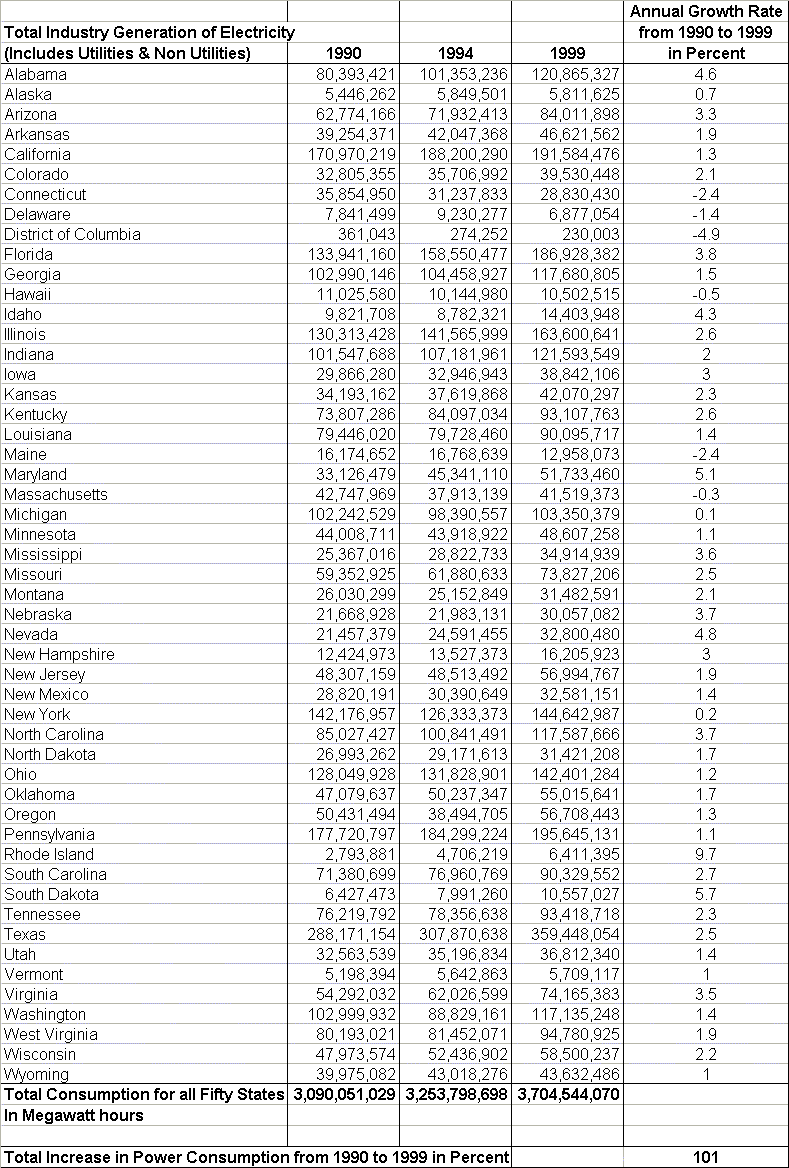
Consulting the Energy Information Administration, which provides raw statistical data for energy consumption in the U. S., provided some alarming statistics. Referring to figure 1 in the appendix I compiled a chart of data showing the percent increases and decreases for each of the fifty states for the years 1990 through 1999. At a glance, it doesn’t appear all that alarming. Most states show minor increases of power usage except such states as Rhode Island who experienced a 9.7% increase in power consumption. For the most part it appears to be a 2% increase. If that’s what you think, then you missed the point. That’s 2% per state. But there are 50 states. What do you get when you multiply 2 x 50? Interestingly enough with all the fluctuations across the states it works out to be a whopping 101% increase in power consumption over 9 years.
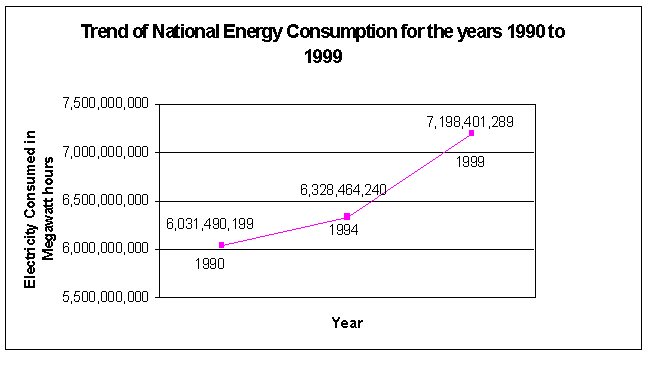
In figure 2, there is a graphical representation showing the trend for power consumption over a nine-year period. From 1990 to 1994 there is an increase of more than 74 million megawatt-hours. Looking at the trend line the slope appears to be a 30-degree slope that I would say is a slight increase in power usage. When we examine the graph from the years 1994 to 1999, a five-year period versus a four-year period, power consumption drastically increases by more than 173 million megawatt-hours. The trend line now appears to be rising at a 45-degree angle. My speculation for this is from 1995 to 1999 is a time period when consumers begin to hear more and more about how great the Internet is and in order to get on you have to have a computer. Also for the years 1997 to 1999 there was a tremendous increase in the sale of computer systems to first time buyers. How do I know this? I was the guy in the trenches on the front line selling them in Micro Center as a retail computer salesman. From the appearance of the graph my assumption is that when the data comes out for 2003, the trend will approximate 65% angle translating to almost a 115% increase in power consumption by the entire nation.
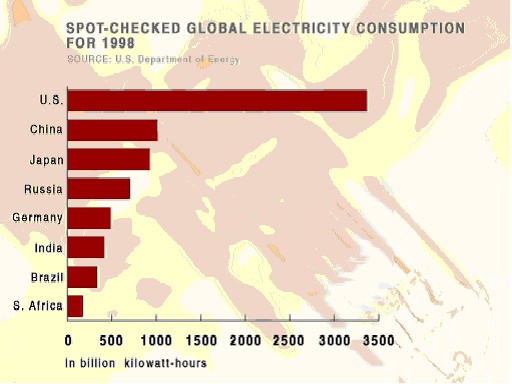
Guess who the world’s biggest customer is for more electrical power? No, sorry, Scotty doesn’t count, he wasn’t on this planet. It’s the United States! After all we all have the latest and greatest electronic and electrical devices made plus Ron Popeil of Ronco Inventions tells us, “Just set it and forget it!” How can you possibly go wrong! In the year 1998 we consumed approximately 3,500 billion-kilowatt-hours of electricity. According to the History’s Channel "Modern Marvels," "without the use of current energy resources, it would require 200 slaves in order to maintain the lifestyle of the average American." If one considers the economic costs of maintaining 200 slaves, one quickly concludes that either he/she would have to be born into a very affluent family or would have to have a phenomenal job in order to afford their basic needs. Second in energy consumption was China and they aren’t even close to our consumption. China’s consumption was a little greater than 1,000 billion-kilowatt-hours. That’s a difference of 2,500 billion-kilowatt-hours!
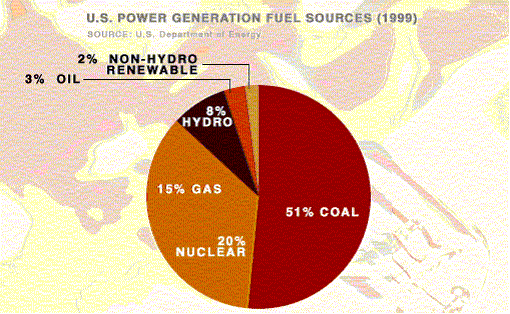
The last graph in Figure 4 shows what methods electric companies use to produce all the electricity we consume. Coal is the primary source at 51% and nuclear fission is our secondary source at 20%. The cleanest of all, hydropower or moving water is a mere 8%. “The disadvantages of dams are extreme fluctuations in water flow, temperature, and oxygen, they create barriers for spawning fish; and fish-killing turbines wreak havoc on aquatic systems. Seventy percent of our rivers and streams have been damaged by human-induced flow changes,” according to James R. Karr, director of the Seattle-based Institute for Environmental Studies who was cited by Beth Baker in the June 1994 journal, Bioscience.
Back in 1995, while working for Micro Center, I came across a curious magazine on their news rack called “Home Power.” The magazine was a monthly publication which discussed and displayed homes that were self-sufficient and created energy for heating, electricity and hot water. The magazine would feature three homes each month outlining how the designer determined the energy consumption of the household, how they went about wiring the household, what alternative energy sources they chose and why, and what methods they used to store electricity. Everything was there in black and white. Wiring diagrams, products used, cost figures, power output, power consumption, everything. The articles were scientific reports written in such a way that the results could be easily reproduced.
In my mind independence from the electric company was intriguing. What appealed to me was the ingenuity involved and the philosophy relying on your own wit and resourcefulness to become self-sufficient. This is a possible solution to the national electrical grid problem, but not a viable one, at least not for everyone. Most people do not have the know-how to take on such an elaborate exercise in engineering. Only people who are thinkers and tinkering types would even consider such a solution. Plus, all of the homes displayed were in remote rural locations where the installation a wind powered electric generator, as an example would be possible. In addition, there were the start-up costs associated with the purchase of all the equipment necessary. In most cases the initial investment was around thirty thousand dollars with no mention of life expectancies of various parts or maintenance costs. It certainly is an interesting solution and a viable alternative for some people, but not for the nation as a whole.
The solution to the national power grid will be as complex as the problem. I am by no means an expert in any of the areas that will need to be addressed, but here are some of my solutions.
1. Government regulation should be maintained as it has been in the past. This should provide the political and economic stability that the power companies are seeking. Also this should create a climate that would be favorable for electric companies to begin construction of modern, fuel-efficient power plants. Once on line, old plants could be gutted and upgraded to new standards. This most likely would have to be done one plant at a time within a state due to financing, power demand, and current land acquisitions.
2. Now would be an excellent time to begin the phasing in of more alternative power solutions across the mid-west and offer government backed financial incentives either to the states or the power companies directly so they will go ahead and invest in the more risky technologies.
3. There needs to be an increase in the number of government grants provided in order to renew and support research in the area of alternative power solutions such as nuclear fusion, cold fusion, hydrogen power and some other cutting edge research projects.
4. The time has come for the breaking out some of the prototypes academic research centers have already designed over the past thirty years and start building full scale models for testing and eventual development.
5. The government once again as it did in the seventies, could offer an initial grant and then continuing tax breaks to those who have the inclination to implement the self-sufficiency method of power generation in their homes.
6. Manufacturers research and development departments should work harder on designing consumer electronics that use less energy and not more. This is done with ovens, washing machines, dish washers, refrigerators and freezers, so why not all consumer electronics. Also energy efficiency labels should be brought back which list the power usage of the device and have them on all electronics, regardless of size.
7. As consumers, we should demand products that are more energy efficient and refuse to buy products that are not. If we don’t buy, they don’t sell and they do want to sell so manufacturers will respond and will respond quickly to consumer demand.
8. As concerned citizens, we have to push for an energy policy and keep after politicians once one has been made. The energy policies fade in and out, according to which administration is in power at the time. We can’t have an energy policy that flexes from conservation to consumption with the change of every administration. Of course as with everything associated with technology, as time goes on, the energy policy will also need upgrades. The policy and the technology should be going in only one direction and that’s towards greater efficiency.
9. Last, the power grid itself has to be upgraded so that it can respond more quickly to increases in power demand.
As with most of our technology today, the more complicated our technology becomes, the more complex the series of problems that arise, and the more complex the solutions become. Our machines are no longer simple and have become interdependent systems each relying on the functionality of the next. Our power stations across the country are aging and becoming antiquate and inefficient as is the national grid equipment. As consumers, we have to have larger televisions, faster computers and of course the latest in labor saving devices for around the household. In the meantime our politicians continue to drag their feet as to where the country stands in terms of energy policy. In our ever expanding desire for more power has no panacea and the solution is going to be very complex indeed involving technology, economics, environmental, social and political issues. If something isn’t done soon, as Science Officer Spock once said, “We’ll all be wearing bear skins and working with stone knives."
Beth, Baker. Aquatic Systems a Concern as the Government Relicenses Dams. Bioscience. Jun.1994. Vol. 44, Issue 6. 433 1p. Academic Search Premier. Accessed 5 Nov. 2003. http://search.epnet.com/direct.asp?an=9406300994&db=aph
“CNN Access: Why wasn’t blackout isolated?” CNN.com/U.S. 2003. Cable News Network. 17 Aug. 2003. AskJeeves.com. Accessed 5 Nov. 2003. http://www.cnn.com/2003/US/08/17/cnna.brain/index.html
“Countries with the Most Computers” World Almanac 2003. Mamma.com. Accessed 20 Jul. 2004. http://www.aneki.com/computers.html
The Energy Information Administration: Official Energy Statistics from the U.S. Government. AskJeeves.com. Accessed 21 Oct. 2003. http://www.eia.doe.gov/
“Energy Policy: Tax disagreements scuttle energy conference until next week.” Environment and Energy Daily: The Best Way to Track Congress. Ask Jeeves.com Accessed 21 Oct. 2003. http://www.eenews.net/EEDaily.htm
“Energy Policy: Energy bill supporters seeking help from the White House.” Environment and Energy Daily: The Best Way to Track Congress. Ask Jeeves.com Accessed 29 Oct. 2003. http://www.eenews.net/EEDaily.htm
Feldman, Charles, The Associated Press. “California power crisis sends shock waves nationwide.” CNN.com. 2003. Cable News Network. Google.com. Accessed 8 Oct. 2003. http://www.cnn.com/SPECIALS/2001/power.crisis/backgrounder.html
“A History of Nuclear Energy.” PoughkeepsieJournal.com. 9 Mar. 2003. Ask Jeeves.com Accessed 14 Oct. 2003. http://www.poughkeepsiejournal.com/projects/indianpoint/stories/lo030903s7.shtml
Newburger, Eric C., comp. Home Computers and Internet Use in the United States: August 2000. US Census Bureau, Doc. P23-207. Washington: GPO, 2000. Accessed 20 Jul. 2004. http://www.census.gov/prod/2001pubs/p23-207.pdf
“Major power outage hits New York, other large cities.” CNN.com/U.S. 2003. Cable News Network. 14 Aug. 2003. Google.com. Accessed 8 Oct. 2003. http://www.cnn.com/2003/US/08/14/power.outage/
Manning, David J. “New Electricity: Generation, Pricing, Wheeling and Regulation.” Canada-United States Law Journal. Vol. 28. 2002. p241, 26p. Academic Search Premier. Accessed 9 Oct. 2003. http://search.epnet.com/direct.asp?an=7896474&db=aph
Popeil, Ron. Ronco Inventions. Accessed October 29, 2003. http://www.ronco.com
Sigwart, Charles D. “The California Energy Crisis 2001.” Disasters, by C. D. Sigwart. 25 Apr. 2001. Google.com. Accessed 8 Oct. 2003. http://www.ceet.niu.edu/faculty/vanmeer/california.htm
Considine, Timothy J. “Cost Structures for Fossil Fuel-Fired Electric Power Generation.” Energy Journal. Vol. 21. 2000. p83, 22p Academic Search Premier. Accessed 9 Oct. 2003. http://search.epnet.com/direct.asp?an=3016133&db=aph
Drinkwater, David W. “New Electricity: Generation, Pricing, Wheeling and Regulation.” Canada-United States Law Journal. Vol. 28. 2002. p267, 33p. Academic Search Premier. Accessed 9 Oct. 2003. http://search.epnet.com/direct.asp?an=7896498&db=aph
“Frontline: Nuclear Reaction! Why do Americans Fear Nuclear Power?” PBS Online. Public Broadcasting Station. Jun. 2001. Google.com. Accessed 5 Nov. 2003. http://www.pbs.org/wgbh/pages/frontline/shows/reaction/
“Home Power Magazine: The Hands-on Journal of Home-Made Power.” Home Power Inc. Issue 97. Oct/Nov. 2003. Accessed 5 Nov. 2003. www.homepower.com/
Lehrer, Jim. “Online NewsHour: Energy Squeeze, March 19, 2001.” PBS Online. Public Broadcasting Station. MacNeil/Lehrer Productions. 19 Mar. 2001. Google.com. Accessed 8 Oct. 2003. http://www.pbs.org/newshour/bb/economy/jan-june01/power_3-19.html
Robinson, J. Michael. “New Electricity: Generation, Pricing, Wheeling and Regulation.” Canada-United States Law Journal. Vol. 28. 2002. p237, 3p. Academic Search Premier. Accessed 9 Oct. 2003. http://search.epnet.com/direct.asp?an=7896461&db=aph
Sigwart, Charles D. 3-21-00 “The California Energy Crisis 2001.” Disasters, by C. D. Sigwart. 25 Apr. 2001. Google.com. Accessed 8 Oct. 2003. http://www.ceet.niu.edu/faculty/vanmeer/california.htm
Wang, P., R. Billinton. “Impacts of Station-Related Failures on Distribution System Reliability. Electric Power Components & Systems. Vol. 29. Nov 2001. p965, 12p. Academic Search Premier. Accessed 9 Oct. 2003. http://search.epnet.com/direct.asp?an=5437393&db=aph
 |
 |
 |
 |
The Home Page · The Integral Worm · My Resume · My Show Car · My White Papers · Organizations I Belong To
Contact Me · FAQ · Useful Links