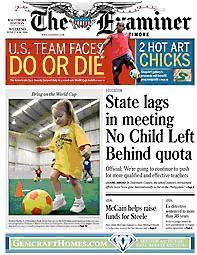
By Gadi Dechter
|

IN THE THREE MONTHS SINCE ITS LAUNCH, at least five staff reporters have already resigned from the new Baltimore Examiner, underscoring one of the major challenges in the free daily newspaper’s editorial business model, which expects each of about 20 staff writers to produce three concise news stories a day, plus several shorter items.
Among the resignations were business reporter Chet Dembeck, Carroll County reporter Craig Meister, and Ari Natter, who covered Howard County for only a few weeks before returning to his previous employer, the daily Carroll County Times.
“It was probably the most challenging workload I’ve ever had,” says Dembeck, 57, for whom journalism was a second career, and who has previously quit after relatively short stints at the Daily Record and the Columbia Flier. “I couldn’t do the kind of journalism I wanted within their constraints.”
Dembeck says a typical nine- to 10-hour workday at The Examiner had him filing two stories of 300-450 words, plus a shorter 150-word story, plus two or three news briefs of 40-75 words. “I think the fallacy that a lot of people view is that you don’t have to put as much time in a 300-word story as an 800-word story,” he says. “But I like to have at least three sources in a story, minimum, and that’s very difficult. . . . So the dilemma I found myself in is I just didn’t have enough time to really do the work to my satisfaction. Others, that might be more talented than me, or faster workers than me, maybe they can.”
Dembeck’s former workload is typical of their daily routine, say current Examiner reporters. By contrast, a typical Sun metro beat reporter files about three stories a week, according to a cursory Nexis analysis of bylines. “About three stories sounds right,” says Sun city editor Howard Libit. “We don’t have any quotas, but most reporters in metro tend to average that.” The lengths of Sun stories vary widely, but standard news articles tend to run between 700 and 1,000 words.
Managing editor Tim Maier says turnover is not unusual in the early stages of a startup company. He declined to elaborate on personnel matters but cautioned against assuming that the intense workload was the common denominator in the resignations. In discussions with several current and former Examiner staffers, however, the blistering pace of production expected at the paper was a recurring theme of concern—though all people contacted acknowledge that the newspaper’s editors were up-front about The Examiner being, in the words of one current reporter, “a newspaper on speed.”
The Baltimore Examiner is the third in a chain of major metro free dailies founded on the belief that readers prefer their printed news in easily digestible chunks. Most of the paper’s 250,000 copies are home-delivered six days a week to affluent suburban households. The entire newspaper, which typically ranges from 48 to 72 pages, is designed to be read in less than 20 minutes.
“The hardest thing is being spread so thin, not just the number of stories,” says Annapolis-based reporter Len Lazarick, who is a one-man statehouse bureau responsible for covering the governor and legislature, as well as all statewide races in this campaign year. Despite the extreme pace, the 57-year-old Lazarick says for him the benefits at The Examiner so far outweigh the hardships.
“There were days, and probably will be days, when I think, Why the hell am I doing this?” he says. “But I’ve never filed on a daily basis before, and it was an opportunity to be a major player in a new startup newspaper.”
A former Patuxent Publishing editor and part-time copy editor on the national desk of Washington Post Lazarick emphasizes that he has received “almost uniformly positive reaction” to the bite-sized editorial model practiced at The Examiner. “I really buy into the idea that people like the shorter stories, though it’s very difficult to do in a way that’s even halfway complete,” he says. “The Sun does Jane Austen, and we do CliffsNotes. And what you find is that some people like the CliffsNotes. People like the idea that they can pick up the newspaper and breeze through it in 20 minutes. They feel like, ‘I read the newspaper and I know what’s going on today.’”
Both Lazarick and Dembeck are considerably older than most Examiner reporters, some of whom were hired directly out of journalism school, or whose previous experience was confined to community and alternative weeklies. The opportunity to work high-profile beats at a big-city daily early in their careers is a major draw, say current staffers.
“The Examiner probably isn’t the most nurturing newspaper out there,” writes cops and courts reporter Luke Broadwater in an e-mail. “You’re expected to hit the ground running, sources intact, and begin producing immediately. . . . Some of the drawbacks of writing five stories a day is that none of them can be truly in depth, the way you’d like it to be. They can be good scoops of high quality, but there’s no way they all can be masterpieces. The good thing is, if you push yourself, you can be surprised at what you can do in a single day.”
Broadwater, 26, who previously worked at the weekly Howard County Times and was a sports freelancer for The Sun, acknowledges he was “highly skeptical” of the newspaper when he first heard about it. “I thought, Are people really going to read something just thrown on their lawn? But apparently they have been. Some days I’ve been inundated with calls and e-mails in response to stories. My stuff has been on the Drudge Report, AP wire, local TV and radio, and followed by The Sun. So, somebody out there’s reading.”
Former Sun managing editor Tony Barbieri, now on the faculty of the University of Maryland’s journalism school, expresses mixed feelings about the desirability of launching a journalism career at a paper like The Examiner. “A workload like that can be both a blessing and a curse,” he writes in an e-mail reply to questions from Media Circus. “Of course a young reporter is going to learn to be fast and be accurate and not to waste a lot of time. In that sense there is nothing at all wrong with having days every now and then when you write a lot, when you grind it out. We used to call it feeding the goat. But as an everyday routine, I think a workload like that is excessive, bad for both for the paper and the reporter.”
The particular danger for young reporters laboring under constant, extraordinary deadline pressure, says Barbieri, is the formation of bad habits such as taking people’s statements at their word, spending too much time on the phone rather than in the field, and relying on too few sources.
“I would tell young reporters looking to go to work at a place with that kind of pace to be very sure they will be working with editors they can trust,” Barbieri says. “This means editors who will be honest and attentive and who won’t put bad work in the paper simply to fill space. I would tell a young reporter starting out that unless they have the kind of editors who will help them learn and grow, they might be better off passing. But then again,” he adds, “Rule 1 for a young reporter starting out is: Get a job.”
In the same week the Patuxent Publishing Company ran an help wanted ad in the Catonsville Times local a weekly publication that read, "Reporter...seeking a qualified candidate who can work well in a fast paced and rewarding environment. Responsibilities include writing an average of 5 stories per week and producing news briefs as needed. Qualifications include knowledge on a variety of topics, composing stories with clarity, logic and flair and the ability to gather information and assess how the information will serve the reader. Must have at least 2-3 years experience, knowledge of AP style and good command of grammar and spelling."
This is not overly demanding. Five stories per week for a weekly paper averages about eight to ten hours per day collecting information, research, speaking to various people and following up on leads. This averages out to a story a day.
While working for the UMBC university paper, The Retriever Weekly , I would receive one assignment per week and "this" assignment would average eight to 12 hours worth of work in tracking down leads, performing research, arranging meetings through phone calls, emails, and performing on the spot interviews with UMBC faculty, administrators, police, and students. On average I would gather at least three student reactions and three UMBC administrators reactions. Most of my time was spend determining who was the "gatekeeper" of the information I required. The lead provided by my editor usually was a dead end and the lead would refer me to someone else. After speaking with two to three administrators I would find the person who held the key to the information I was seeking. Most other information was unusable because it was common knowledge.
Finding students that were willing to speak with me was not always easy for two reasons. One, I am not part of their age group so some students were reluctant to speak with me. Second, other students, as with most people do not trust reporters. Reporters rank in polls as the second most likely people not to be trusted running a close second to lawyers and used car salespeople. In order to gain a student's trust, I would have to explain that everything they said was going to be part of the official record but once we were done I would then recite back to them what I had recorded that I had captured word for word what they said. In most cases, this built a working relationship because this interviewing technique allowed the person to hear their own words reflected back and think about "was this what they really wanted to say" and this also gave the interviewer the opportunity to correct me if I did accidentally record their words out of context. Sometimes I would have to speak to five or six people in order to capture three really worthwhile quotes worthy of publishing. Many times the quotes were would only get all of us in trouble. I needed to be selective in order to not make all of us look like horse's asses. Let's face it, sometimes we get nervous and don't really think about the consequences of what we are saying and once the words are in print, they can't be taken back. Many times I would say to students, "Is this really the message you want to send to the public?" Most times they said yes, but a few did think about the consequences and rearticulated or revised their quotes.
The reporting style at The Examiner demonstrates how the Internet has changed how we read, interpret, and consume information. Many of us are not willing to pay fifty cents for a newspaper for one. The average newspaper reader only reads the first three paragraphs of an article before moving on to the next article. Second, many of us have become accustomed to reading our newspapers on the Internet for free and no longer buy paper newspapers. "Why pay for milk if you can just walk out and milk the cow?" Third, we are reading faster and in smaller chunks. We now have a tendency not to read huge bodies of text and tend to scan for information because we are undated with so much information per day. We actively seek only the information that we deem useful therefore we have become "scanners" and not readers. We seek out information in small digestible chunks. Therefore the Examiner is gearing their paper based newspaper towards a reading audience that is accustomed to obtaining their information on the Internet and talk radio format. Hence The Examiner is not modeling itself in the writing style of papers such as the Baltimore Sun but in the new style of publishing dictated by the Internet. As a young newspaper, The Examiner is doing the right thing especially when one finds their street corner kiosks empty within a few hours.
Over the course of five months (July-November), 37 Examiner papers were chosen at random and statistically analyzed for frequency of quotation. Out of 720 articles the following was found. 12 articles had zero quotations, 141 articles had one quotation, 285 articles had two quotations (the most frequently occurring), 183 articles had three quotations, 77 articles had four quotations, 20 articles had five quotations, two articles had six quotations. Due to publishing deadlines, the Examiner has determined that two quotations per article is sufficient for web style reporting. This also supports that the Examiner is web format paper published in paper for those who do not have access to the web.
The Examiner may be a daily newspaper publishing on crack but "this" is the same direction news publishing has already headed on the Internet with minute to minute updates and readers hitting their refresh button every few minutes to see what is the latest update. This publishing style may be the only viable alternative to compete with the Internet for news hounds.