| V.1 | 39 - 40 - 41 |
| On longitudinal electromagnetic waves | |
|
|
| 39 | |
 |
|
(Moreover, by the condition of the field calculation
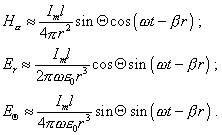
r >> l , consequently, Proceeding from that, (2-3-10) has to take a normal form |
|
|
(33) |
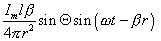
As we can see, (33) describes the progressive wave; it means that the longitudinal component of the field has, none the less, the wave nature, and in the view of progressive nature of wave propagation it is illegitimate to divide the field of radiator into the near and far fields. Both in the near and far fields the wave is progressive.
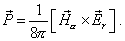
One would think: having determined such important characteristic, we can consider the Pointing vector for a longitudinal wave: |
|
 |
|
| 40 | |
However here we are running into a double complication
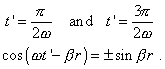
caused again by the invalid simplifications and omissions. First, if we try substituting
the corrected system (33) into the system of Maxwell equations, this will not work because
of phase shift by  /2 between /2 between   ( ( t - t -  r) and r) and   ((t - r) ) . For example, when substituting (33) into the
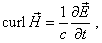
equality ((t - r) ) . For example, when substituting (33) into the
equality |
|
 |
|
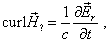
| in the left-hand part of the sum the uncompensated term | |
 |
|
appears, and it must be equalised to zero with all consequences. Given the derivation of field equations, conducted by Kugushev and based on the standard field theory formalism, coincides in its technique with that conventional, the incorrectness of simplifications was caused not by the author's inattention but it was a compulsory action to retain the structure of the formalism based on Maxwell's equations. This conclusion can be corroborated simply by way of analysing the second pair of Maxwell's equations 41 |
|
 |
|
| by analogy with the pair of Maxwell's equations | |
 |
|
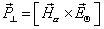
S econd, the vectorsr and anyway must not be combined, because was created by way of variation of , i.e., of the transversal wave vector. So for the Pointing vector |
|
 |
|
is true. The vector of the magnetic field strength |
|
 |
|
and if |
|
Contents: / 15-16-17 / 18-19-20 / 21-22-23 / 24-25-26 / 27-28-29 / 30-31-32 / 33-34-35 / 36-37-38 / 39-40-41 / 42-43-44 / 45-46-47 /