

Philosophy Notes
May 12th 2000
Plato has Meno go to a house, which belongs to one of Socrates’ accusers. Socrates is still being tried for impiety here. Socrates visits this house, but only goes in as far as the garden. Socrates has questions for Meno.
The topic at the beginning of this conversation is “What is a just state?” They conclude that a just state is one in which everyone is virtuous. But why is Socrates talking about virtue with a man from the most unjust state of them all. But you know Socrates and his questions. They then decide that the next generation must also be virtuous. So can virtue be taught? This is a very important question. Meno claims that virtue cannot be taught. This is Meno’s Paradox. “How is it possible to seek knowledge? If one does not know what one is looking for, one will not recognize it if one finds it. If one does recognize it, then one already knew it, and did not need to seek it in the first place.” For example, there is a guy standing under the lamppost scanning the ground, looking for something. You go up to the guy and ask what he is looking for. He says that he is looking for his keys. So you, trying to be helpful, ask him where were they lost? He points to some bushes and says "Over there in those bushes." You are confused so you look at him and ask, "so why are you looking over here?" His simple answer is "Because this is where the light is." Meno’s Paradox depends on the definition of knowing or learning as the acquisition of something new.
When knowing is defined that way, Meno’s Paradox makes sense. Have in mind, however, the drama that exists here. If Socrates can’t answer Meno’s Paradox, he’s going to die. (Socrates must answer Meno's Paradox because if you can't have knowledge, he will never understand what piety is and then lose his life.) Socrates tries to answer the Paradox this way.Meno, being the mercenary general that he is, brought slaves with him, Socrates calls one of the slaves over.
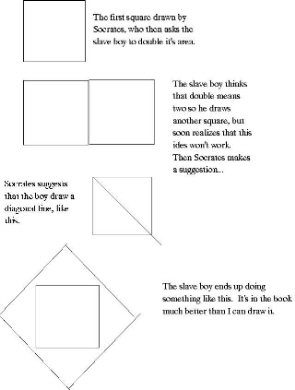
Socrates draws a square in the dirt of the garden and asks him to double the area of that square. Of course since this boy is a slave, he has had no education in any of the mathematics, much less any instruction in Geometry. The slave boy thinks about it and decides that double means two, so he draws two more squares, but he doesn’t even finish before he realizes that he has made the square too big. So he thinks some more and decides that he’ll take half of that square and add it. But that doesn’t work. Socrates suggests that the draw a diagonal line. The slave boy looks at and figures it out. So the slave boy has proven a2 + b2 = c2But this is discursive, meaning that one thing comes after another in space and time. The slave boy is simple seeing something.
Plato says that this scene with the slave boy is done with the minds eye and that it happens all at once. So a2 + b2 = c2 is just a Form, and that you see Forms with the mind’s eye.
This is a truth about something that is not in space and time. Something that stays the same and will not change. Just like that Plato says, you can see the Good, the Beautiful, and the Just. Exactly like a2 + b2 = c2. Plato says that they must exist in another world because things like chairs are not in our heads. But Plato also says that what is in our world, in space and time, is only more or less good, more or less beautiful, and more or less just. This view of Plato’s is Objective.
The slave boy was never taught any mathematics so how then did he know a2 + b2 = c2??? This is explained by Socrates. Socrates says that the boy just knew it from before. So now this conversation between Meno and Socrates has turned into an argument for the immortality of the soul.
Aletheia The Greek word for Truth.
Knowledge is just remebering stuff from a previous life, and if that is the case, Socrates has a chance to learn what piety is and save his life. (but we know what really happens)
The Meno (the dialouge written by Plato about Meno and his conversation with Socrates) is best summed up like this...
Mr. Clark has never thought about this, it just kinda came to him, but I didn't quite get the connection. He says that # 5 and # 6 mean that virtue can be remebered, he said some other things, but I didn't get those ones down. Sorry! He might say more about it later though, there weren't that many people in class.
