
Rugby in Kenya
Rugby was introduced into Kenya at the beginning of the 20th century by British settlers. Indeed before the 1970s rugby in Kenya was played mainly by people of European origin. The Kenya cup featured teams belonging to exclusive clubs such as Nairobi Sports club, Impala , Nondescripts , Kenya Harlequins and a farmers team from Eldoret. Mean Machine RFC a team representing the University of Nairobi was the first team consisting mainly of indigenous Kenyans to compete in the Kenya cup in 1977. Mwamba RFC formed in 1978 was Kenya's first independent team.
The 1980s saw a significant rise in the popularity of the sport. However it was mainly concentrated in the Capital City Nairobi. Virtually all the teams participating in the Kenya cup and other KRFU organized tournaments were based in Nairobi. The sport was hardly played in any of the schools outside of Nairobi.
In the 1990s there has been an explosion in the popularity of the sport countrywide. Several teams based outside Nairobi now participate in the Kenya cup including Mombasa sports club , Kisumu RFC and Nakuru RFC. At high school level, several upcountry schools are now narrowing the gap between them and the traditionally dominant schools from Nairobi.
The Kenya Rugby Football Union (KRFU) is the sports governing body in Kenya. It organizes several annual tournaments for local club teams such the Kenya cup, Eric Shirley shield , Enterprise cup as well as a local sevens circuit. Also it organizes the Safari sevens which attracts participating teams from across Europe and Africa.
Kenya like other third world countries continues to lag light years behind the top Rugby playing Nations. This is mainly due to lack of a professional league in the country and due to the fact that rugby unlike other popular sports like Football(soccer) and basketball , involves a myriad of technical intricacies which countries like Kenya are yet to master. Lack of a professional league means that the top Kenyan players can only play part time while training only 2 hours a day. It also means that several of the countries' most talented players quit playing early either immediately after high school or in their early twenties, due to lack of incentive. Indeed the average age of Kenya's national team is around 23/24 years.
Kenya is however more adept at playing the sevens version of the game. They have shown this at several international tournaments such as the Dubai sevens and the commonwealth games.
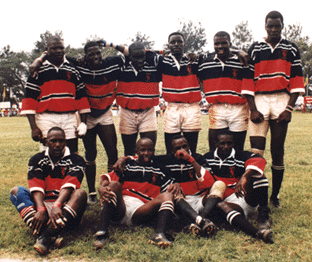 Kenya's 1999 sevens team
Mwamba RFC was formed in 1978 as kenya's first independent team for indigenous Kenyan's. The teams all black strip was deliberately selected to counter the all white strip worn by Nondescripts RFC. Mwamba soon became Kenya's most popular team and soon a rivalry developed between Nondies and Mwamba. Mwamba was instrumental in the growth of the game in Kenya. It formed the backbone of Kenya's national team , among them Jimmy Owino, Arthur Kibisu, Andy Mwenesi , Pete Belsoi ,Chris Onsotti and speedster Pritt Nyandatt. As Kenya's economic fortunes took a turn for the worst in the late 80s, so did the fortunes of Mwamba. Being a self supporting team , they were unable to keep their best players many of whom left to seek greener pastures at institutional teams such as Stanchart RFC and Barclays RFC.
Mean Machine RFC which represents the University of Nairobi is arguably the most popular club team especially among the youth. It is Kenya's richest rugby mine having produced several of Kenya's best players. The list includes Absalom Mutere , Joe Masiga , Dave Sakari , Rowland Odipo,Martin Ndeda, the legendary Edward Rombo and more recently the likes of Paul Murunga Sammy Khakame ,Shaka Kwatch and Steve Gichuki. Rombo along with Jimmy Owino who played for Mwamba in the early 80s are probably Kenya's greatest ever players.
Following the introduction of World cup qualifiers in Africa, Kenya had an opportunity to test its strength against other African Nations. While they easily overcame challenges from nations like Botwana, it was soon apparent that kenya could not match the likes of Zimbabwe , Namibia, Morocco and Cote'd Ivoire. The latter two of whom possess several players plying their trade in the French League.
As the 20th century fades into the new millenium, Kenya and other developing nations are taking initiatives to improve the standards of the game at home. kenya is set to participate in an all African rugby tournament that will involve other African nations divided ino two divisions. It has already started participating regularly in the newly created World sevens circuit. On its debut, Kenyan players were subjected to a rude awakening ! They were not prepared for the intensity of International sevens rugby. Their sub par fitness levels , tactical awareness and defence(tackling) was ruthlessly exposed by the likes of South Africa and Australia. It was soon apparent that plenty of work had to be done to raise the level of the game at home. Nevertheless Kenya recorded some creditable performances against Japan and Namibia.
Impala RFC is one of the Countries recent success stories. It has risen from the ashes of obscurity o the forefront of kenya's rugby thanks to an influx of several talented players including Oscar Osir, Benjamin Ayimba , Vincent makanga and Kevin Okwatch.
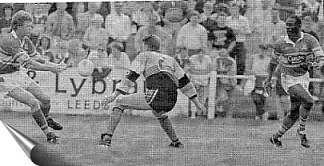 Edward Rombo pictured here receiving a pass from All-Black fullback John Gallagher , played for British premier league club Leeds RFC
