DISCLAIMER:
The following information is not medical advice, or a substitute for medical advice.
I am not any kind of qualified medical or fitness professional.
The following information merely comes from my own experiences of dancing and other various
physical activities as well as experiences from other knowledgable Irish dancers.

The easiest way to prevent injuries and to stay healthy is to take good care of your muscles. There are over 650 muscles in your body and they make up 45% of your total body weight, which is why it's so important to take good care of them. There are three simple steps for keeping your muscles in goog shape; 1)warm up, 2)stretch, and 3)cool down every time you dance and exercise. Consuming sufficient amounts of protein, calcium, vitamins and carbohydrates and giving your muscles regular exercise will improve their overall health, strength and endurance. If your body does not receive enough carbohydrates and fat (its preferred energy sources) it will start to burn muscle for energy instead. Muscles that do not get regular exercise will atrophy (shrink and disintegrate). Read on.

Step 1 - Warm Up
One of the most important things to do is to warm up before stretching and exercising. The purpose of this stage is to increase your heart rate and blood flow to the muscles. Increased blood flow causes muscles to heat up. Stretching cold muscles will increase the risk of muscle tears, which are very painful, and depending on the severity of the tear can even end a dancer's career. To get your heart rate up, try light jogging, doing skip-2-3's or sidesteps, or a beginner reel or light jig or anything else that you can think of. A good way of warming up your feet is to roll your ankles in both directions and point and flex your feet. Your muscles perform much more effeciently after being warmed up and stretched properly before dance or exercising.
Step 2 - Stretching
Stretching your muscles is just as important as warming them up. Stretching allows an athlete to acheive their best performance. Stretching also improves an athlete's long-term performance by avoiding the consequences of long-term muscle discomfort and injuries. Muscles that are stretched properly on a regular basis are more flexible and thus less prone to injury. Here is a list of things to keep in mind when stretching:
Stretch before AND after any physical activity.
This will reduce risk of injury and muscle stiffness afterwards.
Do not stretch cold muscles.
Do some light dancing before stretching to get your heart rate up and to get blood flowing to the muscles. Increased blood flow heats the muscles up. Stretching cold muscles can easily result in muscle tears, which in some cases can end an athlete's career.
Ease into each stretch slowly.
Again, this reduces risk of muscle damage.
Don't bounce while stretching.
Bouncing while stretching causes miscroscopic muscle tears. As a way of repairing these small tears, the body builds up scar tissue and the muscle gradually loses its flexibility and range of movement.
Do not put your weight on the leg you're stretching.
This can also cause muscle damage.
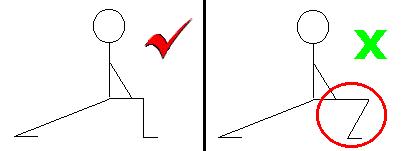
Don't let your knee pass your ankle.
This puts enormous stress on the knee joint and the ligaments surrounding it, and may cause irrepairable damage. Not sure what I mean by 'letting the knee pass the ankle'? See the diagram below.
 Do not stretch to the point of pain.
Well, duh!
Hold each stretch for approximately 20 seconds.
However, children (whose bones and muscles are still growing) should hold a stretch for a maximum of 10 seconds.
Remember to breathe.
Some people get so engrossed in their stretching that they forget to breathe. Your muscles need oxygen, especially during physical activities, so never hold your breath!
Don't let a lot of time pass between stretches.
Doing that will cause your muscles to cool down, which is the complete opposite of what you're trying to do here! Also, don't let a lot of time pass between a stretching routine and actual dancing for the same reason that your muscles will cool down.
Step 3 - Cool Down
This is the key in preventing muscle soreness. I've had experiences when I've warmed up and stretched, but forgot to cool down, and couldn't walk the next day. The purpose of a cooldown is to lower your heart rate to its resting pace. Stopping suddenly while your heart rate is up is very dangerous and debilitating to your cardiovascular system. You must also stretch as a part of your cooldown to prevent injury and a buildup of lactic acid, which causes muscle soreness.
The Benefits of Stretching
enhanced physical fitness
enhanced ability to learn and perform skilled movements
increased mental and physical relaxation
enhanced development of body awareness
reduced risk of injury to joints, muscles, and tendons
reduced muscular soreness
reduced muscular tension
increase in flexibility of tendons and ligaments
reduced severity of menstrual cramps