|
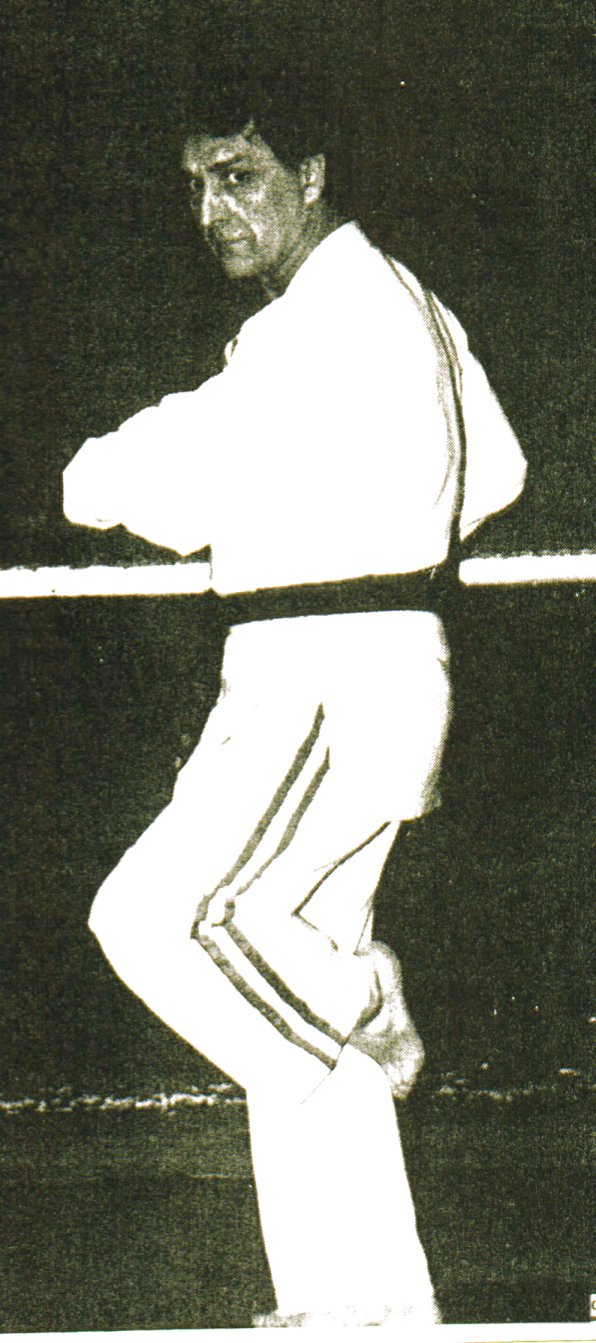
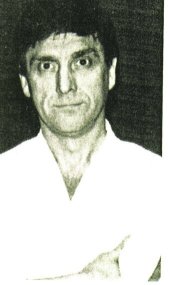
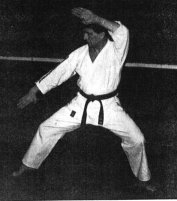
Interview with Roy Partridge
5th Dan
Roy Partridge, 5th Dan, is Chief Instructor to the
Amateur karate Kai, a Wado-Ryu group based in the midlands area.
He has been studying Karate for over 20 years, with many famous
names, and is well respected amongst the hierarchy of karate. There
now follows a rare interview, which I was lucky enough to obtain
from one of the quiet men of British Karate, which gives a rare
insight into both the man and his art.
Derek Ridgway: How many years have you been doing
martial arts?
Roy Partridge: Just over 30 years now. I started
doing judo in 1956 when I was 17/ I did that for about nine years,
but had to retire due to knee problems. It was then that I started
karate.
DR: Who taught you judo in those days? I expect
instructors were hard to find in the 1950’s.
RP: Yes that’s right. Judo was still largely unknown
in those days. Instructors were few and far between. I started under
a Green belt in West Bromwich, the only grade in the area. Then,
luckily, a Japanese Sensei called Kenshiro-Abbe, and 8th Dan, started
to teach in Birmingham (which is not far from West Bromwich). As
well as an 8th Dan Judo Kenshiro-Abbe was also a 4th Dan Aikido
and a 4th Dan Karate Shotokan- style I think.
DR: Did you enjoy your Judo years?
RP: Yes. I enjoyed Judo a lot and won many medals
as a youth on the Judo circuit. I enjoyed competing and the physical
aspect of the sport, as most of us do when we’re in our teens and
early 20s.
DR: So how did Karate come about?
RP: Well as I said previously, I started to suffer
with cartilage trouble, which caused me to retire from Judo and
look elsewhere in the martial arts.
DR: Did you decide on Karate straight away?
RP: No I did Aikido for a few months, but I kept
hearing about this thing called Karate. So I enrolled at the West
Bromwich club which, at the time was being run by a Polishman called
Jan Bujak, who was a Green Belt at that time. I started not long
after Eddie Daniels, who also trained at West Bromwich at the time.
DR: What style was it at West Bromwich, then?
RP: Wado-Ryu, although we went through a few styles
in those days. Jan Bujak left for South Africa and we tried Shukokai,
which Eddie Daniels decided to stay with, although I decided to
stay with Wado.
DR: Who graded you in those days?
RP: I graded with Mr P Suzuki, Mr Iakawa or Mr Go
Adachi, who were teaching in Birmingham at the time. Sensei’s Iakawa
and Go Adachi have since returned to Japan and Sensei Takamizawa
tells me that Mr Iakawa is now a successful businessman.
DR: What about your 1st Dan. Who graded you for
that?
RP: I took my 1st Dan in the old BKA under a panel
of Takamizawa, Spanton, Donovan, J. Smith and D. Connors. I also
took my 2nd Dan with the same panel a few years later.
DR: I know that you have long since taken over
as Chief Instructor at the now famous West Bromwich club and that
over the years many famous instructors have visited your club.
RP: Yes that’s right. From the very start when I
took over as instructor I would try to get top instructors to visit
the club. In the early days we had visits from a 6th Dan Shotokan,
who was touring Britain from I think Malaysia at the time. His name
was Mr Chu-Chu-Soot. We also had visits from the famous Hirada of
the Shoto-kai style. When I joined the BKA every month I would have
visits from Takamizawa, Spanton, Donovan, J. Smith or D. Connors.
I also booked D. Valera it was his first visit from France and John
Smith acted as his interpreter. It was a great day. Hundreds were
training. I think it was Valera’s best turnout. He told me he really
enjoyed his stay. He showed us a lot that hadn’t been seen in this
country. It was a great day.
DR: Those were good days in the BKA, with so
many good instructors, all with different ideas and different techniques.
RP: Quite true. You weren’t tied to one man’s ways
or methods. This gave a much larger scope for learning. You could
have your cake and eat it. Also, with such a good standard of instruction
the standard of the BKA, as a whole was good both in Kumite and
Kata, certainly the best I’ve seen for a group that size.
DR: So why did the BKA split? You knew the committee
as well as anyone at that time. What went wrong?
RP: One of the main reasons, I believe, was that
it just became too big. The top instructors wanted more freedom
to do their own thing and run their own affairs independently. It’s
a shame the BKA split really, because it was a good association
and maintained a good standard, which is good for Karate and students
as a whole.
DR: So. It was decided after the BKA split that
you decided to join Toru Takamizawa’s Tera Group. Why did you choose
Tera as opposed to other groups you could have joined?
RP: Yes I did join Toru when the BKA split. Whilst
in the BKA I was a member of John Smith’s club/ John is a good friend
and excellent instructor, but at the time was experimenting and
moving away from traditional methods and I preferred to practice
Wado. As John was based in Plymouth I decided to find a much nearer
instructor and continue in Wado. I was left with either the Tera
Group of Takamizawa or the Higashi group of Peter Spanton, both
of whom taught Wado. I decided on Toru at the time because he was
local in Birmingham. I could train with Toru every week with no
need to travel far from West Bromwich, whereas if I had stayed with
Peter I would have had to travel to Forest Gate in East London,
which just wasn’t practical. At best I would have seen Peter only
once a month. With Toru he was close enough to visit whenever I
chose.
DR: Did you enjoy training at the Temple Centre
with Toru?
RP: Oh yes. My years with Toru were where I learned
most about Karate and certainly about Wado-Ryu Karate. I would have
regular private lessons with Toru and my standard was greatly improved
by him. You see there are a lot of Karate-Ka who wear the Wado badge
and claim to be doing Wado-Ryu \|Karate, but they are doing a mixture
of many styles, so their standard of Wado-Ryu is often quite poor.
You would be surprised at the amount of people who claim to be Wado
who don’t even know the Ohyos or Kihons.
DR: So why did you leave Toru and form your own
group, the AKK?
RP: Just the urge to move on, to do my own thing,
to evolve my own ideas.
DR: In many ways the same reason the BKA split
up, then?
RP: That’s right. Toru told me that the Japanese
call it Shu-Ha-Re, which means to ‘move on’ or to ‘move away.’ He
said it was quite a natural evolution of the experienced martial
artist. After all, as children grow up and mature they leave home
and start to run their own lives. After many years of hard training
Toru believes it is quite natural for the student to want to leave
and run his own affairs.
DR: I assume then that Toru was quite understanding
about you leaving his Tera Group?
RP: Yes, he was quite supportive. As I said previously,
Toru accepts that as the student evolves he will eventually move
on and do hid own thing.
DR: Did Toru give you any advice when you left?
RP: Only to wish me luck and tell me he had confidence
in my ability to make a success of running my own affairs. We parted
as good friends.
DR: So how does the AKK differ from other associations
you have been in?
RP: In the AKK people have more freedom, particularly
Dan grades, although the Wado syllabus is strictly adhered to for
gradings. In the normal class many other techniques are taught,
also Kata from other styles, which gives the student an insight
into what other styles have to offer. In my opinion, too, many instructors
brainwash their students with only one style, giving them the impression
that only their way is the correct way, when as we all know, styles
have things to offer. You should use what is good and cast away
what is not. Personally I think it shows ignorance on the behalf
of the instructor if he does not have an insight into other styles
both Japanese and Chinese in origin, or, for that matter, martial
arts of any country if they have things to offer. My senior members
(3rd Dan and above) have freedom to move, to develop their own ideas.
If I show a technique and one says, “Well I feel more comfortable
doing it this way,” that’s OK with me. Senior grades must be allowed
to evolve their own ideas, if not, that’s when they leave your association
to form their own.
DR: To diversify a little I know while you were
in the BKA you were a top international referee. Have you any memories
you would like to share of those days?
RP: Yes. I was a top national referee with the BKA.
I was referee at the nationals several times at Crystal Palace,
London, and Belle Vue, Manchester. During that time I officiated
all the top stars of the time too many to mention, really.
DR: Moving on to your own personal training.
What aspects of Karate do you now enjoy most?
RP: Basics. When I first started Karate I never
really enjoyed them, but now I just can’t get enough of them. I’ll
spend hours in front of the mirrors in the dojo trying to get them
to some sort of standard that I am personally happy with. You see
I have gone full circle the most basic technique now seems to pose
the most difficulty because there is no room for error. Only perfection
will do.
DR: You mean, in basics, you are constantly striving
to better yourself, to obtain that perfect technique?
RP: Yes. In basics there is no opponent, but oneself,
and there is no sterner judge of oneself, than oneself.
DR: I must ask you what you think of competition
Karate. Do you think there is too much emphasis on competition Karate?
RP: For young people I think it is good. Young people
need to compete. I certainly did when I was young and doing Judo.
But I believe people must beware of neglecting the older parts of
Karate just for fighting. When people only fight, often when their
fighting career is finished, their Karate career is also over. They
don’t know where else to go for satisfaction because they lack the
knowledge of other aspects of Karate. Karate is a lifetime study.
At the age of 30 years you are just beginning to understand it,
that’s if you started as a teenager. So during your fighting career
you enjoy your competition after all we have the best fighters on
the world. But do keep your hand in at the other aspects and then
when you retire you will have them to turn to and to direct your
energies towards.
DR: What do you think of the standard of karate
today as opposed to, say, 15 to 20 years ago?
RP: Technically O think the standard and knowledge
has greatly improved. On the whole, instruction is a lot better,
although there is still a lot of ineffective Karate about. On the
other hand, Karate these days is a lot softer 15 to 20 years age
Karate-Ka were a lot tougher, they could take a lot more punishment,
but, technically, we were behind today’s Karate-La On the whole
I think things are better today. I remember being on a course with
a senior Japanese Wado instructor years ago, and we were doing Junzukis
up and down a rugby field for hours. How many of today’s students
would put up with that type of training?
DR: What advice would you give to people wanting
to start Karate today?
RP: Try to find a decent club, which isn’t always
easy. Ask about; find out if a friend does it. Pop into your local
martial arts shop or sports shop they often know the local clubs.
Above all, good clubs will have a good reputation. Always make sure
that the club is recognised by one of the major federations.
DR: What are your opinions on youngsters in Karate?
RP: Although I teach youngsters in a junior class
at my club, I personally would recommend under 14s to do Judo first
to learn throws, locks and breakfalls, also to familiarise themselves
with Japanese terminology and discipline etc. That early Judo training
would put them in good shape for their Karate training. You would
be surprised at the amount of Karate-Ka who cannot breakfall.
DR: Which Karate Ka do you most admire today?
RP: For me, the people I respect most today are
the same people I respected 10 to 15 years ago. They are all great
Karate-Ka and I have a great respect for them all. People such as
Peter Spanton, John Smith, Ticky Donovan, Danny Connor and, above
all, Toru Takamizawa, whom I regard as technically the best Karate-Ka
I’ve ever had the pleasure to train under.
DR: If you had to sum up your philosophy on Karate
in a few words, what would it be?
RP: Above all, enjoy your Karate, and don’t be tied
down to one technique or method. Karate is continually evolving
and we must move with it or we will get left behind. After all,
you would use a boat to cross a river, but you wouldn’t pick it
up and carry it once you were on the other side.
DR: Roy, thank you for your time.
RP: Thank you.
The above interview was printed
in Traditional Karate.
OBITUARY ROY
PARTRIDGE AGED 61 YEARS
It is with great sadness that I have to report the
death of a well-known karate instructor from the midlands, Sensei
Roy Partridge.
Roy started his martial arts training with Judo
in the late 1950’s training under the famous Judo instructor Kenshiro
Abe. This he continued for many years winning many medals and awards.
Due to knee problems Roy had to retire from Judo competition and
was looking for some other martial art to challenge him.
This by now was the mid sixties and Karate was just
making a name for itself so Roy decided to find a Karate club and
give it a try. Roy soon became one of the most respected instructors
in the area and was well known by the hierarchy of karate in this
country.
Roy’s main club became the West Bromwich Karate
club, which is one of the oldest clubs in the country. He taught
there for over 30 years; teaching generations of students Wado-Ryu
karate. It was not unusual for someone who started training at the
West Bromwich club when it started to have their children come and
train when they were old enough; and then when they had kids, they
would bring them along to the club. In so doing Roy would touch
the lives of three generations; all of them coming to him for instruction
and guidance.
Over the years Roy had many famous instructors
visit the club among them are Toru Takamizawa; Peter Spanton; Ticky
Donovan; John Smith; Dominique Valera; plus many others.
I, myself, first met Roy in the early 1970’s I was
training at a club in Wilenhall, near Wolverhampton. None of us
were black belts and we were really very starved of good black belt
instruction. It was then we contacted Len Palmer and he told us
to get in touch with Roy as he was local and he came highly recommended.
After that Roy came and taught at our club every
week and conducted gradings. This relationship continued for many
years with some of us also travelling to Roy’s club in West Bromwich
for extra training and private lessons.
With the demise of the B.K.C.C. Roy then joined
Toru Takamizawa’s Tera group, which was based at the famous Temple
club in Birmingham. Roy often told me how he enjoyed his time training
with Toru and how much Toru influenced his karate training. When
Toru Moved down to Kent in the early 1980’s Roy took the decision
to form his own Association which he called the Amateur Karate Kai
(AKK) He remained chief instructor to the AKK until his untimely
death recently Over the years Roy taught literally thousands of
Karate-ka both young and old; both male and female. He touched people’s
lives, some briefly some permanently. He will be remembered as a
great Karate-ka; a friend; and as a source of respect and inspiration
to many people.
I, myself, will miss him dearly, he was, and still
is a great influence on my karate training. For me he was one of
the greats, an unsung hero who just got on with it. I will always
remember him, he was my first black belt instructor, he was a good
friend and will continue to be a source of inspiration in all my
future endeavours.
On behalf of all your students
both past and present.
We all miss you
Sensei Roy Partridge (1939-2000)
|



 Sensei
Roy Partridge
Sensei
Roy Partridge