|
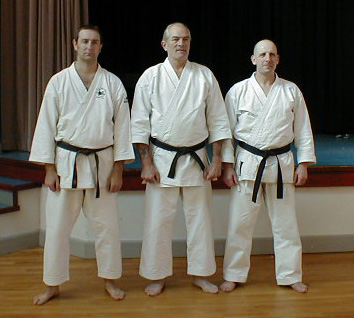
INTERVIEW WITH PETER SPANTON
7th DAN
BY DEREK RIDGWAY
I recently had the chance to talk to Peter Spanton,
7th Dan. Peter is a Karate-ka from the old school, from the first
generation of British Karate-ka. He was one of my first instructors
and is a Karate-Ka I have a great respect for. I managed to catch
up with him when he was teaching at one of his member’s clubs in
Cannock, Staffs. We chatted about his life in Karate, a career that
spans well over 30 years.
D.R.: When, and why, did you start training?
P.S.: I started training in 1965. I had just come
out of the Merchant Navy and was working in a brewery. I didn't
really have any sports interests at the time such as football or
cricket etc. So I was looking for something different, I looked
at Judo and that didn't really stir my interest. Then I think I
read a small article in a newspaper or magazine on this martial
art from Japan called Karate. This sounded very interesting so I
did what research I could and tried to find a club etc., but I couldn't
find anything. Then I heard about a Judo club where someone had
some information on Karate, this person turned out to be Len Palmer.
I contacted Len Palmer and he told me that yes, they did have a
small Karate Federation going, and that they had invited an instructor
from Japan to come over and teach. His name was Tatsuo Suzuki and
he was teaching the Wado-Ryu style at the club in south London.
This sounded like just what I wanted, so I went down to the south
London club to watch a session and to see Mr. Suzuki in action.
I was most impressed and thought this is definitely for me. So that's
how it all started for me and I have never looked back.
D.R.: So your first instructor was Mr. Suzuki?
P.S.: Yes that's correct, although we had visits
by other Japanese instructors.
D.R.: Can you remember any of the other instructors
who you trained under?
P.S.: Yes I can remember some although it was a
long time ago. Instructors such as Mr. Toyama, Mr. Kono, Mr. Shiomitsu,
and of course Toru Takamizawa. Plus of course others who Mr. Suzuki
would invite over to teach. In those days I just never stopped training,
morning noon and night, and three times a week at the Dojo. I would
also follow Mr. Suzuki around the country when he was teaching away
on courses.
D.R.: Where exactly was that first club?
P.S.: That was in south London, Clapham North. That
club was classed as the Hombu Dojo.
D.R.: Who else trained at that Hombu Dojo who
is still active in Karate.
P.S.: The one that instantly springs to mind is
Ticky Donovan. He started about 6 months after me. I think John
Smith came in a little later to the club. Of course there were others
training up north such as Danny Connor, Trevor Overfield is a name
that springs to mind. Plus of course others whose names escape me
now. But in the actual Hombu in the very 1st year Ticky is the only
name that springs to mind that people would know now.
D.R.: So what was a typical session like in those
early days?
P.S.: Well what you have to remember is that we
were all beginners or relative beginners. There were no Black belts
in the club then. In the Hombu I think that I was the highest grade
when I was a Brown belt. This of course meant I got the job of teaching
the raw beginners, which I felt was losing me out on my own training.
But at the time I was doing so much training that I don't think
that it made much difference to my progress.
D.R.: How many people would be training in a
typical class at the Hombu dojo then?
P.S.: Classes ranged from about 20 to around 40
people. 40 would be a big class for those days.
D.R.: Were the classes all adults, what about
women? any children training?
P.S.: The classes then were all adult; mostly male,
although there were a few women training. I don't remember any children
training, at that time it was all adults.
D.R.: What about the standard of Karate in those
early days? When you passed your, Black belt how would it compare
with someone passing their Black belt today.
P.S.: Well I can only comment on what I see in my
clubs and the other clubs that I teach as regards comparing standards.
So that is my standpoint when I say to be perfectly honest with
myself looking back at my standard when I took my Black belt compared
to the ones I see today, my standard was really quite low. At the
time of course I thought I was the bees knees when I got my Dan
grade, but my limit of knowledge and ability was far below what
it is now for one of my own students who I would grade to Dan grade
now. When I actually think back to the actual range of techniques
we did back then there were really, compared to today, very few.
We would do front kick; roundhouse kick; side kick (usually only
to the knee); and back kick. Our knowledge of combinations was limited
to a few from the syllabus. So as you can see in the early days
we were very limited. At the time front kick was my best technique
that was because we did so many of them!
D.R.: What was your Black belt grading like all
those years ago? How was it different to a Black belt grading of
today?
P.S.: Well it was different in as much as I didn't
know it was my Black belt grading. I had been, in my opinion, jumped
quite quickly through my grades by Mr. Suzuki, which on reflection
perhaps was not that realistic. I went from beginner straight to
Green belt 6th Kyu, then from 6th Kyu to 4th Kyu. Then when I took
my 3rd Kyu I was graded straight to 2nd Kyu. My 1st Kyu grading
came along just before Christmas in 1966. I took what I thought
was my 1st Kyu grading and just before Christmas 1966 Mr. Suzuki
gave me my Dan grade. That was a bit of a surprise as all I thought
I was doing was my 1st Kyu. I don't know to this day why Mr. Suzuki
did that, perhaps he thought I was too good for 1st Kyu, or perhaps
he needed the Black belts, I really don't know. Anyway that's how
it happened.
D.R.: Kata knowledge in those days. When you
passed your Black belt, what Kata did you know?
P.S.: As I recall, when I passed my Black belt I
knew the 5 Pinans, Kushanku, Naihanchi, and that was about it. I
know that I didn't know Chinto at the time, I think Mr. Suzuki took
us through a little bit of Seishan once, but that was about it.
Compared to today I certainly didn't have the range of Kata that
today's student would have when approaching Dan grade.
D.R.: So when did you decide to open your own
club?
P.S.: I opened my own club when I was a Brown belt;
that was in East London at a place called Custom House. At the same
time I also opened a club in Forest Gate East London, that was over
a pub. When I got my Black belt the Forest Gate club moved to the
local community center and I have had a club there ever since in
Forest Gate East London.
D.R.: Lets talk about Higashi, how did that evolve?
P.S.: We were in the British Karate Association
(B.K.A.) at the time, which was getting progressively bigger. We
didn't want the Forest Gate club to become isolated on its own,
and as one of the senior instructors in the B.K.A. at the time I
would be asked by other clubs to go to their club and teach. So
these clubs started to get together with my Forest Gate club to
train; have friendly competitions etc. At the time it was only a
small friendly group of clubs such as Swindon, Cheltenham, Cardiff,
Bristol etc. That's really how Higashi began. Eventually we decided
as membership was growing steadily we had a fair few clubs that
we were big enough to go it alone and form a federation of our own
which we call Higashi Karate Kai (H.K.K.) and so Higashi was formally
created.
D.R.: What does Higashi mean?
P.S.: Higashi means EAST, the first club was in
the East End of London so it just seemed a natural name and it has
stuck with us.
D.R.: Would you consider Higashi a style, or
to be precise do you consider Higashi is now a Ryu?
P.S.: I am almost inclined to. In fact some of our
senior grades would prefer that we call it Higashi-Ryu, rather than
Wado-Ryu. I myself still feel a great loyalty to Wado-Ryu; our techniques
are Wado-Ryu and we use Wado-Ryu Kata. Perhaps we have evolved them
slightly but never losing the original concept.
D.R.: How big is Higashi as an Association?
P.S.: In England we have about 1800 members, then
we have affiliations in Wales, Northern and Southern Ireland and
Australia.
D.R.: What are your opinions of competition Karate?
P.S.: My own personal competition career was in
1965/1966. I took part in British championships of the time, such
as the B.K.A. championships etc. I represented Great Britain in
65 and 66 in the European championships where I gained a Bronze
medal. Then after that I really lost interest in competition Karate,
I just loved my training and I didn't think that competition was
why we trained; that was not the direction I wanted my Karate training
to go, it was not my goal in Karate to be good at competition. I
still recognise competition as an important aspect of Karate training
although in my opinion by far not the most important. I still wanted
to contribute to competitions that's why I got involved in refereeing
and became Chief referee for a while. And now of course I contribute
in that I help in the administration of competitions on computer
both Europe and world-wide for the World Karate Federation (W.K.F.)
D.R.: What are your opinions on competition Kata?
P.S.: Well to be honest I find alot of it is very
cosmetic. I see alot of competitions both here in Europe and Worldwide
and it seems to me that alot of judges tend to award points for
how good a Kata looks, not how good the Kata actually is! It is
a very shallow, thin way of looking at Kata and that is what I mean
when I consider it very cosmetic. That is what I personally don't
like.
D.R.: Your own Higashi squad is doing very well
at the moment?
P.S.: Yes I am very pleased. I put that down to
the dedication of the squad and the tremendous ability of squad
coach Alan Flook and his assistants who have really brought the
squad on. Recently, at Aston Villa, we had some tremendous results,
the squad did really well so yes I am really pleased.
D.R.: I was well impressed last year when I helped
referee at one of your nationals, the squad to me looked really
sharp!
P.S.: Yes we are flying really high at the moment,
which is really great for us and very good for Higashi.
D.R.: Do your top fighters still get treated
the same as the rest; do they have to do their Kata and their basics
just like the rest of the students?
P.S.: Oh yes we still insist our squad members train
in the normal Dojo environment and do what everyone else does.
D.R.: You don't see much of that these days;
usually top fighters have little or no regard for Kata; and Kata
people are the opposite, they concentrate only on Kata performance
and see little or no connection to fighting.
P.S.: Yes that's very true, most Kumite people can't
do Kata; and alot of Kata competitors can’t fight. No side of your
Karate should be completely ignored in favour of another or it ceases
to be the complete package. You are only doing a part of the whole,
which is Karate. Obviously when a large tournament is coming up
you adjust your training accordingly, but in the end to be a good
Karate-ka all priorities must be observed.
D.R.: Changing the subject, earlier you mentioned
computers, how did you get involved with computers and Karate?
P.S.: Well, as I touched on earlier, I retired from
refereeing and still wanted to contribute in some way to Karate.
I was already into computers and was starting to run Higashi using
computers. It seemed a natural step to help Karate as a whole in
the administration of Karate tournaments and to help other associations
administer their members in a more efficient manner via the use
of computers. I now provide programs for use with tournaments and
for use with association licensing duties and a considerable amount
of associations are now using the above programs and finding them
very useful.
D.R.: Was there any other reason why you were
drawn towards computers?
P.S.: To be honest I knew that I wasn't getting
any younger and I knew that even if in the future I can't be as
active physically in Karate as I am now, I can still make a contribution
via computers. So you could call them my insurance policy to keep
me involved with Karate which is what I love.
D.R.: What does your own personal training involve
nowadays?
P.S.: I would like to say that I train every day,
but in truth nowadays I have to be more careful what I do. I do
have a few small injuries and when they play up I have to work around
them. So these days I tend to train how and when I can, when I was
younger I would throw myself about thinking I would last for ever,
but after 30 odd years you realize that you have to give the body
more respect and be far more careful.
D.R.: Your training has to change and evolve
relative to your age; you can't be doing the same Karate when you
are 50 as you did when you were 20.
P.S.: Yes that's right; up to about 10 years ago
I thought I was still 18 but now I'm more cautious and think more
about safety especially with my own students, I want them to learn
from my mistakes.
D.R: What aspect of Karate training is your favorite?
P.S.: I like good basics, good combinations, but
I think the favorite aspect of my training is Kata. Especially Bunkai,
that really appeals to me and is one of my favorite aspects.
D.R.: So why is Kata so important?
P.S.: Well for me especially, when I do Kata on
my own I shut myself off from the world; all is blocked out like
I am in my own little shell.
D.R.: Approaching a meditative state of mind
perhaps?
P.S.: Almost because it’s like a shutter comes down
and all I can see in my mind is the kata. So maybe extreme concentration
would be a better term to use than meditative. Concentration is
very important to me. Then there is the Bunkai of the Kata, which
gives you the chance with a partner to practice the practical applications
from the Kata.
D.R.: Without Bunkai do you think Kata ceases
to be as important?
P.S.: Without Bunkai the Kata becomes just an exercise.
It may be a good exercise but it is only that, an exercise. You
must practice Bunkai, even our lowest grades are taught the application
of the Kata they are learning so that they understand that Kata
contains techniques that when practiced with a partner and learned
well, can be used in real fighting situations. So yes Bunkai is
very important.
D.R.: Do you have any favorite Kata?
P.S.: Yes, some Kata suit the taller person, some
the shorter person. It is the same with a person’s build; some Kata
will suit the lighter person, some the heavier person. So for me
Wanshu was always one of my favorites, although the jump now causes
me a little trouble. Bassai is another one I like. Niseishi is another
Kata I quite like but as I get older I am not to keen on the sidekicks
in it. Seishan is another kata I quite like. I would not like to
say that I have any absolute favourites, maybe preferences would
be a better word to use rather than favourites.
D.R.: I find things can change as your karate
career evolves, a Kata you liked when you were younger may not be
one of your favourites now, and vice-versa.
P.S.: That's right, and obviously not just for Kata,
but for individual techniques as well. You could have been perhaps
a Gyakuzuki person for years then all of a sudden another technique
takes preference. As I said earlier in my early day’s front kick
was my favorite technique. I would use it on people and 9 times
out of 10 I was successful with it. Then later I got into roundhouse
kick and I still really like it, and while my hips hold out I will
continue to use it. If one day I start having trouble with it I
will perhaps drop back to a front kick again.
D.R.: I know you do some Kata from other styles,
which ones?
P.S.: Yes I do, but obviously I'm not going to
qualify them, they include Kata such as Seienchin and Seipai from
Shito-Ryu, Tensho and Yang-Su from Kyukushinkai, and Kanku-Sho from
Shotokan. So I will show these Kata if people ask but I stress that
they should get their in depth expertise from someone else who actually
does the style in question. We allow our Dan grades to learn Kata
from another style but we don't use them in our syllabus. In our
own nationals we did allow Kata from other styles to be performed
but now it is only Kata from the syllabus which are allowed. This
was because we thought it unfair that a competitor may get up and
perform a Kata from another style, which he/she had learned, and
none of the judges that were supposed to mark it would know it.
So now we limit it just to Kata from the syllabus which makes it
alot fairer for all concerned.
D.R.: I know that you have developed your own
Higashi Kata, how many are there?
P.S.: There are four Higashi Kata.
D.R.: Why evolve your own Kata?
P.S.: Well the Wado style has less Kata than most
other styles, for example Shotokan have perhaps twice as many Kata
as Wado, Shito-Ryu three times as many or even more. Master Ohtsuka
probably knew alot more kata than the Wado list, which is taught
as standard now. Unfortunately though, if he did know more, he never
passed them on. So we were limited to a certain few, which in itself
is not such a bad thing, because with less you can probably make
a better job of them. Anyway we wanted to give our students the
opportunity to do something extra without losing our Wado concepts.
So although the four Higashi Kata do use some stances and techniques
from other styles, there are not many. The kata do for the largest
part contain the principles of Wado-Ryu karate.
D.R.: Do you think you will keep it at four
kata for Higashi?
P.S.: I did toy with the idea of a fifth, but then
changed my mind. You have to draw the line somewhere, so I have
decided to keep it at four.
D.R.: You have been doing karate now for well
over 30 years, who do you respect and admire?
P.S.: All of the instructors that I trained under
for a start, if I did not respect them I would not have trained
under them. I don't really have to name names, just any senior high
grades of any style who have kept at it and kept training through
the years. They deserve respect. Obviously my mate Ticky Donovan,
who lives very close to me anyway, we get on very well. So sure
I admire and respect him. I suppose to put it in a nutshell I respect
the old school of Karate who came from my generation of Karate-ka.
There are people calling themselves 4th/5th Dan and I have never
heard of them, that does not make them bad 4th/5th Dans but I can't
comment on what I don't know.
D.R.: What are your personal hopes for the future?
P.S.: For myself to keep on training when I can
and as often as I can, to hope that the body holds out a bit longer.
To contribute to Karate as a whole as much as possible, and not
to get involved in politics, which I can't stand.
D.R.: And the future for Higashi?
P.S.: For Higashi I would like to continue to see
it successful, to keep it at the top in competition. To continue
to give plenty of opportunity and scope to our members. And to maintain
our standards, as standards must not be dropped.
D.R.: What do you hope for the future of English
Karate as a whole?
P.S.: I would like to see all aspects of English
karate become the best in the World. One thing I do wish is that
we could unify standards a bit better, and clamp down on the cowboys
teaching Karate, there are still to many of them.
D.R.: Finally Pete, any advice you could give
to Karate-ka who are perhaps not as experienced as you are?
P.S.: Work hard on your basics, get good fundamentals
and foundations, and keep your mind focused.
D.R.: Thanks very much.
P.S.: My pleasure.
I WOULD
LIKE TO THANK PETER VERY MUCH FOR HIS TIME AND PATIENCE, AND TO
WISH HIM AND HIS MANY MEMBERS ALL THE BEST FOR THE FUTURE. YOURS
IN KARATE
DEREK RIDGWAY.
|



 Sensei
Pete Spanton
Sensei
Pete Spanton