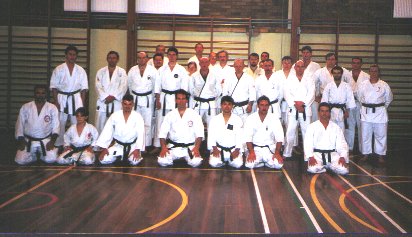
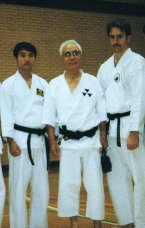
INTERVIEW WITH KEIJI TOMIYAMA 7TH DAN SHITO-RYU
INTERVIEW BY DEREK RIDGWAY
D.R: So Sensei when did you first
start Karate?
K.T: I first started training at
high school, originally my cousin taught me.
D.R: Was that in the Shito style?
K.T: Yes, well before that I did
some boxing and I had a fight with my cousin and he beat me so
I decided to take up Karate and that's how I started.
D.R: So after that you went to
university, which university was that?
K.T: Doshisha university which is
where I continued my training.
D.R: Was that the same style of
karate?
K.T: No originally it was Goju but
it later changed to Tani-ha Shito-Ryu.
D.R: Who were your instructors
at that time?
K.T: First instructor was Mr Una
and Mr Tani also.
D.R : I know that Doshisha university
is a very old university dojo. Can you tell us anything about
it?
K.T: It is one of the oldest in Japan
and was originally a Goju dojo.
D.R: So how old is the dojo there?
K.T: It dates back to the original
Goju in Japan its first instructor was Chojun Miyagi.
D.R: So where is the link with
Shito-Ryu did Kenwa Mabuni teach there also?
K.T: Well as I said Chojun Miyagi
would come and teach at the university but he was only visiting
Japan he did not live there permanently so he suggested that his
friend Kenwa Mabuni who had recently arrived in Japan should continue
to instruct in his absence. Kenwa Mabuni only taught Goju at the
dojo as was the tradition started by Chojun Miyagi.
D.R: After university you moved
to Europe. When was that?
K.T: In 1972 I went to Paris where
I stayed for nearly two years, then in 1974 I moved to Brussels.
Finally I moved to England in 1978.
D.R: At that time you were doing
what we would know as Shukokai?
K.T: Yes our organisation was called
The Shukokai World Karate Union.
D.R: Your style seems different
to what we would associate with Shukokai in this country?
K.T: Yes we study more of Mr Tani's
original teaching hence Tani-ha Shito-Ryu.
D.R: Can you tell us about Kofukan?
K.T: When I came Mr Suzuki was chief
instructor for Europe (not to be confused with the Wado instructor
of the same name) so we were working under him. Then he went back
to Japan and his dojo in Japan was called Kofukan so that is how
we came upon the name. There are so many breakaway Shukokai groups
we wanted to make sure that we kept our authentic identity so
we called ourselves Kofukan.
D.R: What does Kofukan mean?
K.T: Ko is the Tiger, Fu is the wind
and Kan as you know means group or organisation. Originally Chinese
legend said that king of the sky is the dragon and king of the
land is the tiger and when the tiger appears the wind blows, and
when the dragon appears so do the clouds. this is a common oriental
legend.
D.R: what was Mr Tani like to
train with?
K.T: It was very enjoyable, he was
a good teacher.
D.R: Did he ever talk of the
times he trained with Mr Mabuni?
K.T: Yes, but not too much. He would
sometimes mention his times with Mr Mabuni and of course Mr Miyagi.
D.R: Did he say what training
was like in those days?
K.T: He did not speak too much about
training, but as you know I have other instructors and they do
tell me things and I learn more from them about the days with
Kenwa Mabuni.
D.R: how did your relationship
with Mr Fujimoto begin, because I know he is also a big influence
on your Karate?
K.T: Initially at university, as
I said Doshisha university is the birthplace of Goju in Japan
and Mr Fujimoto graduated at that university as did Mr Tani. So
his history at the university Karate club goes back a long way.
D.R: Mr Fujimoto studies the Uechi
style of karate. Who were his instructors?
K.T: His instructor is Mr Sakihama
he is still alive, although now very old.
D.R: What was Mr Sakihama like
to train with when he was younger. I have heard his training was
very hard?
K.T: Yes he was very hard before,
but now he is much softer, my instructor still learns from him
although Mr Sakihama is now around 90 years old.
D.R: Does Mr Fujimoto ever talk
about when he started karate all those years ago?
K.T: Well when he started it was
as I said at university so the main training was free fighting.
Then after training at university they would go to Kenwa Mabuni's
dojo it was there that he taught them kata and Bunkai. This would
only be Naha-Te Karate which is what he taught at Doshisha university
because he considered that he was looking after the club for Chojun
Miyagi.
D.R: Does the Goju taught there
still use the posture of rolling and appearing to unhook the shoulder
like the Uechi stylists do on Okinawa.
K.T: Yes that is correct, it is different
from mainstream Goju. We call it the Kotsukake principle, it is
still taught to Goju students there and is the principle taught
by Mr Fujimoto. (This leads us to assume that Chojun Miyagi and
Kenwa Mabuni must have taught these principles although it is
not now found in mainstream Goju or Shito)
D.R : Has Karate changed much
since you started?
K.T: Well when I started, competition
was becoming very big especially of course in university, now
competition is more sports type; much more mobile. So in a way
the sports side has progressed I suppose. But on the other hand
it is progress in the wrong direction we must not neglect Traditional
training.
D.R: Moving onto the subject of
Kata there are lots in Shito-Ryu.
K.T: Yes we practice well over 50.
D.R: Why do you need so many?
K.T: Well blame Kenwa Mabuni, he
was so hungry for knowledge he would train with many people and
collected many kata. His approach was open minded to knowledge
so his students have the same approach and if we have the chance
to learn kata which are interesting we do so and add them to the
system.
D.R: Do you have any particular
favourite kata which you personally like?
K.T: Yes and no. All kata have merit,
but if you want me to go for a personal favourite I like to practice
the kata taught by Mr Fujimoto namely Higoanna Seisan and Sanrinryu.
But I like to practice all kata.
D.R: Mr Fujimoto's kata are Uechi
type kata?
K.T: Yes, but if you see the main
Uechi style people they are a little different to the way Mr Fujimoto
does them. His kata have a different lineage, from Mr Sakihama.
He put his stamp or seal on the kata and Mr Fujimoto has also
put his own stamp on the kata. I don't mean that they changed
the Kata, that is still the same, but they changed how you do
it, the feel of the kata. On the whole the kata has been made
much softer.
D.R: Recently you have had the
chance to learn kata from the Ryuei-Ryu style of karate as popularised
by the many times world kata champion Mr Sakumoto.
K.T: Yes that is correct, Mr Sakumoto
is very good and has been world champion. The rules for kata competition
state that you must perform kata of the four main styles only.
Shito-Ryu, Wado-Ryu, Goju, and Shotokan. Anyway Mr Sakumoto's
style is not of the main four and Shito-Ryu is very broad in its
kata syllabus so it was decided that Ryuei-Ryu kata should be
added to the Shito-Ryu list for competition kata. So if they are
on the list I have to learn them. On the other hand as I said
we in Shito are open minded and the Ryuei-Ryu kata are very nice
so we have no problem in adding them to the system just like Mr
Mabuni did with kata in the past.
D.R: So you have actually learned
them from Mr Sakimoto?
K.T: Yes we learned four kata namely
Anan, Heiku, Paiku, and Paichu.
D.R: Do you know any history on
these kata, are they very old?
K.T: I think they are old, history
says that Higoanna Kanryo went to China with Nakaima, who is the
founder of the Ryuei-Ryu system, and trained with a teacher called
Ruruko. He also went to China and trained with the same man Ruruko.
So they both were supposed to have trained with the same man although
as we know the kata they learned are different so I don't know.
D.R: What are your hopes for the
future.
K.T: I would like to achieve a very
high level, I am very lucky to have been able to train with such
good instructors as Mr Tani and Mr Fujimoto, I feel that I am
still learning and trying to improve. All martial arts go from
hardness and ultimately end with softness, so the top level is
pure soft but if you learn pure soft from the beginning you never
get it. You must learn hard first and eventually progress to softness
which is ultimately the strongest. Most Karate people including
myself are still too hard, I believe. When I go to Japan Mr Fujimoto
tells me that I am still too stiff, but that is the path that
I wish to follow towards true softness and if I can instruct people
along that path I will be happy. I also wish to give the best
to my members to give them a good standard so that they can improve.
Competition gives students a determination and strength of mind
and also it can promote friendship which is important.
D.R: Karate as a whole in the
future how do you see it?
K.T: Sport is good but we must be
careful if we go too much for the sport it can be detrimental
to the traditional side, but if you do too much on the traditional
side maybe the popularity of Karate will fall and you will not
have many training. So you have to find the middle ground between
the two that, I believe, is the way forward.
D.R: Sensei Tomiyama thank you
very much.
K.T: Thank you.
I would like
to thank Sensei Tomiyama for his time and patience in granting
me this interview, and to wish him his family and all his members
all the best for the future.
Derek Ridgway



 Sensei
Keiji Tomiyama
Sensei
Keiji Tomiyama