|
Harry Cook: When did you start training in Martial
Arts?
Derek Ridgway: It was almost 30 years ago now when
I started at my local comprehensive school in a small town called
Penkridge in Staffordshire. The style taught was Shotokan; although
I didn’t really understand this at the time, I just wanted to learn
karate. It was at the time when the Bruce Lee films were being shown
at the cinema, and the kung fu series was on TV. Everyone wanted
to do a martial art at that time and I was no exception, so when
I heard that a club had started at my school, I went down and joined.
I had to lie about my age to get in, but I was tall for my age,
so I got away with it! Shortly before the karate club started at
my school I went to try to join a king fu club in Wolverhampton,
but the queue was all the way down the street, and I was told it
would be expensive, so I never bothered to sign up.
HC: So why did you begin training, what was it
that attracted you?
DR: Well to be honest, when I started I was only
12 years old, and I had seen some of the martial arts films and
programs on TV, which really impressed me at the time. I wanted
to be like the heroes in those films, and I thought that after a
few weeks I would be doing martial arts like them! I couldn’t have
been more wrong, and quickly realised that my romantic vision of
martial arts was nothing like reality, it was bloody hard work and
it hurt like hell!!
HC: You said you started in Shotokan, I thought
you always did Wado-Ryu?
DR: Most people do think that, but I originally
started in a Shotokan dojo, where I trained for around 18 months.
HC: What made you change to Wado-Ryu?
DC: It was actually due to necessity rather than
an in depth study of the styles (I was only 13/14 at the time!).
The Shotokan club always closed during school holidays, which during
the summer was a long period of time. My cousin trained at a club
in Willenhall, nr Wolverhampton, who had a black belt instructor
called Fred Smith. He taught a strange style called something like
Gire-Ryu, which apparently originated from India. The training at
this club was very intense and involved lots of breaking and hitting
things. I can remember an Indian instructor called Binda coming
to teach. He would break lumps of coal as his party piece. I only
trained at this club when my original club was closed. My cousin,
Dave, would drive me, and it kept me training when the school club
was closed. Soon after, the club at my school folded. We were never
given a reason why, just told that the karate had finished. I called
my cousin and said I wanted to train with him more regularly. He
told me of many changes within the Willenhall club, including the
change to a new style Wado-Ryu. Two Green belt students John Gutterige
and Eddie Hinde, now taught the club. The reason for this change,
as I later discovered, was because they had tried to join the (then)
BKCC who were the controlling body for Karate in the UK, but were
turned down as they didn’t recognise the Gire-Ryu style. The chairman
of the BKCC, Len Palmer, put them in touch with Roy Partridge, who
was one of the very few Black Belts at that time. Roy ran a big
club in West Bromwich, and agreed to take in our club; conduct proper
gradings; and teach us Wado-Ryu. Roy would visit us once a week
and John Gutterige and Eddie Hinde conducted the rest of the training.
HC: So you came to Wado quite by accident?
DR: Yes that’s true, I think the style chose me
rather than vice versa. It could have been any of the major styles
at that time Shotokan and Shukokai were big in the area, but Len
Palmer recommended Roy Partridge, so our club became Wado.
HC: So which other well-known instructors did
you train with at that time.
DR: Well as regards Wado my main senior instructors
were Toru Takamizawa and Peter Spanton. They were regular visitors
to our dojo and I did a lot of training with them. Also Roy would
have other people visit the dojo such as John Smith of Bujinkai
fame, Ticky Donovan, Danny Connor. I remember Valera doing a course
there in the early 70’s. There were loads of people training; it
was a great day for Roy. Also we had Harada visit to teach, and
Chu-Chu Soot from Malaysia, who was touring Britain at the time.
So you see we were never limited just to Wado at the West Bromwich
club. Although that was our style Roy Partridge would always have
an open mind and look at what other styles had to offer.
HC: What aspects of Karate appealed to you and
kept you interested?
DR: I always found Karate a challenge, and still
do! I was never a natural, and had to work hard to make progress.
I enjoyed that challenge. Lots of people over the years have told
me how stubborn I am. Many times in my Karate career I have taken
on challenges which were certainly not the easiest route to take,
but I have stuck at what I decided upon and that is what has made
me a better Karate-ka, and more importantly a stronger person.
HC: Can you tell us something about your time
in competition?
DR: It’s been a long time now since I had any involvement
in competition, either national or international. I came to competition
quite early. From about green belt onwards you were expected to
compete if you did Wado. I won several local and area competitions
and was eventually invited to join the national squad, which is
where I met Steve Cattle, with whom I was to become good friends.
I was only a teenager then, and he helped me a lot and brought my
Karate on loads. I was just on the verge of the senior team, when
the whole of the Karate scene went into political turmoil in GB,
and there was a big split. It never seemed the same after that.
After the BKCC split our club joined the HKK (Higashi) where I continued
fighting in their national squad, which was a very strong team.
I won or took part in winning many memorable events with the squad.
Reflecting on these years now I still feel they were important.
External factors such as Karate politics, and work pressure I was
studying for my electrical engineering degree at the time - prevented
me from reaching my true potential, but I had some good times (and
some bad ones!!)
HC: What are your thoughts on competition now?
DR: At the moment competition is of no importance
in my Karate career, but I still encourage others to compete when
they are young and keen. Most young people want to fight or perform
their kata to an audience, and who am I to prevent them? One of
my young students, Keenan Pedley, was picked for the England Wado
squad, and travelled to Japan to represent his country in the world
championships in Tokyo. But, and I think it is a big but, I always
remind them that competition is only a step on the way in Karate,
and there is a whole flight of steps before them. I want students
to do karate for life, not retire from competition and be lost for
a direction, or just grow fat and lazy and award themselves grades,
losing the way of what true karate is about. I want them to continue
the traditional values and methods in their karate. After all you
do study Karate for life, of which only a very small, and not very
important, part is competition. Remember Karate is for all ages
and sizes, only a very few will become national or world champions,
but everyone can challenge and improve themselves along the Karate
path. It may take less gifted students many long years to reach
their black belt, but they will have climbed their own mountain,
which is just as important as the superb athletes who represent
us in the various championships around the world.
H.C: While we are on this theme, what do you
think of Karate in the Olympics?
D.R: Well it depends on what you think karate is
and what you want from it. If you do sport karate and live for competition
then it will be a great thing and would give you the chance to represent
your country and ultimately to win any athlete’s goal of a gold
medal. If however you are a traditionalist like me I see it as another
step along the slippery slope towards karate which is of no practical
use and purely sport, this sadly is what most of Joe public already
think. I think that very soon there will be a distinct split between
sport karate and traditional karate. It is, in my opinion, very
difficult to mix the two, particularly nowadays.
H.C: Explain what you mean by a split.
D.R: I think sport karate will become exactly that,
a sport. It will have no particular style or root. The kata that
it uses will be borrowed from traditional karate then adapted to
suit a competition format where appearance is the prime objective
and combat effectiveness is not even considered. We could end up
with, in the worse scenario, kata which are no more than gymnastic
dancing! As regards Kumite, I think that to try to gain a bigger
audience, especially if the Olympics are our goal, sport karate
will go down the Taekwon-do path with loads of high kicking and
flamboyant techniques to get extra points. This, I believe, will
be very sad because in the public eye that will be “Karate” and
that will be a great shame. Years ago when I was fighting or if
I am fighting now in the dojo if someone starts dancing on one leg
I sweep his bloody legs from under him and hope he learns his lesson.
If you start doing that flashy sort of stuff in the street; on a
door; or in any real situation you are going to get a rude awakening!
So that is what I mean by a split, sport karate and traditional
karate are growing ever more apart.
HC: How did your interest in Shito-Ryu develop?
DR: When I trained with Roy Partridge, he taught
us Kata which were not in the Wado syllabus. I think the first were
Sienchin and Saifa, which he probably learnt from Peter Spanton
or John Smith, both of whom knew various kata from other styles.
These kata were a lot different from what we learnt in Wado, so
I was determined to find out more. It was about this time (early
1980’s) that there was a course put on by Terry Pottage, at which
Sensei Ishimi taught. Sensei Ishimi was a high grade Shito-Ryu instructor
from Spain. He taught us Seipai kata, which had hardly been seen
in this country. Seipai was so different from Wado kata that I struggled
with it at first, but this was what made me determined to learn
more about Shito-Ryu. By this time I had graded to Sandan, and as
so many people kept asking me to, I started my own club (this was
the beginning of Kazoku Kai association, which is now world wide).
I was still very interested in Shito-Ryu, so I set about finding
some instructors who could teach me the style properly. Shito-Ryu
was, and still is, quite small in this country, but I found an article
with Sensei Tomiyama who was 5th Dan Shito-Ryu at that time. I contacted
him and he agreed to teach at my dojo. He came down and blew my
mind. He taught the basic principles of Shito-Ryu and the kata Shissochin.
From then on I wanted to learn Shito-Ryu Karate, and so began a
long relationship with Sensei Tomiyama and Kazoku Kai, which still
continues. He is a regular visitor to our Dojos and over the years
we have followed him all over Gt. Britain and into Europe.
HC: So does this mean you stopped doing Wado-Ryu
Karate?
DC: Oh no, I still continued my Wado training, I
had done it for such a long time and enjoyed doing it. I talked
to my good friend and mentor Steve Cattle, who said that there was
no reason that I couldn’t do both with some hard work and determination,
and that it would be of great benefit to me in the end. This advice
still rings in my ears now, and how true it was!
HC: How did you go about training in two different
styles? Your training schedule must have been pretty hectic!
DR: Well, at that time I had just been made redundant,
so I decided to go professional. With help from my students and
my redundancy payment I built my own Dojo, so that I could train
as much as I wanted whenever I wanted. The Dojo has mirrors all
along one wall, and all the equipment I need to train Karate. This
Dojo enabled me to progress much quicker in my studies of Shito-Ryu.
What I learnt off Sensei Tomiyama I could put into practice every
day. I would practice the principles over and over, coupled with
lots of Sanchin and Naifhanchin training. Also having my own Dojo
meant I could have more private lessons with Sensei Tomiyama, like
I did with Sensei Takamizawa and Sensei Spanton in my early Wado
days. In private I could learn some of the more obscure kata from
Shito-Ryu which are not taught in public, and of course perfect
and improve the basic principles of Shito-Ryu Karate. Basically
it was get the information from Sensei Tomiyama, make sure I understood,
then work on it in my own time. With regard to my Wado training,
apart from the people I have already mentioned, I also trained with
Sensei Jiro Ohtsuka, Sensei M Shiomitsu, and recently Sensei Toru
Arakawa. Also I must mention Sensei K Sakagami who is a regular
visitor to my dojo and lives close to me. He is a real gentleman
and a good Wado instructor. Earlier this year I was lucky enough
to train with and meet Master Arakawa, who Sensei Sakagami had brought
over from Japan to teach. I have also trained several times with
Shingo Ohgami from Sweden, who like me studies both Wado & Shito-Ryu
karate. As you can see I still train hard in Wado as well as Shito-Ryu.
I am very busy teaching and training, and although I teach the two
styles, I do not mix them, but keep them as pure as I can, the way
I was taught them. Only in Kumite and Bunkai can the styles mix,
as the situation requires. Ultimately the principles of all proper
martial arts are the same; it is only the peripherals that change.
As Steve Cattle often said there are only two styles of Karate,
good and bad, and I agree with him.
HC: Have you done any other styles?
DR: Well, as I said, I started in Shotokan, and
my mate Steve Cattle would come and teach at my dojo right up until
his untimely death in 1995. He obviously taught Shotokan, but in
his own unmistakable way. That’s about it really, apart from Wado
and Shito-Ryu, which are my main styles. In my bunkai, all my influences
come through, which is what you would expect after 30 years of training.
HC: Have you ever done any Chinese systems?
DR: Not really, I have done some Tai Chi, which
I really enjoyed. I am a bit of a social realist when it comes to
some of the amazing claims that are often made by Chinese systems.
If a small frail person can push a big man across the room, I believe
it has nothing to do with magic, just many years of proper training
and good Sanchin. I am not saying such things don’t happen, but
that usually it is not mystical at all, and there is a perfectly
scientific reason. I say nothing replaces good hard sweat and training,
that’s the only way to develop real Martial arts skill and ultimately
you may be able to knock someone flying with little effort, but
that’s the result of a lifetime of proper training, not a mysterious
power.
HC: Earlier you mentioned Sanchin. Why do you
think Sanchin is important?
DR: Sanchin is probably the most important Kata
you will ever learn. It contains all the principles you need to
master Karate. Its roots lie in the Southern styles from China,
all of which use a version of Sanchin as the core of their system.
Okinawan karate is no exception, all styles who teach Naha-Te type
Karate, such as Goju-Ryu; Uechi-Ryu; and Shito-Ryu use Sanchin as
their core Kata to teach all the principles and fundamentals of
the style. Sensei Tomiyama said to me “Sanchin, everything is Sanchin”.
If you do Naha based karate, you must do Sanchin. A few years ago
I was at the national championships at the NCI in Birmingham, with
Steve Cattle and we were watching the Kata performances. One of
the competitors did Seienchin, and afterwards asked me what I thought.
I replied that it was not bad, but he needed to practice Sanchin
more. His reply was “What is Sanchin?” He was performing a Kata
from a system of which he did not even begin to understand the principles!
It is like watching someone trying to swim in an empty swimming
pool, and being asked what you think of their swimming, replying
it would be better with water, and being asked what is water! Sanchin
is of prime importance. I practise it every day. On the surface
it is one of the simplest Kata, but in reality it is the most difficult!
I am nowhere near mastering it, but I am making steady progress,
and I won’t let it beat me!
HC: What about Shuri based systems, don’t they
have Sanchin?
DR: No, but they do have Naifhanchin (Tekki) which
has all the same elements as Sanchin, although subtly different,
the principles are the same. Some of the newer styles that do mostly
competition Karate have neither Sanchin nor Naifhanchin, which from
a traditional point of view is fundamentally flawed. When you see
these people you can see their lack of real core principles everything
is for show to please the judges, and win a point or two. This may
win competitions and trophies, but it may never defend you should
a situation arise where you need to apply your karate. The first
time I trained with Sensei Tomiyama, he told me “Kata is not a dance,
it is a self defence” this is very true.
HC: What do you think of Kata and Bunkai?
DR: That is a huge question and a very important
one. Kata in my opinion is the most important aspect of Traditional
Karate. It contains all the techniques and strategies needed to
defend yourself against armed and unarmed opponents. They contain
knowledge passed down through generations; lessons that were learned
in actual combat in life or death situations. When I first started
training, I thought Kata was just something you learnt to pass a
grading, and had nothing to do with fighting. All I wanted to do
in those days was fight, but nowadays I understand Kata a lot better,
and can easily see that Kata is full of fighting techniques including
locks; throws; takedowns; attacking vital spots; it’s all there,
you just have to know how to look. Kata was never designed to work
on modern Karate-Ka in a dojo; it was designed to work on the thug
or mugger in the street. They are designed to despatch people very
effectively and often very ruthlessly with the attacker ending up
seriously injured, or worse.
HC: So you obviously believe that Kata can be
used for self-defence?
DR:Yes, definitely. Sport
is very good for young people, but sport Karate has rules it must
have to be safe, but any fighting system that has rules will not
be as effective in a real situation where your life is threatened.
If all you ever do is fight with rules, in a crisis you will respond
automatically within those rules, which may not be enough, if you
have a nutter trying to pull your face off. You have to learn to
be ruthless and train that way to be able to respond appropriately
in a situation without thinking.
HC: Some people may not see the connection with
what you are saying and their Kata.
DR: Let me quote a simple example which most people
will be able to relate to. Take the first three moves in Pinan Shodan
(Heian Nidan). With a little thought they be used to defend against
a front punch or jab; a hook punch; a grab with either hand; a lapel
grab; a knife slash etc…. and that is only the first three moves
of a very basic kata. Imagine what is within the more advanced Kata.
You must practise as often as possible, repeat the Kata over and
over again until it becomes part of your body, so you respond without
thinking what is necessary. This type of response takes a lot of
training both on your own and applying the techniques with a partner.
I remember when I interviewed Master Tatsuo Suzuki the world famous
Wado Master, and he said you must practise Kata so that it becomes
your body. Now I understand what he was telling me. Another important
point is that when you practise your kata many times over it should
end up looking very good, although you must remember this is not
the point of training, but one of the results. The main purpose
of training this way is to train your body to react instinctively
without hesitation, which is often forgotten by many Karate-Ka who
endlessly repeat their Kata. The real reason for this is to gain
instinctive response & not necessarily a perfect external performance.
HC: Tell us more about Bunkai
DR: Well, Kata without Bunkai is like driving a
car with no engine, the heart of it is gone and it ceases to serve
the purpose it was designed for, and ultimately is of little value.
There are still a lot of Karate-Ka out there who do not practice
Bunkai, or just pay lip service to it in that they have several
attackers gathered around the same person, who performs the Kata
exactly true to form with the attacks chosen to suit the Kata moves.
This has some value for basic training, but in regards to self-defence,
it is nonsense. Kata is far deeper than that, it is a collective
sequence of self-defence techniques that can be practices and adapted
to suit. The techniques are not in any particular order, you could
work on Bunkai from the beginning of the kata, then finish off with
a takedown or lock from near the end. It doesn’t matter, you pull
the techniques out to suit the purpose at hand, all that matters
is whether it would work or not. The true purpose of Kata is not
to make you look good or to win a point, but purely as self-defence.
HC: Some instructors say there is only one correct
Bunkai for each Kata
DR: Rubbish, utter rubbish. Almost every move in
every Kata, and I teach a lot of Kata, has more than one application,
often many. I look at the working out of Bunkai like a crossword
puzzle, where you have the clues, but not the answers. It’s up to
you to solve these. Some people never do crosswords, some prefer
just a coffee time quickie, I like to do the cryptic and dig deep
into the Kata, that is the real challenge.
HC: Do you have a favourite Kata?
DR: No, not really. I have probably half a dozen,
which I practice really often, and really dig deep. Kata such as
Suparinpai; Aragaki Sochin; Higoanna Seisan from Naha type and old
style; Bassai (Passai) Kiyan or Tamari Chinto; and Useishi (both
types) from Shuri system. Of course I practice Sanchin and Tensho
a lot and sometimes I will cool down with Hafa or Papuren from the
white crane system. In all I know over 100 Kata, and I practice
them all regularly after all they are our cultural inheritance from
past masters, and we owe it to future generations to pass them on
properly and intact.
HC: Moving on to Makawara and similar devices
do you use them in your training?
DR: Yes, I am a firm believer in hitting things.
You must learn how to hit hard and how to be hit hard. Both are
the opposites of the same coin. In a real fight you need both. At
the moment I don’t have a Makawara in my Dojo, I use real solid
impact pads, which can be held by your opponent. We also use bags
of differing weight and height, which are good to hit and develop
speed and power in both arms and legs.
HC: Is strength training important?
DR: Of course, all Karate-Ka need strength. What
sort of strength depends on the system in which you train and what
points it enforces. I prefer to use small weights, with loads of
reps to keep my mobility and be light on my feet. Perhaps a large
person who is not so mobile would go for heavy weights and rely
more on sheer strength than mobility. It really depends on your
build as to how you develop and use your strength. But strength
is very important as we all need it and very few people have natural
strength, so we need to train to develop it.
HC: What about pressure points?
DR: It is well proven that some pressure points
do exist, but hitting them in real fighting would be hard. In a
fight there are three main targets to go for The eyes; the throat
and the groin anywhere else is a bonus. If you can hit pressure
points then fine, but don’t rely on them, just hit hard and keep
hitting. It is my opinion that many people who profess to be hitting
one point to trigger another then another to get the desired results
have never been in a real fight where someone is trying to take
you apart. For me a simple good right hook is better than trying
to hit 2 exact points. I’m not really convinced there are probably
about half a dozen you could train to hit in a crisis, but the rest
leave them to acupuncture.
HC: Who were the biggest influences in your training?
DR: As mentioned earlier, I have trained with many
great Karate-ka who have all influenced me to a greater or lesser
degree. Some of the ones I haven’t mentioned are Sensei Tani of
Tani-ha Shito-Ryu. Also Sensei Fujimoto who Tomiyama brought over
from Japan I have trained several times with him he left a real
impression on me, I know he has influenced Sensei Tomiyama a lot
I could see why. Another person I have trained with several times
is your old instructor in Goju; Sensei Higoanna, he too impressed
me a great deal. But the ones who have influenced me most are Sensei
Roy Partridge; Sensei Peter Spanton; Sensei Toru Takamizawa; Sensei
Steve Cattle and Sensei Keiji Tomiyama. Firstly there was Roy Partridge,
who was my first Black Belt instructor and my first grading examiner.
Roy was an excellent instructor with very exacting standards. He
set me off on the right path and spent many patient hours coaching
and guiding me in Wado Karate. Then there was Peter Spanton. I would
often train at Forest Gate where Peter Spanton taught. His training
was very hard, and this put off a lot of people, but I enjoyed training
with him and still invite him to teach at my clubs from time to
time. I have a great respect for him, as he made a man of me and
taught me never to give up even when your back is against a wall.
Our club was a member of Peter Spanton’s Higashi Association for
some time during the 1970’s to 1980’s and he used to visit our dojo
in Willenhall regularly. Peter Spanton has for many years held courses
in the mountains of Wales, and at this time I was a regular attendee.
The courses were very tough, and there were some students who couldn’t
complete the weeks training. We were up at 5:30am and training until
5pm each day with only a couple of breaks. At times your body ached
so much it was difficult to continue, but by the end of the week
you got through the pain and felt like you could take on anyone!
The courses helped me tremendously, and were a great influence with
the development of me as a karate-ka and as a person in the coming
years. Thus Peter Spanton was a great influence in my Wado training.
Another was Toru Takamizawa, whose training was very technical.
Roy Partridge would book private lessons with Toru, and I would
book one straight after. The one on one instruction was invaluable
to my training, I was very lucky to have such an opportunity, and
learnt loads about Wado in those lessons. I would also visit Sensei
Toru in his Dojo called the Temple, in Birmingham. This was a really
good Kumite club with many famous competition fighters in the 1970’s.
It was a shame for me when Sensei Toru moved to Kent as I lost contact,
and the training at the Temple dropped off. He still came to teach
occasionally at his clubs in the Midlands, when I would go and train
with him, but it was never the same as having him permanently in
Birmingham
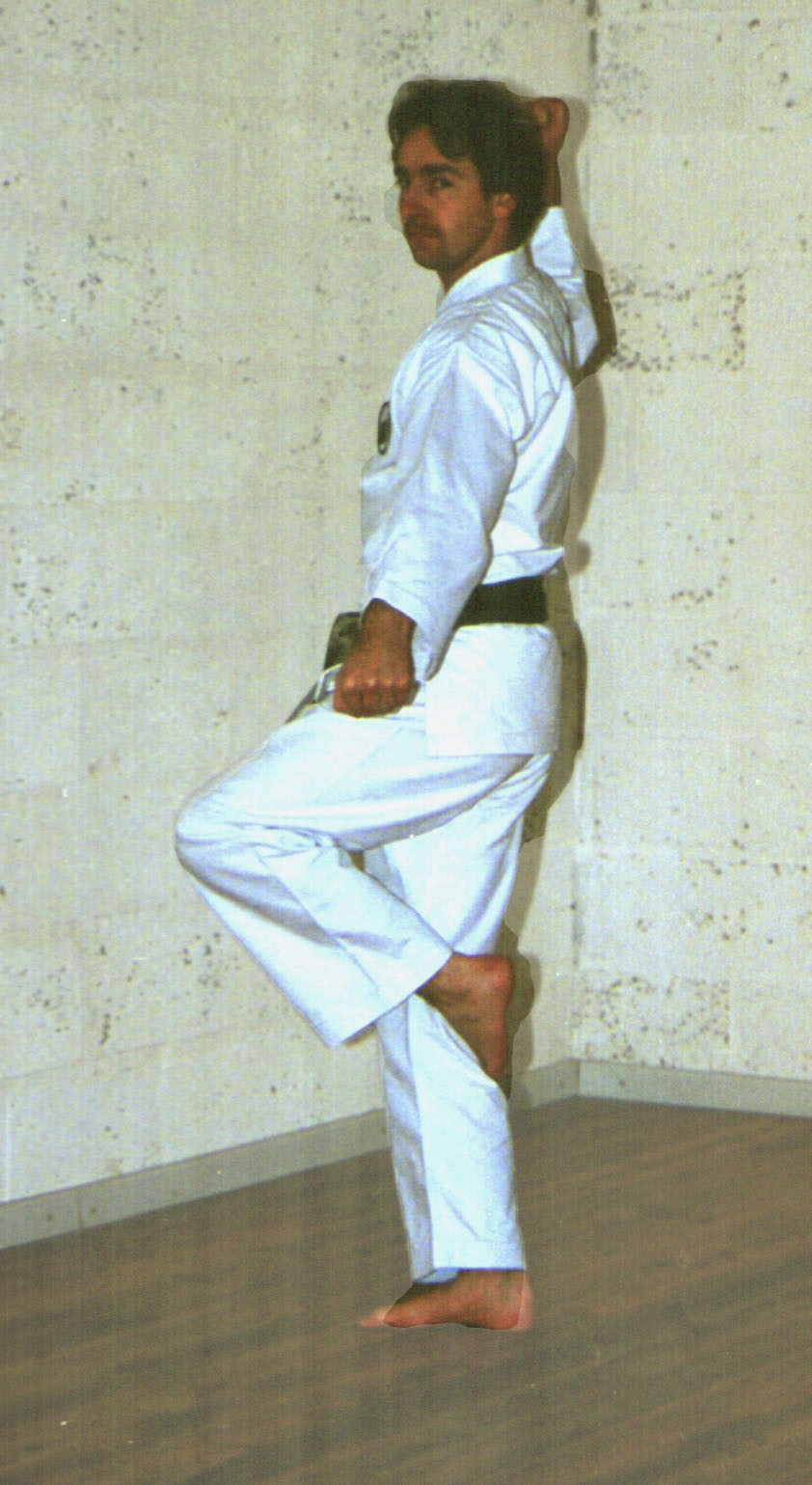
|



 Sensei
Derek Ridgway
Sensei
Derek Ridgway