
Hence, a mixture of house stucco and commercial cement was used to enclose the tusks so they could be transported to Lincoln.
This mixture turned out to be the downfall of the casting project. This combination failed to "setup" properly. It was eventually removed, and the tusks were reinforced lengthwise with wood excelsior, plaster lath, and then wrapped from end to end with wire.
There is concern about the condition of the bones and how they seem to be broken in small pieces. As a general rule, the ribs and vertebra were found in very good condition. Some ribs were broken in a few places, but still in the "natural position".
This animal apparently was exposed for an extended period of time after death. The bones are scattered over a large area. Present day elephants move and fondle bones of their departed mates, so this may account for the randomness of the bones. The mystery is why are the long bones in pieces and haven't been found whole? One archaeologist, thinks humans may have broken the long bones open for their marrow content. This would account for the absence of whole long bones at the site. The ribs would probably not yield enough food source, to counteract the work involved with opening the ribs. To my knowledge, no human involvement has been attributed to the site.
What caused the death of this Columbian Mammoth will probably remain a mystery. However, when all the bones are examined in the museum laboratory, who know what will surface? This site has been dated to at 17-18,000 years ago. The bones are lying about 18 inches above the Gilman soil, and that soil layer has been dated to 21,000 years ago.
When the site was reopened seventy-six years later, the stucco-cement mixture was found in a neat pile. The newspapers that separated the stucco from the tusks are still legible, and can be read without any effort at all. These remains made me feel like the earlier men were still at the site, maybe just out to lunch.
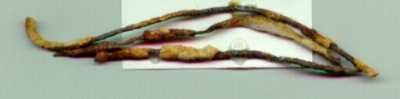
Many pieces of scrap wire were also found. Just like we were standing exactly where the men snipped off the unneed wire seventy six years earlier. And we were in the precise spot. A sample of the wire is shown below after being buried seventy six years.
The tusks measured 11 feet 8 inches long, and have a circumference of 30 inches at the point where they enter the skull. No small project to package tusks, load them on a wagon pulled by a team of horses and transported to the railroad station in Campbell, for transport to the museum in Lincoln, NE.
Moving water at this site doesn't seem to fit the scenario as a contributing factor of the bones being scattered. This site is composed of windblown loess. There are terrestrial invertebrates found associated with the bones.
