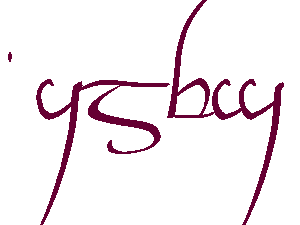
| Decades ago, when J. R. R. Tolkien
wrote his fantasy book series: "The Hobbit" and the "Lord
of the Rings", he described a race of Elves possessing a rich
history, language and culture. Not all Elves spoke the same language.
The most important languages were: "Quenya" (the language
of the High-Elves) and "Sindarin" (the language of the Grey-Elves).
Early in their history they devised an alphabet for writing their
languages. The oldest Elvish alphabet was the "Tengwar of Rumil",
but unfortunately Tolkien left no details or examples of this script.
Later Feanor of Noldor, inspired by the alphabet of Rumil, created
a revised writing system. The Feanorean alphabet was designed to be
an orderly phonetic writing system for use with pen or brush.
Consonant sounds were represented
by letters called: "Tengwar" . There are 24 primary Tengwar
letters. The letters were organized into four series or "Temar"
Each series was used to represent sounds created by different parts
of the mouth. Series I and II were almost always used for Dental
and Labial sounds. Series III was generally used for either Palatal
or Velar sounds and series IV for either Velar or Labiovelar sounds,
depending on the phonology of the language represented. These four
series were further broken down into six grades or "Tyeller".
Each grade was used to represent sounds created by different ways
that air flows through the mouth and nose. Grade 1 and 2 was used
for voiceless and voiced Plosives. Grade 3 and 4 was used for voiceless
and voiced Fricatives. Grade 5 was used for Nasals. Grade 6 was
used for Semi-vowel consonants. Each Tengwar letter was assigned
a phonetic value determined by its position in this grid. People
speaking different languages would often re-define this grid, so
only a few of the letters had a fixed phonetic value.
All of the primary letters were
composed of (at least) two elements: a vertical stem or "Telco"
(representing air) and a curved bow or "Luva" (representing
voice). There were also numerous additional letters that supplemented
the Tengwar primary letters. These additional letters did not necessarily
follow any symbol conventions.
In the alphabet's earliest forms,
vowel sounds were represented by symbols called: "Tehtar".
The Tehtar symbols were placed above and below (and sometimes inside)
the Tengwar letters. There were five standard Tehtar symbols, representing
the five most commonly used vowel sounds (a, e, i, o & u). They
were most frequently placed above the Tengwar letters. (Tolkien
used this style when creating most of his Quenya, Sindarin, and
English language Tengwar inscriptions.) But both the number of vowel
symbols used, and where they were placed depended on largely on
the preferences of the people using this alphabet.
Later forms of Tengwar used individual
letters to represent unique vowel sounds. This "open"
form was developed by the Grey Elves living in Beleriand, and was
therefore referred to as the "Mode of Beleriand".
Tengwar became a very flexible
writing system that was easily adapted by many different races to
their languages. Unfortunately, since it was so flexible it was
possible to have several different versions of it for each and every
language. Also, over the centuries, a great deal of shorthand developed.
Since Tengwar can be so easily modified, customized and mutated;
most people in Middle-earth devised their own version.
Tengwar / Quenya Language
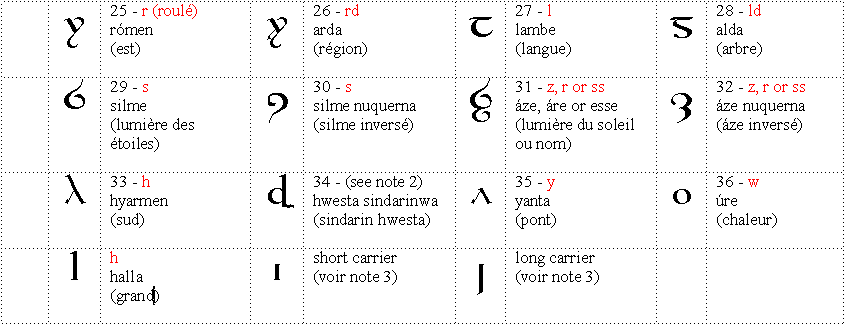
Tengwar Chart for consonants:
Primary Letters:
Additional Letters:
Notes:
1) Technically, anna does not have the value "y" when
used in the Quenya mode; "y" is represented by anna +
"following-y" tehta (or ). Anna is not used by itself
in the published Quenya texts.
2) Although this letter is part
of the standard set of additional letters, it is not used for writing
Quenya language texts.
3) The long and short carriers
are silent letters. They are used in conjunction with vowel symbols.
--------------------------------------------------------------------------------
Tehtar Chart for Quenya vowels:
Notes:
1) In Quenya, the a sound occurs
so frequently, that it's symbol (three dots) is often simplified
(to look like a circumflex) or if no confusion would occur, eliminated
altogether.
2) All of the published Quenya
Tengwar inscriptions by Tolkien have used the acute accent mark
for the e sound and the single dot for the i sound, but Tolkien
also stated that the reverse could be equally valid.
3) Long vowels have the same
sound as short vowels, the only difference is the duration of the
sound. For example: the short u is as the u in brute, while the
long u is as the uu in cool (English pronunciation).
--------------------------------------------------------------------------------
Writing Quenya with Tengwar:
Writing Quenya with Tengwar is relativity easy, just remember that
Tengwar is a phonetic alphabet. Words are written exactly as they
are spoken. Typically the Tengwar (consonant letters) are written
first, then the Tehtar (vowel symbols) are written above the appropriate
consonant. In Quenya, and other languages that end most words with
vowels, the Tehta is placed above the previous Tengwar letter. To
read Quenya/Tengwar script you would read each Tengwar letter, then
the Tehtar vowel symbol above it (in an upward motion), before going
on to the next Tengwar/Tehtar letter combination. For example:
If a word starts with a vowel
sound (and there is no previous consonant letter in the word) then
a "Carrier" symbol can be used. Carrier symbols do not
represent a sound, but rather provide a symbol for vowel marks to
be placed upon. There are two different standard Carrier symbols;
the "Short Carrier" and the "Long Carrier".
The Short Carrier looks like the undotted letter "i".
The Long Carrier looks like the undotted letter "j". The
Long Carrier is used with "long" vowel sounds. If two
or more vowel sounds appear consecutively in a word, the Carrier
symbol should be used when there is no consonant in the appropriate
location. For example:
Normally, "short" vowels
are represented by a single Tehtar symbol above a Tengwar or Carrier
symbol. But "long" vowels can be represented several different
ways; long vowels can be written as two Tehtar above a single Tengwa,
two Tehtar above a single Short Carrier symbol, two Tehtar above
two Short Carrier symbols, or one Tehta above a single Long Carrier
symbol (preferred); as shown below:
--------------------------------------------------------------------------------
There are no examples in the
books: "The Hobbit" or the "Lord of the Rings"
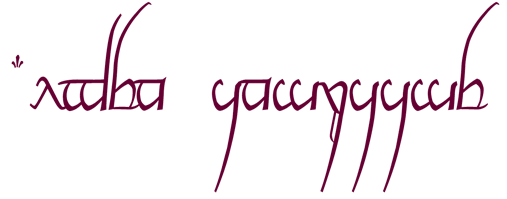
of Quenya written with Tengwar letters. But early in the book "The
Fellowship of the Ring" Frodo uses a Quenya phrase to greet
Gildor the elf:
This phrase could be transcribed
as:
Notice that in the word "lúmenn'",
the under-bar/tilde which is used for the long (or double) "n"
consonant sound.
--------------------------------------------------------------------------------
Sources:
The Lord of the Rings, Return of the King, Appendix E
TOP
|