|
"Models aren't
snobby" and other myths revealed
By Becky Castle
 "Hello…and
what can we do with your hair?" "Hello…and
what can we do with your hair?"
"You can G.I. Jane it!" I replied, delighting the hair show directors
and ushering in my weekend-long modeling career.
Several wingmates and I had decided to respond to the Matrix model
call on that Friday night. I was as delighted to be chosen for the
show as they were to have a model who would let them do anything
they wanted with her hair.
Before my evening in the Matrix room at the downtown Doubletree
Hotel, my only exposure to the modeling world had been from a magazine
reader's standpoint. Forty-five hours later I walked away from the
Tulsa Convention Center exhausted, looking completely different
and carrying a new view of the modeling world along with my bag
of free hair products.
Hundreds of suspicions, rumors and preconceived notions about models
and the fashion world constantly circulate. Let me try to shatter
a few of those myths by answering several common questions. Understand
that these are simply one person's experiences with one show, but
also keep your mind open.
1. Don't they do horrible things to your hair at those shows?
I'll let Sarah Chaboya explain that one. She used to live in Tulsa
and has participated in the Tulsa Matrix show for years. Even though
she now lives in California, she flew back to Tulsa to take part
this year. She raved about the way Matrix has always treated her.
She said some other companies have done terrible things to participants'
hair. They lie about what they're going to do with it, and the products
can ruin hair. She said it can take months to get it back to normal.
In all of her experiences with Matrix, she said they have never
done anything like that to her. Their products are wonderful, she
said, and they have always asked what she would let them do.
I did not have the opportunity to work with any of the other companies
myself, but I was impressed with the way Matrix treated me. My hair
was softer and healthier after the show than before. Sandra Carr,
host of the Matrix runway show, chose a red that complemented my
natural coloring and discussed the cut with me beforehand to make
sure I was okay with the idea. She was careful to ask each participant
about her personal cry zone-how short would be too short?
Carr gave me more than a haircut; she gave me a makeover. It's not
often that you receive a makeover from a nationally renowned artist
(Carr has won many national awards, including Hair Colorist of the
Year, Most Inspirational Hairdresser and Makeover Artist of the
Year). When she cut my hair onstage during one of the presentations,
she stood me up and showed the audience of hair stylists how to
choose a cut based on body type and dimensions. In analyzing my
facial structure she decided that she wanted to emphasize my jaw-line.
She was obviously successful: You wouldn't believe the number of
compliments I received afterward about the style doing just that.
I was especially impressed with the work that went on after the
show. If any of the models didn't like the cut or color they recieved,
the Matrix technicians stayed and changed the styles for free to
make sure all the models left happy.
2. Isn't modeling a hurry-up-and-wait situation?
This is so true! You wait for wardrobe, then rush to change. You
wait for your turn to get your hair dyed…or "colored," which I learned
is the correct term, then you become the focal point as technicians
furiously paint and foil your flowing locks. Finally, you wait and
wait for your turn to strut the runway, and then sprint to the wings
to catch your music in time for your entrance.
Most of my three days in the Convention Center I spent behind the
towering black curtains, sitting in uncomfortable chairs, talking,
trying to read or just zoning out-and eating (salad, of course).
3. Aren't models stuck up?
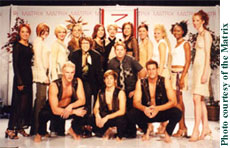
This I found to be entirely inaccurate. The Matrix models were some
of the nicest people I've met. A few of them were professional models
but most were completely new to modeling like I was. The experienced
models never looked down on us or laughed at us. In fact, they went
out of their way to help us and teach us. Emily Mock and Samantha
Higgins, who along with Chaboya have done the Tulsa show many times
and enjoy seeing each other again every year, taught me how to walk
a runway. Chaboya even offered me her tomato juice one morning when
I was feeling sick because I hadn't eaten breakfast yet.
Quite a few of the models were Christians-their Christ-like attitudes
shone through their words and actions. I heard Todd Berman, one
of the male models, talking about his experiences with an organization
called Models for Christ and also caught part of his conversation
with Higgins about mission trips they've been on. Peace and laughter
permeated the backstage area and made the long days more enjoyable
and encouraging.
4. Walking that runway is easy, right?
Although it may look like runway models just walk wherever they
please, this is not the case! Each section of the show had to be
precisely choreographed and timed to get each model exactly where
he or she needed to be at the perfect time without running into
anyone else.
Walking a runway takes a certain amount of acting. I love acting,
so I enjoyed my three sessions as a presentation model. Even if
you're uncomfortable in your outfit (and here's something I bet
you didn't expect: Even many of the experienced models were uncomfortable
in the fashions they sported!), or think that your haircut is "not
you," or you're freezing cold and getting goose bumps, you have
to "walk like you're the most beautiful woman in the world and you're
the only thing that matters at that moment," Chaboya told me.
5. Runway fashions are outrageous-they're not applicable to ordinary
people, are they?
I would agree that they're outrageous-look at Higgins' updo! However,
some were more practical. And even the outrageous ones could be
toned down slightly for use by the average salon patron. One reason
Carr and Derek Rutherford, the co-host of the show, created such
noticeable styles was to show off the abilities of the new Trix
products.
6. Isn't it all about the models?
Nope. Even though the audience only sees the models, the show could
never take place without the army of stylists, colorists, makeup
artists and wardrobe assistants who start their days before the
models and stay afterwards to pick up the pieces. There were some
fun, talented and kind women backstage who did whatever it took
to make us presentable in the first place. And one can't forget
the artists who offer the creative vision for the show and put everything
into motion. Carr and Rutherford are clearly masters of their trade-they
even taught me (the farthest thing from a hair stylist!) a thing
or two about cutting and styling! They were as down-to-earth as
anyone and did much of the grunt work themselves, jumping in and
helping while still keeping everything under control.
I entered the Matrix backstage area on a Saturday morning with long,
straight brown hair. I left on Monday evening with my worldview
expanded and my hair short and orange with crimps and waves. I love
my new hair and I loved my experience. Everyone should be a model
for a day.
For more information, you can check out Carr's salon and makeovers
at www.sheerprofessionals.com.
The Matrix website is www. matrixbeautiful.com.
|









)