|
Worldwide shortage
of nurses holds promise for ORU students
By Becky Castle
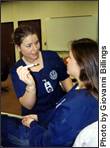 A
worldwide shortage of nurses promises to benefit already well-qualified
graduates from ORU's Anna Vaughn School of Nursing gain jobs. A
worldwide shortage of nurses promises to benefit already well-qualified
graduates from ORU's Anna Vaughn School of Nursing gain jobs.
The Bureau of Labor Statistics reported that there will be a demand
for over one million new nurses by 2010. With an increasing number
of people retiring and young people choosing other health care options,
however, projections indicate a potential deficit of 400,000 working
nurses by 2020. This is happening at a time when 78 million baby
boomers are hitting senior status with increased health needs.
The current nursing shortage makes it more conducive for any board-certified
nurse, especially a well-trained one, to get
a job. "ORU nursing graduates are already highly sought after,"
said ORU Nursing Instructor Audrey Thompson.
"They
are known for being efficient, competent, caring nurses. This shortage
only intensifies their potential."
Not
only will ORU nurses quickly find jobs, they will also rise through
the ranks of the profession rapidly. Thompson
said that many students will be able to move into leadership positions
much sooner than their predecessors because
of the shortage. "[In addition,] they will
be able to get managerial and administrative
positions very early because they have bachelor's
degrees," Thompson said.
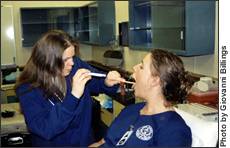 Ruth
Weaver, an ORU nursing student who will graduate this May, knows
it will be easy for her to get a job. "It's almost guaranteed I'll
get the job I want," she said. Ruth
Weaver, an ORU nursing student who will graduate this May, knows
it will be easy for her to get a job. "It's almost guaranteed I'll
get the job I want," she said.
The Jan/Feb issue of "American Nurse" cites several causes for the
shortage: "an aging workforce, the after-effects of hospital downsizing
and salary issues." The shortage is reaching critical proportions
not only in the U.S. but also worldwide.
Some countries look to recruit nurses from other nations to alleviate
the problem. This has given rise to the term "nurse poaching." The
practice increases a foreign land's workforce, but does not entirely
solve the situation. The first country is left with fewer nurses.
Lack of fresh recruits is complicating the situation.
"The mean age of nurses practicing on the floor is 45," Thompson
said. The fact that those nurses will be retiring in 10 to 15 years
is causing "a lot of concern in the nursing profession," Thompson
said.
Although women now have countless opportunities for more highly
paid careers, an outdated image of nurses and their jobs is frequently
blamed for the lack of interest among high school graduates.
"[Nursing] is not an easy job," Weaver said. "It doesn't always
involve things people like to do."
As demand increases, schools are expanding their programs. More
students will have the opportunity to go into the field. Weaver
wants to use nursing in missions, as do many ORU nursing students.
Thompson said ORU incorporates missions into its nursing courses.
"As nursing schools are offering more diversity, more students will
come because they will find their niche," Weaver said.
|