|
Just Plane
Fun!
By Sheldon Yoder
Aviation
just runs in the family. For Dr. Dominic Halsmer, Chair of the Engineering
and Physics Department, aeronautics is one of his passions, and
he has plans to bring that passion to life at ORU.
 Halsmer
practically grew up on an airport in Lafayette, Ind. Every year
his father, an aviator, would take the family up to a major air
show in Oshkosh, Wis., put on by the Experimental Aircraft Association
(EAA). Halsmer soloed in high school, but other responsibilities
pushed obtaining his pilot's license to the backburner. Aviation
never left Halsmer's blood, however. Halsmer
practically grew up on an airport in Lafayette, Ind. Every year
his father, an aviator, would take the family up to a major air
show in Oshkosh, Wis., put on by the Experimental Aircraft Association
(EAA). Halsmer soloed in high school, but other responsibilities
pushed obtaining his pilot's license to the backburner. Aviation
never left Halsmer's blood, however.
He acquired his Bachelor of Science in Aeronautical and Astronautical
Engineering (A&AE) from Purdue University. After obtaining his master's
(A&AE) from Purdue, he went on to UCLA to obtain his Ph.D. in Mechanical
Engineering.
Halsmer gained experience in the aerospace industry at Hughes Aircraft
Company working on satellite attitude dynamics and controls for
seven years. Since 1992 he has been teaching at ORU, and has been
the Chair of the Engineering and Physics Department for the past
three years.
Halsmer's love of airplanes has spurred him into proposing an airplane-building
project for the Engineering and Physics Department. The project
was made possible by the donation of a $40,000 airplane kit, called
the CompAir 6, by Aerocomp, Inc. in December 2001. A six-seater
with a 300 horsepower engine, it features cruising speeds of between
150 and 200 mph.
"One of the reasons we want to do this is because it provides us
with a hands on case study of aircraft design using modern materials.
The airplane is almost exclusively made from composite materials.
Composites are modern, lightweight, strong materials that have been
used in aircraft design only in the last few decades. These are
state of the art aircraft structures that we will build and test
and analyze," Halsmer said.
"And, I've always wanted to build an airplane. So, even though it's
hours and hours of long work, I think I will enjoy it. And there
are many students and faculty members that are excited about building
a plane here at ORU," he added.
While the thought of building an airplane is exciting, Halsmer understands
there are several hurdles to overcome before the project becomes
reality. Although the kit was donated at no cost to the University,
funds are still needed to purchase the engine and some remaining
items. "I'm hoping that we can have a shared ownership between the
investors and the builders after it's built," Halsmer said.
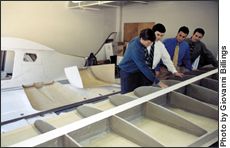
Currently, the airplane is being built in an enlarged garage next
to the executive parking garage. There is enough space to complete
the fuselage and wings. When it comes time to put the wings on the
plane, the assembly will move to an airport. If all goes as planned,
the final assembly can be done in the last few weeks of the project.
The plane builders will largely be faculty and to a more limited
degree, students of the Engineering Department. "The Comp Air 6
is going to take about 2000 hours of work, and I think we can finish
it in two to three years. Furthermore, it is required that there
be inspections and careful records kept throughout the building
process. So I want students to have a hand in building it, but any
work done by the students will be carefully supervised so that the
investors will know that they have a product that has been built
right. But it is to be a project for the entire Engineering and
Physics Department," Halsmer explained.
The actual building of the plane will require some muscle work and
plenty of attention to detail. "It's a lot of elbow grease: sanding,
epoxying, measuring and carefully laying pieces. A lot of nuts-and-bolts
work. It's going to require a lot of hours. It will be a challenge,
definitely," Halsmer said.
Along with the actual building of the plane, the Engineering Department
will conduct analysis of how it was designed. This ties into the
department's goal of expanding aeronautical study at ORU in the
future.
"Next semester I'm teaching a course on aircraft design. It will
be the first time this course is taught at the University. We're
going to use this aircraft as an initial case study. The students
will analyze the plane and once we get smart in this area, the next
step will be designing our own aircraft. But first we're going to
learn what is state of the art right now," Halsmer explained.
Halsmer believes this will be beneficial for both the Engineering
Department and the University as a whole.
"The number one goal is to benefit the Engineering and Physics Department
by producing even better qualified engineers-engineers who have
more confidence because they've worked on a project like this and
gained the experience. I think it will increase enrollment in the
department, drawing and attracting more students who can be positively
affected by the University and the spiritual atmosphere here. From
here, they will go out to other technical areas and bring the gospel
to other engineers."
|









)