





Finally, after a long, long journey across the states and across the Pacific Ocean, I arrived in Hong Kong! Emily met me at the airport making my first couple of hours much less difficult as we traveled for about 1 1/2 hours to the south end of Hong Kong island. My initial feeling was simply exhaustion - after not sleeping the night of the 7th at all and Jonathan taking me to the airport at 4:30 am on the 8th (many, many thanks, bro!), I arrived at Hong Kong International Airport at 10pm on June 9th. Altogether, about 30 hours of travel (plus 12 hours gained by time zone). My second impression, however, was one of awe at the size of the city. The skyline is truly something to behold --and not just from the waterfront that most postcards depict. Before we entered the downtown area on my trip from the airport, I gazed at row upon row of 50+ floor apartment buildings lining the highway in a very orderly, yet busy manner. As we left the financial district on British-style doubledecker buses that struggled to wind their way up the narrow, steep, mountain roads, I looked back on a beautiful display of lights. Pretty amazing.
When I finally wandered back into the downtown area during daylight, I realized that my initial impression about the size of the city were justified. The downtown area of Hong Kong feels bigger and more crowded than New York. There are so many people, everyday, busily walking the streets from work to home to the markets to the buses. I was also lucky enough to get my first taste of Hong Kong in the rain. Note to anyone entering Hong Kong during the rainy season (which I unfortunately timed my arrival with) -- you must be on your toes, prepared to dip, dodge, and duck through an ungodly number of umbrellas that go up as soon as a few measly drops begin falling! And these aren't the umbrellas you can strategically place in your handbag or backpack...these are beach umbrellas that an entire Chinese family could hide under! So, if the umbrellas are so big, at least they share umbrellas as they walk down the streets, right? Wrong! Every person has their own super-sized umbrella, apparently assuming that those normal, one-person umbrellas won't do when the rainy season comes full force. It's a mess! One other note about the umbrellas before I move on -- I haven't checked this officially yet, but I think that the size of one's umbrella is also inversely proportional to the size of the person carrying it. The biggest umbrellas were inevitably carried by tiny, little old Chinese ladies and little kids! As they say in Hong Kong, "aye ya!" (Yiddish equivalent - "oy vei!").
Umbrellas aside, spending a week in Hong Kong also gave me a great appreciation for the efficiency of the city. Cars are a definite luxury item, and an unnecessary one at that for most people, since public transportation is pretty fantastic. Private vehicles are expensive to buy and gasoline is expensive. On top of that, you need to pay for parking and an annual tax for owning a vehicle! Those are some darn good deterrents. The city is also very safe. Crime figures are very low, and if asked, most residents would agree that crime is not a problem. Everyone I've talked to say that Hong Kong is one of those places where they feel safe going anywhere, at anytime, with anyone or alone. That's a mighty impressive thing to say about a city of over 10 million people.
Even with all of those reasons not to own cars, pollution is still a huge problem. There are very few days where you get clear, bright blue skies. There's a permanent haze that hovers over the city, and combined with the heat and humidity, can make it seem like a suffocatingly difficult assignment to walk too far in the middle of the day. I ran about a mile uphill my last day in Hong Kong (hoping I wouldn't miss my flight to Thailand), and arrived at Emily's apartment huffing and puffing like I haven't done in as long as I can remember. I can't even imagine what it would be like when it's REALLY hot (apparently, what I experienced was nothing compared to the pre-rain days).
This is also when I felt our "holiday" was really starting. While in Hong Kong, Emily was finishing up all of her responsibilities for teaching, so it didn't have as much of a "visiting" feel as it had a "temporary living" feel. But we were starting our official vacation with a bang, staying at a beautiful resort before doing more of the backpacker lifestyle for the rest of our trip. The plane flew us directly to Phuket Island, over the Phang-Nga Bay, which we would explore closer to sea level in a few days. Right away, we were amazed at the beauty of the multitude of rock islands scattered all over the calm waters. Seeing them from the air was quite a magnificent sight.
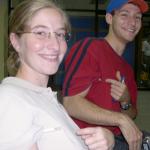
Customs was a bit amusing - we sat with thermometers under our armpits to make sure we weren't transmitting SARS to Phuket from Hong Kong (even though the epidemic has been over for some time). I guess we all passed since they let us go on our way. A mini-bus brought us about an hour south on the island to the village of Karon where the Karon Villa Resort was located. Coming from someone not used to staying in accommodations where they do much
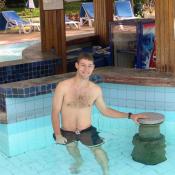 more than hand you a sheet and a pillow, this was quite a change of pace. The five of us checked in at the front desk, then got escorted by golf cart to our own little bungelow, complete with mini-fridge, aircon, and robes. I awoke early the next morning to explore the grounds a bit. Our bungalow was about 50 feet from the pool complete with a swim-up-to bar and even more exciting, a diving board :-). I entertained myself for a while there before heading to breakfast with the gang. This was quite exciting too (offering more than granola bars we would eat for breakfast for much of the trip). The buffet style meal offered fruit, cereal, salad, omelettes, bread and pastries, yogurt, ham, bacon, sausage, and what we figured was leftovers from last night's Thai dinner. The rice and chicken dish was quite good...even at 9am!
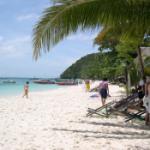
After breakfast we headed to the beach to swim in the tropical waters. Deb and I wondered whether we should pay any attention to the large sign of someone swimming with an "X" through the picture. Nah! We figured, they must have forgotten to take that sign down. As we were about to wade in the Andaman Sea, a local tells us not to go in the water - no one swims there this time of year because of strong rip currents due to the monsoon season. In fact, 2 people died there just last week, getting swept out to sea in 20 minutes! We debated swimming for 19 minutes and pressing our luck, but then thought better of it.
 It was just as well, though, since a terrific storm crept up on us anyway. We ran back to the resort where we entertained ourselves with ping pong, the weight and aerobics room, and picture-taking. Overall, the staff at the resort were wonderful, and I would absolutely recommend it for anyone looking for a honeymoon spot or other romantic-type getaway. However, Phuket in general is not much of a backpacker's destination. We made the most of our time there, though.
It's tough being a conspicuous foreigner in a country where many of the merchants you meet try to milk you for a little more money than they would a local. It automatically puts you on the defensive. As they get more aggressive, I get more defensive! This happened when we stopped at the bus station in Phuket town. As soon as the taxi stopped, six men asked us where we were going, and tried to escort us to the Krabi bus for a mere 90 baht. Being on the defensive, I thought this was another scam since we were told it was a 50 baht bus ride to Krabi. So, I confidently and defiantly ignored all of the men pulling at my arm and trying to gently maneuver me towards the correct bus; instead marching towards the "Information" window 20 meters away. Emily said that one man finally agreed to the 50 baht fare. So, the four of us boarded the bus, content with our saviness not to be taken for an additional 40 baht (equal to $1!) per person. Well, that feeling was short-lived! Soon after departing, the ticket guy came around to collect fares and looked at us with a bit of confusion when we paid 50 baht per person. It seems that 50 baht is the price of the non air-con bus to Krabi! So, after all that, we paid the fare we were originally told as we exited the taxi! Boy I wish I knew Thai!
The air-con bus blasted Thai television at us for the entire four hours, and although it seemed to be a very funny episode of whatever Thai program they had taped, I didn't get it (that whole language barrier screwing things up again). Instead, I gazed in awe at the landscape and the small towns we passed along the way. The rock formations, both on the peninsula and in the Andaman Sea, are phenomenal natural specimens that are unlike anything I've ever seen. In many past travels, I have seen impressive mountains, canyons, and various stone structures. Normally, the shapes and sizes of the rock can be attributed to water's impact, one of the ice ages, or other geological activity. Whenever I heard such an explanation, I was normally content with the reasoning. Here, though (at least so far), the rocks seem to have just been placed from above! These enormous, jagged, pieces of sedimentary rock dot the land and the sea. They look fantastic for climbing, and hopefully tomorrow I'll have a chance to check out whether or not that is true.
Upon arriving in Ao Nang (20 minutes from Krabi) and finding a wonderfully clean and scenic hotel owned by a Chinese family, we strolled half a block down to the beach for some swimming. This particular beach is probably about 1km in length, but other beaches are only a hop, skip, and short swim around some of those fascinating rock towers. The water was almost too warm! I'd guess 90 degrees F, but that could even be low. A swim a little ways out brought the temperature down to a more manageable 85 degrees and was a wonderful way to spend the afternoon. Snorkeling proved futile, however, since the murky waters left little beyond an arm's length to see. I had visions of swimming further out and exploring possible sealife around some offshore rocks, but past attempts with Emily that have been less than successful kept creeping into my mind, preventing me from venturing out there alone. That turned out to be a good decision since shortly after returning to our beach blanket, the wind picked up and a threatening thunderstorm scared us off the beach.
The evening was quite relaxing. We casually checked out some of the shops for bags, shoes, post cards, and other interesting Thai memorabilia. I also have had my faith in the good of the Thai people reconfirmed here after talking to several street vendors. One man, in particular, seemed to have a wonderful outlook on life. He makes his own jewelry that he sells on the street. He chatted with us for a good 10 minutes after we displayed some passing interest in some of his work, but without any intense pressure to buy or barter. Instead, he asked where we were from, when we arrived, what we planned on doing, and even offering suggestions for where to go! He recommended rock climbing on Au Rai Lay, and diving by some of the offshore islands. He prefers diving and does so whenever he has the free time. He had an unkempt look about him, but it gave his friendly demeanor an even greater innocence. If I buy any jewelry here, it will be from him.
after climbing, we enjoyed the absolutely breathtaking beaches of Hat Rai Lay. the beaches were clean and the water clear, but the highlight of it all was the absolutely awesome mountains and cliffs that backdropped the scene. the cliffs are made of coral (dead coral), and they seem to jet out of the ocean like fingers. it was so cool.
after swimming, jeremy and i played with the local monkeys (macaques) for awhile. i know, i know....we could have been bitten and infected with ebola. but, we weren't. and the monkeys were cute and rather tame. in fact, i fed the monkeys corn right out of my hand. their lips are so soft...and their fingers are so, so human-like. it's incredible. i can now say i am a bonafide proponent of the theory of evolution.
and shortly we're headed to the Perhentian Islands on the east coast of Malaysia. these islands boast some of the most beautiful beaches in the world. i am soon to become a beach connoisseur. in any event, i'll write again soon.
best always,In general, the trip so far has consisted of seeing more beautiful tropical beaches than I ever thought I would get to see. The next phase will include a lot more trekking in forests both here in Malaysia and northern Thailand. Emily and I flirted with the idea of taking a ferry across the border into Sumatra, Indonesia, but were dissuaded by an American who said while there, witnessed people driving by and yelling "Death to America", pirates board the ferry boat before there's and take both people and supplies, and one restaurant supposedly try to poison him. There is an awesome national park in Sumatra, but these stories were enough to convince us to head in another direction (I must admit I was quite intrigued to confirm these stories myself, but I did promise my mom I would not take unnecessary risks).
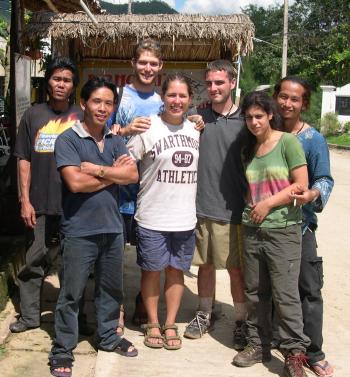
I knew that this was going to be an experience unlike any other just an hour into the trip for our first “snack.” We pulled over on the side of the road by a small grassy area and laid out a large tarp to use as a blanket. Our snack consisted of sticky rice (appropriately named), chicken, and tom yam soup. Our leader, Chart, then pulls out one more bag, this one containing at least a dozen crickets. He puts it in a bowl in front of us and says, “Eat…very good.” I laughed, assuming he was kidding – that is, until he takes an entire cricket and pops it into his mouth. I bravely try to follow suit and am able to tolerate the taste just long enough to convince my fellow trekker Mark to do the same. The taste was a bit much for me though, and spit out the chewed up cricket remains behind me. I swear there’s still a cricket wing stuck between my molars, though!
The background.
On July 1st, Emily and I took a relaxing 3 hour ride on the back of a pickup truck to Pai, a northern Thailand town that is known for basically two things - its laid-back atmosphere and a launching pad for treks through the jungle that include hiking, rafting, elephant rides, and visits to tribal villages. Shortly after arriving, Emily and I heard about a trek that sounded a bit different than all the others. While most last 3-4 days and include some of the more popular tourist activities mentioned above, the Permchai Trek would last seven days and promised a truly authentic jungle experience. We met Mark (Canadian) and Shany (Israeli), who let us to Chart, our potential tourguide who enthusiastically described the originality of the trek he would offer through somewhat broken English. All of the remarks of past trekkers suggested that it was wonderfully enjoyable and truly a once in a lifetime experience. So, although a bit more expensive and longer than what we had planned, Emily and I decided to go for an “authentic” jungle adventure.
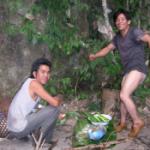 July 2, seven of us left Pai, did some last minute shopping in Chiang Dao, and headed off. Our little “snack” of crickets proved to be only the first of many interesting dining experiences. Our group consisted of Chart, David, Nick, Mark, Shany, Emily, and me. Our veteran guide, Chart, had a commanding presence that demanded respect despite his 5’3” height. As the trek went on, my respect for him only grew. He is 37, but looks barely older than 30. His assistant, David, was sociable, funny, and good-natured throughout the trek. Nick’s role was primarily one as a worker and cook, since he knew little English.
Our first day was a bit frustrating, since it consisted of several hours of driving, and a final stop at a Lisu (northern tribal) village without hiking at all! It was interesting, however, to see how a simple bribe of a handful of rambutins (small, red-shelled fruits with a white, sweet, gooey center) got us through the entrance of Haui Nang Pang National Park without paying the 200 baht (about US $5) permit fee. On the way back out, one liter of homemade rum did the trick! Our bumpy truck ride on rocky dirt paths ended in a small, remote, simple village looking onto _____ Mountain, the tallest peak in the country. I felt as if we traveled back through time as well, for the lives of the Lisu is much the same as it was one hundred and two hundred years ago - no electricity, running water, or other remnants of modern, capitalist society.
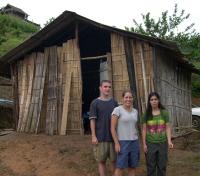 We stayed in the bamboo hut inhabited by a single old lady dressed brightly in what reminded Emily and me of traditional Chinese garb. Apparently, the Lisu tribe came from China and have kept many of their traditional culture intact. A little boy could not help but just stare at me as I walked past him back to the truck we arrived in – if I wasn’t the first white person he’d ever seen, I was certainly the first one he remembered!
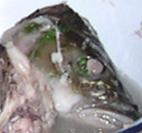
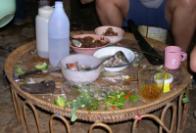 With no electricity and no running water, we relied on a wood fire to cook our fish, and the rain run-off from the roof of the hut (which of course was collecting in a rusty metal barrel) for water for tea. It was initially shocking to see how Nick just chopped up the entire fish into bite-size pieces before throwing it in the tom yam soup - eyes, mouth, tail, and bones included – but it wouldn’t be long before we realized they weren’t going to change their ways because of us! I also had my first taste of home-made rum (they call all of their home-made liquor “whiskey”). That is some powerful stuff! Eight of us (the seven on the trek plus the old lady) slept shoulder-to-shoulder on a bamboo bed that was surprisingly comfortable despite any bit of padding.
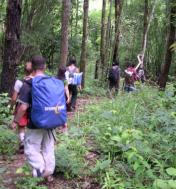 We finally got our chance to hike – about 2 hours to a cave close to the Thai-Myanmar border. It was nice to finally use our legs after spending most of Day 1 in the truck. We passed some soldiers along the way dressed in full fatigues and carrying semi-automatics – border control, apparently, and they smiled at the sight of four white visitors looking out of place while travelling so deep through the forest. Since we were in the mountains during the rainy season, we expected quite a bit of rain, and the slick paths led to some entertaining acts of (non)athleticism. Whenever there was an incline of any degree, the slick, clay-like mud seemed to claim at least one victim (often more). I believe that on the day, the award for most times falling on one's bum goes to yours truly.
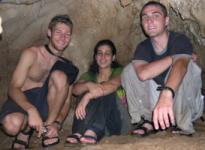 Shany was quite good at initially slipping, losing her balance, yet somehow finding a way to stay on her feet. Emily took the greatest one-fall pounding, with a thunderous crack that I thought might have been the sound of her tailbone splitting in two (luckily, it wasn't!). Our hike through the bamboo forest was pleasant - lush ferns, spiralling vines, and tall shoots of bamboo surrounded our path, and ended with a thrilling view of a large cave opening complete with a small, cascading stream flowing through. What else could one ask for as far as night accommodations go! A large, open area for cooking and lounging protected from the rain, with fresh river water at our disposal!
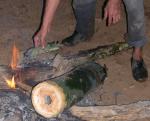
This is also where we got our first real feel of jungle living and could truly appreciate the wonders of bamboo. During our seven days, we drank tea that was boiled in bamboo, ate rice that was steamed in bamboo, drank out of cups made from bamboo, used spoons and other utensils made from bamboo, ate soups flavored with bamboo shoots, rafted 20 km down a river on a raft made of bamboo, tired with strings that were strips of bamboo, slept in houses constructed entirely of bamboo in villages predominantly built with bamboo. Dad, I know how you said you really like bamboo...well, you're not the only one :-)! It was incredible to see how people who are used to living off the land in the jungle truly live. Because bamboo is hollow but each section is sealed, it is ideal for holding liquid! Nick filled a large, fat stalk with river water and set it upright in the fire. Tea leaves were added, and half an hour later, we had a wonderfully aromatic and flavored tea! In another stalk of similar width, David placed two sections of bamboo on the fire – the bottom section was once again filled with water. A small hole covered with banana leaves were next placed inside. On top of the leaves, he poured an enormous amount of dried rice into the remaining section of bamboo. Perhaps half an hour to an hour after placing this bamboo in the fire, a large quantity of deliciously steamed sticky rice overflowed the top of our bamboo “pot!” In addition to bamboo, the large, strong, broad banana leaves often assisted at meal time.
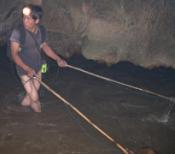 They served as make-shift mats when we sat down for meals, the filter when steaming rice, oven mitts when handling the heated bamboo, and packaging material when storing leftover sticky rice. Mushrooms picked as we hiked from spot to spot as well as tender bamboo shoots growing along the river banks flavored the numerous soups we enjoyed. Chart fished in the river waters by using a cool contraption that produced a battery-induced electric shock, stunning the fish. And of course, our trek would not be complete without tum yum snake soup! This was a delicacy that Chart especially enjoyed. In fact, on our truck ride back to Pai, I was lucky enough to be looking out the window when a snake was slithering across the road. Chart intentionally swerved to run over the snack just below the head! He stopped the truck, picked up the bleeding snake, and tossed in the back with us so he could have tum yum snake soup the night we got back into Pai! Now that’s rugged!
As great as a locale the cave was for dinner and sitting around playing cards, surprisingly enough, the stone wasn't the most comfortable bedding! Spiders climbed over me as I slept, and hundreds of bats left for a night of hunting mozzies and other flying insects. Their shadows danced and jumped above us thanks to the flickering of our fire. Not the most comfortable night's sleep, I have to admit!
But instead, we eventually found a small flat clearing next to the river we had been walking alongside, frequently crossing, and sometimes simply wading through. The tarp went up to form a small covered area in case the rains came, and fires were built for boiling water, cooking rice, and roasting our friend Piggy! Piggy was taken down to the river and rinsed, clubbed a couple more times (probably still alive, but barely at this point), and held over the fire by Chart and David. After the fur was singed, Chart and David used our soup spoons to scrape off the fur from Piggy, revealing white skin beneath. This “burn and scrape” method was repeated a few more times until our black-furred friend had been reduced to a white-skinned carcass. Nick proceeded to cut up the pig into nice, barbeque-sized pieces that could be grilled over the fire. As late afternoon turned into night, our meal of sticky rice, pig, and some leafy vegetables continued. I would have to say that guilt is really the overwhelming feeling that drove my reason to continue to eat the pig. Although Piggy looked like a fairly healthy specimen, there was a shockingly tiny amount of meat on the fellow! When I say that I ate “pig” for dinner, what I really mean is that I ate pig fat! There was a tiny layer of meat on the ribs, and a bit more in some of the other nondescript pieces I ate, but pig fat was the overwhelming look, touch, and taste that I encountered!
So, after such a healthy meal as rice and pig fat, what could you possibly have to cap the night? How about some nice, home-made whiskey and tum yum snake soup (eaten, of course, with the same spoons used to scrape off the pig fur…having a short-term memory was very necessary in dealing with some of these unsanitary conditions)! Yes, THIS was our dessert after eating much more pig than my stomach would have liked!
Our night in the forest in hammocks (as Mark slept) or on the ground beneath the tarp (like the rest of us) passed by without rain (lucky for Mark!). Mark suffered a spider bite that made his arm swell and brought him neurotic thoughts of amputation to mind, while Emily and I shared our sleeping quarters with thousands of ants, millipedes, and other fun little buggers. But besides that, the night grew quite pleasant as our drunken guides passed out from the whiskey and the sounds of the crickets and frogs became the dominant voices of the forest.
No ride down the river would have been complete, however, without a little mid-trip bartering – after getting off the rafts to push them over a 3 meter high dam, our rafts needed a little first-aid care. Some locals who were fishing in the river provided their assistance, and also offered to grill some of the little fish they had caught as a mid-day snack right there! In return, we gave them the head of the pig, and the hindquarters, both of which had been sitting in the bottom of the basket since the night before, infested with hovering flies and other bugs. And thus, the benefits of trade! I’m sure the fishermen were happy to get some meat in their diet, and I was more than happy to get rid of the head of that pig (I was worried it was going to end up in the next bowl of soup served to me!). I have to admit, the fish was even good! Sebastian, a local who was originally from Singapore, and I shared a bonding moment when he convinced me to just pop the little anchovy-sized fish in my mouth - head, tail, bones and all - and enjoy a more filling meal than just the tiny bit of meat on the little suckers.
Chart’s town was the most modern area we had seen for five days. This village, unlike the traditional hilltribe villages of the Lisu and Karen tribes, had electricity, paved roads, and of course, bars complete with Thai karaoke! But before grabbing the mike and belting out obscure American country love songs that no one had ever heard before, we enjoyed an even more special treat…a game of 20-on-20 soccer at the schoolyard with kids from the ages of 6 to 18. Mark, Emily, and I all had a blast, and the Thai kids thought it was hilarious that these big, goofy white people joined in their game. They laughed with us when people collided, goals were scored, or good plays were made. But mostly, they just laughed at us! Still, it was a lot of fun to get a change of pace from the jungle and river life we had been living. Chart was kind enough to let us stay at his parents’ house in the village, and we had our second opportunity to actually sleep on thin mattresses rather than just stones, wood, or concrete.
David was thrown from the raft a couple times…at one of these times, we also witnessed an incredible effort by Chart to save the raft from getting destroyed! At the largest rapids we passed, the four trekkers got out of the raft and walked along the banks to the other side while David and Chart manned each raft, one at a time. With Chart steering up front on the first, they survived the rapids without any problem. They walked back up the river where the second raft was beached. This time, David was head poleman while Chart provided backup support. We was doing a good job until right at the end of the rapids, when the raft hit some rocks, David lost his balance, and fell off the rapidly moving raft. Chart ran from the back to the front of the raft just in time to use his pole to redirect the raft that was headed for a straight-on collision with a rock wall! A crash would have destroyed the raft, making the remaining hour of the ride quite crowded with seven passengers on one raft!
We arrived at a ranger station, where Chart’s uncle worked. Here, we were lucky enough to sleep inside again, only this time, “inside” consisted of the concrete floor of a wasp and ant infested classroom! The wasps were a little agitated when I unknowingly swung my shirt above my head to dry it, but were peaceful companions otherwise. The ants, however, made sure to show that this was THEIR place! As Emily and I slept on the hard concrete floor, some of the ant scouts found something quite delicious in Emily’s backpack. The scout whistled and called to his fellow ants, who then walked, single file, right over me to get to their tasty treat! When Emily woke up in the morning, she saw a row of ants crawling up, over, and down my body and over to her backpack and shoes, which were both infested with ants! My back looked diseased, where the ants must have decided to stop and take a bite here and there as they traveled over my body. I pulled 3 ants out of my hair once awake when I felt something biting my scalp! Even with such a restful sleep, I was going to be glad to get back to civilization!
Many thanks to Chart, our fearless guide, David, our social director, and Nick, who encouraged me to eat things I never thought I’d try!
Another interesting thing is that although Cambodia has a national currency (the riel, valued at about 4000 riel to $1 US), having riel in your possession is completely unnecessary! Things are priced in US dollars...in hotels, guest houses, even grocery stores! We exchanged some US dollars when we first arrived, but everyone wants US dollars...we even exchanged US$20 for 20 US$1 at the bank!
Cambodia is quite interesting, although not a place I could imagine staying long. While Thailand and Malaysia both were populated by extremely welcoming people who were excited to show you their country, Cambodia, by comparison, seems too poor to have this welcoming feel. Instead, little kids, obviously trained by parents when white people are around, come up to us with sad, cute, pouting faces and hold their hands out, hoping for a little money. It's sad to see, and impossible to ignore (at first) - I try to move on without seeming curt and insensitive but also without giving them any money, for that would only lead to the hordes of cute, poor, hungry children coming our way. But then, a feeling of guilt overrides me as I think that I can't stay here long because I can't bear to see this scene time and time again - I have the freedom to leave whenever I want, but of course these children (and their families) are not so lucky. Unfortunately, after spending several days in Cambodia, though, the annoyance from their persistence (following us for as much as 25 meters) overpowered our guilt of ignoring children who could certainly use a little money. It's terrible and embarrassing to think that I could reach this point. This reminds me of what I've heard about Indian cities, where people of all ages reach out, begging for money as you pass them on the street. The other seemingly perpetual aggravation is the persistence of motorbike, tuk-tuk (three-wheeled carriages behind motorbikes), and taxi drivers to take you to wherever you are going. It doesn't seem to matter that your destination is two stores away...they'll take you there for "only a dolla" anyway! And, if you have already arrived at your destination, they will ask what time you are leaving because they will meet you later on to take you to your next spot. Or, if your plans are already solidified for the evening, they insist that they will be happy to meet you bright and early the next morning to show you around the city for a full day's tour..."very good tour; i show you all da city."
Eventually, we caved in and picked the lucky driver who had the pleasure of driving us around. As Emily and I were escorted around Phnom Penh by motorbike, the wind would pick up, sending dirt and dust blowing into the eyes of all travelers. I would say that 90% of the road traffic consisted of motorbike or bicycle, with only a rare car or truck making an appearance (motorbikes are extremely popular throughout Southeast Asia). The dirt, the motorbikes, and the lack of any modern looking buildings all contributed to the feel of a provincial, third-world town rather than a capital city.
Besides walking and motorbiking around the streets which were certainly cultural experiences in and of themselves, Emily and I paid a visit to the Genocide Museum in the south part of the "city" (it pains me to call it such). Here, we are greeted by more beggars - not children, but victims of past atrocities in Cambodia - missing legs, arms, hands, and feet. We gave some riel to three of them standing nearest the gate before making our way inside.
The Genocide Museum was located on the site of a former primary school which was converted into a prison during the reign of the Khmer Rouge from 1975 to 1979. Through the early 1970s, the Khmer Rouge, a communist-type political party, began to gain increasing popularity throughout the country until they finally took over the national government in 1975. They preached a simple, peasant life that took people away from the corruption and dirtiness of urban areas. So, in order to pursue this great agrarian society, a great migration back to the countryside occurred as Phnom Penh was evacuated. As part of this effort, the regime hoped to clear the country of any people not of Khmer descent (Cambodians who supposedly had inhabited the area for over one thousand years) and educated individuals, since they posed a threat to the simplistic, agrarian lifestyle. Under the leadership of the horribly cruel and tortuous Pol Pot, hundreds of thousands of Cambodians were jailed and then executed en masse at "killing fields" located throughout the country. The crimes of these victims could have been only one of ethnicity, education (doctors, teachers, monks, and other educated people were killed), or rumored treason (often with no truth to it at all).
At the museum, we saw the living conditions prisoners were forced to endure. Prisoners were isolated in 0.8 meter by 2 meter cells, blindfolded, with barely enough water and food to sustain life. The prison was really just a holding tank before transporting inmates 20 km south for execution at the killing fields. In a sickening, Nazi-esque sort of way, the Khmer Rouge regime also meticulously photographed and recorded the lives of the people they imprisoned. The former classroom walls are now lined with mug shots of innocent Cambodians who died during their 4 year rule. Additionally, paintings by a former inmate who was lucky to survive depict the horrific acts of torture and inhumane living conditions that prisoners had to endure.
Also on some of the walls are photographs, then and now, of former prison guards who almost universally acknowledged the terrible nature of the entire event but also their lack of choice in the matter. Often, the guards were children, rarely older than 12, holding guns and told to shoot inmates if they acted out of line at all. Harm was threatened on them and their families if they did not obey. Some now admit regret for being a part of it, but others are unrepentant, insisting that they did what they had to do to remain alive. The biggest injustice of them all, which is a running theme at the museum, is that those in positions of power during the reign of the Khmer Rouge have never been held accountable for the genocide. They insist that they did not know what was going on at prisons such as S21 (here in Phnom Penh). All of the prison guard testimonies dismiss this as utter lies. There seems to be a strong push to put these officials, many of whom are still alive and living well within and outside of Cambodia, on trial in an international tribunal (the Nuremberg trials of the East, you might say).
That was the extent of our cultural experience in Phnom Penh. It was enough. The evening was much more pleasant, consisting of a fancy hotel buffet dinner with Emily's fellow HKIS teacher, Paul Forester-Brown, his wife Helen, and their two (extremely energetic) children, Nathaniel and Julia. They were in Cambodia to check on a sponsored child they have been helping through the international non-profit organization, WorldVision. They took a bumpy pickup truck ride for two hours on a dusty, rocky, rutted road to a small village to check on the 15 year old. This is the age when families sometimes "sell" their daughters into the sex trade industry to get a little more money for the family, and Paul was concerned for her well-being. Emily and I hoped to accompany them there today to get a feel for rural Cambodian life, but unfortunately would not get that opportunity. Paul was happy to report, however, that the Cambodian girl was doing well and still in school.
This morning Emily and I took a 5 hour speedboat ride up a river and through the Tonle Sap (a big lake) to get to Siem Reap, gateway to possibly the most awe-inspiring Wat (temple) in the entire world, Angkor Wat. The waterways were lined on both sides by delapidated, wooden houses in various states of disrepair floating on equally dodgy wooden rafts. We took a smaller motorboat the last 20 minutes through a similar scene. I could nearly picture the various boards, planks and supports getting torn off with each storm. There was a police station on one raft, and an elementary school on an especially large raft. We were told that fishing is the livelihood of nearly everyone there (which seems incredibly difficult to make a living considering the number of people fishing in the same general area). I would guess that the people rarely stray farther than the shoreline closest to their home.
Even as we were escorted to Siem Reap proper on a couple of motorbikes, it became apparent that the people here do not often go very far. Our motorbike drivers had never been further than 50 km from Siem Reap. Emily's driver said that he didn't have the US$25 to take a boat ride down to Phnom Penh (it's probably about 150 km), so he's never even been there (not that the capital is first on my list of places to visit). In fact, his top three places to visit would be Australia, the United States, and China. Good luck to him.
On Sunday, Emily and I finally had the opportunity to visit the famous site of Angkor Wat. We awoke at 4:30 to get there in time for sunrise. Boy was it worth it! It was by far the most beautiful sunrise I have ever seen. The sky seemed to glow with pinks, reds, yellows, and blues as the sun crept over the horizon, just to the left of the majestic Angkor Wat. Angkor Wat, built in the first half of the 12th century, was originally a Hindu temple for the thriving city that lived in the area at the time. Soon, however, the Buddhist-controlled leaders transformed Angkor Wat into their own place of worship, replacing Hindu gods with Buddha. As the pictures show, the wat is an enormous stone structure with four towers rising from each corner of the square walls, and one even larger tower smack in the center. In fact, it is the symbol on Cambodia's flag.
Throughout the day, Emily and I visited various temples and ruins of ancient cities in the heyday of Angkor civilization. The most fun and interesting temple to explore was Ta Prohm, known as the jungle temple. While some of the other temples have been cleared to show what is left of the structure as they would have looked 900 years ago, Ta Prohm looks the way a thousand year old stone ruin in the jungle should look! The walls have crumbled, passageways are blocked by fallen stones, and the trees have reclaimed the land. The fig trees' roots creep and crawl over the walls like long, extended fingers. At the other sites, as impressive as all of the stone structures were and still seem to be, it was hard to really gain an appreciation for each specific locale. One temple blurred into the next. But here, the living aspect really changed the feel. We weren't just walking through ruins trying to imagine what it would have looked like in all its splendour 900 years earlier. We could also see how the jungle had tried to recapture this land, where the roots were able to break through the stone, and how the first Europeans must have felt in the 1800s when they "rediscovered" these amazing temples through the dense forest. Sunset was an utter disappointment - after spending all day crossing paths with only a few tourists at each site, it looked like everyone in the park was rounded up and herded on top of Bakheng Prahan to see the sun set over a lake to the west. Too many people, and the sunset was quite unimpressive.
Our last day in Siem Reap brought a surprisingly interesting, informative, and inspiring visit to a small, private collection of grenades, bombs, and mines. Aki Ra, the owner of the museum, is a 30 year old who spent most of his first 20 years surrounded by war. As Cambodia was controlled by various forces (the Khmer Rouge, the Vietnamese Army, the Cambodian Army), he was bumped from one brigade to the next starting at the age of 5!
I also received a little more insight into the complex and bloody history of Cambodia. There were three main periods that the museum mentioned when land mines were set in various parts of the country. After Cambodia declared independence in the early 1950s, it went through a period of slow growth through the 60s. Starting in the early 70s, the US began bombing Cambodia and supplying the South Vietnam army with land mines to booby trap the eastern part of Cambodia. As I was told at the museum (I still want to read a detailed history of the country to confirm all of this), the US believed that the Ho Chi Minh trail ran through eastern Cambodia, and hoped to cut off the supply routes of the Viet Cong in order to give them a fighting chance. The land mines that were set throughout eastern Cambodia are truly horrific things - designed to either blow off a leg or two of one person, kill a small group of marching soldiers, or blow up an entire tank. During the reign of the Khmer Rouge, in addition to the atrocities the regime committed against its own people, it also continued to attack Vietnam. In retaliation and through backing from the Soviet Union, Vietnam finally invaded Cambodia in 1979, liberating the people from the rule of the Khmer Rouge. As the Soviet Union backed Vietnam troops pushed the regime's forces back across Cambodia, each side continued to lay landmines to foul up movements of the other side (even at the historically and religiously significant sites at Angkor Wat!). Eventually, the Khmer Rouge was pushed all the way past the western border into Thailand, where the Vietnamese basically landmined the Khmer troops in to prevent them from advancing back into Cambodia. This makes the western border of Cambodia possibly the most heavily mined area in the world! Cambodia remained stable under a pro-Hanoi government throughout the 1980s, but the Khmer Rouge were never defeated - just contained across the Thai border. As the Soviet Union weakened at the end of the 1980s, they could no longer give support to Vietnam's army. This led to the third period of heavy mining in a twenty year era. The Khmer Rouge tried to regain power until the UN stepped in to oversee elections in 1992.
The conclusion from all of this - there are a lot of landmines in Cambodia! Estimates put the number of active landmines and unexploded bombs in the country at 3 - 5 million! It prevents fertile lands from being used by farming, and kills or injures over 1,000 Cambodians a year! This brings us back to the owner and creator of this museum, Aki Ra. As a former soldier in various armies, he gained the skill and knowledge to both lay these landmines and diffuse them. Since a UN agency employed him in 1992 to track and diffuse them, he has made it his mission to rid the country of landmines and bombs altogether. He goes throughout the countryside as often as he can (he doubles as an Angkor Wat tourguide to make some money) to help villages rid themselves of these mines. He does this without any metal detectors, any other fancy equipment that foreign agencies might use, and without any protection against a mine he might set off. And yet, he has diffused over 20,000 landmines, and still has four limbs to show for it! At the museum/his home, he has also taken in 7 boys who have been innocent victims of these landmines. He provides them with food and shelter, and pays for their schooling (public school is not free in Cambodia). Emily and I were both blown away (figuratively, lucky for us) by this remarkable man who has undertaken such a noble mission.
And that's our quick overview of Cambodia!
