Web Architecture
Notes from: http://www.vanderbilt.edu/create/tech/index.html.
Organisation and Design
Good organisation and good design make web sites stand out.
The features of good organisation are:
- clear organisation
- 'intuitive' organisation
- content that is up to date, original, properly edited, well presented
- consistent format
- attractive presentation.
Look at Pataks and evaluate it according to the criteria: http://www.pataks.co.uk.
Layers
The home pages is the top layer.
Any links on the home page are the next layer.
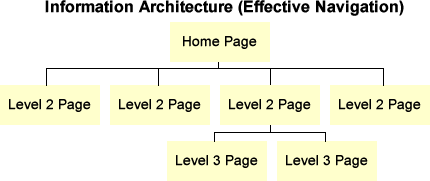
This is a conceptual notion called Information Architecture, and does not reflect
the actual folders of the website (called site architecture).
Evaluate the home page of this site: http://www.bentivoglio-olive-oil.com.au/.
What does the home page tell you about:
- the company
- the business they do
- why they do what they do
- what else?
- what do you notice first about the page?
- layout?
- are the key issues immediately apparent?
- is it attractive?
- is it appropriate for the product they make/sell?
Navigation
Designers speak of three generations of web pages.
The first generation
Early web pages were just text. Usually black text on grey backgrounds. In
many cases they were printed text placed on a web site.
The second generation
White backgrounds, icons, banners, tiled images.
The third generation
- Use of metaphor and theme.
- Clear typography.
- Navigation is inviting as well as clear.
- Objects are well positioned.
- Layout is tightly controlled.
- Colours in link or buttons should pick up the colours in the images.
- Images should be highly relevant.
- Visiting the web site should also be an experience in itself.
- A web site is not viewed linearly like a book.
- Visitors move about a site.
Go back to http://www.bentivoglio-olive-oil.com.au/
and browse through the whole site.
Answer the following questions:
- Does it use theme and metaphor to gets its message across?
- What do you think of the navigation?
- Is the typography clear?
- Are objects well positioned?
- Is the site interesting?
- What are the main messages of the site? Name five.
- Does it gets its message across?
- (Note: The navigation style here is called a web (or full web). You can
go from every page to every other page.)
The Four Stage Process of Design
Design may be seen as a four stage process.
- Define Content
- Develop Architecture
- Create Design
- Implement the Site
Define Content - Stage 1
- Target Audience: cultural make up, age.
- Internet skill level of site visitors.
- Purpose of the site: informational, promotional, educational.
- News groups and chat rooms?
- Transmit information or build community?
- Dynamic or static?
Task - A University Site
Make a list of the type of people that might want to visit the web site of
a university. (They might include: potential students, current students, businesses,
parents, researchers, staff, former students (alumni), overseas students etc).
Make a list of the type of things that people might look for on a university
website. (This might inlcude course information, contacts, student services,
general services, campus information, books, library, history of the university,
distance education, jobs, dates, online learning, summer courses, other languages,
local community / country etc).
Go to the web site of James Cook university: http://www.jcu.edu.au/.
(Note that the home page is made without tables in xhtml.
What information can you find for prospective students just one click from
the home page?
What can you find for current students that is one click from the home page?
Find the following information:
- Anything for alumni?
- Faculty information?
- Staff names and contact details?
- Community information?
- Is there information for emplyees?
- Overseas students?
- Distance education?
- Job opportunities?
- Global audience?
- Speakers of Languages other than English?
- Relationships to other univeristies?
- Where are the campuses?

