
DOPPLER
DIASTOLOGY MADE EASY
- A practical guide for the interpretation of Doppler studies of diastolic function
George Thomas
Department of Cardiology, Indira Gandhi Co-operative Hospital
Gandhi Nagar, Kochi 682 020, India. E-mail gthomas@doctor.com
(Adapted from an article published in Cardiology Today,
September-October 2002. Reference: Thomas G. Interpretation of Doppler studies of
diastolic function. Cardiology Today 2002; 6(5): 236-240)
See also Thomas G. A simplified study of transmitral Doppler patterns. Cardiovasc Ultrasound 2008; 6:59
Echocardiography
or ultrasound cardiography (UCG) has become an important diagnostic tool in
clinical cardiology. With the advent of Doppler studies, diastolic dysfunction
has assumed great importance.1,2 In spite of the large volume of
literature on the subject there is still a lot of confusion. How to interpret
the Doppler findings? What are the implications of Doppler studies of diastolic
function? How relevant is it in clinical cardiology? This article aims to bring
out the practical aspects of the phenomenon and bring a semblance of order into
this complex subject. It is a sequel to an earlier article on the topic
published in this journal.3
The Diastole
Classically, diastole has been sub-divided into four phases: isovolumic relaxation, a rapid-filling phase, a slow-filling phase and atrial systole. Isovolumic relaxation is the interval between aortic valve closure and mitral valve opening. Here the ventricular pressure rapidly declines without a significant change in volume. This process is energy-dependent and is very susceptible to cellular ischemia. Most ventricular filling occurs during the subsequent rapid-filling phase, which is also partially energy-dependent. This is the end of active relaxation. The rapid filling continues, but further increases in ventricular size are limited by passive elements affecting stiffness of the myocardium. This slow-filling phase is primarily dependent upon these properties, which are not constant but may increase in proportion to the ventricular volume. Passive stiffness will be increased by fibrosis resulting from recurrent ischemia, infarction, or an infiltrating process. Myocyte hypertrophy induced by poorly controlled hypertension or valvular disease may increase passive stiffness. The last phase of diastole is the atrial contraction. The atrial contribution to ventricular filling will be greater in patients with diminished early relaxation. The ventricular diastolic pressure - volume relationship may therefore be abnormal because of changes in active relaxation, passive compliance properties, or both. Note that diastole is a metabolically sensitive part of the cardiac cycle and almost all diseases of the heart are bound to affect it to variable extents.
Assessment of Diastolic Function
Diastolic function can be assessed by a number of invasive and
noninvasive modalities, including clinical examination, cardiac catheterization,
nuclear imaging, UCG, magnetic resonance imaging, computed tomography, and
nuclear imaging. However conventional flow Doppler is by far the most widely
used technique in assessing diastolic function. The present discussion focuses
on this modality only. The left ventricular diastolic properties are usually
studied. The Doppler assessment include measuring the isovolumic relaxation
time, peak E and A wave velocities, calculating the E-A ratio, measuring the
deceleration time (based on the downward slope of the E wave), velocity time
integral, diastolic filling time, flow propagation velocity, analysis of
pulmonary or hepatic veins Doppler and calculation of tau. Details of
assessment are given elsewhere.4
Terminologies
To understand
diastolic dysfunction better we need to define some terms so as to avoid
confusion. Abnormalities that occur during the diastolic part of the cardiac
cycle would be diastolic dysfunction. Thus, ‘diastolic dysfunction’ (DD)
will cover the universal set of all diastolic abnormalities in the heart. This
will include components like left ventricular DD, right ventricular DD, left
atrial DD, right atrial DD, mitral valve DD, tricuspid valve DD, aortic valve
DD, pulmonary valve DD, aortic root DD, pulmonary artery DD, pericardial DD and
rhythm related DD. Mitral stenosis would represent mitral valve diastolic
dysfunction and atrial fibrillation would represent atrial diastolic
dysfunction. The pericardium is closely related to the cardiac dynamics - hence
pericardial diastolic dysfunction. Similarly, ventricular filling is related to
heart rate and ectopic activity– hence rhythm related diastolic dysfunction.
Most commonly we address left ventricular diastolic dysfunction. In current
literature, diastolic dysfunction usually means left ventricular diastolic
dysfunction. But for clarity of discussions it is better to specify ‘LV
diastolic dysfunction’.
Doppler UCG is the
commonly used investigation to study diastolic function. Doppler interrogation
of orifices produce spectral patterns. In the context of ‘diastology’ these
could be of 2 types: 1 Diastolic patterns 2. Filling patterns. Doppler diastolic
patterns (DDP) refer to Doppler patterns obtained in diastole at the orifices.
These could be mitral DDP, tricuspid DDP, aortic valve DDP, pulmonary valve DDP,
pulmonary venous DDP and systemic venous DDP. Normally there are no aortic and
pulmonary valve DDP but these are evident when there is a diastolic dysfunction
of these valves.
The term ‘diastole’ also connotes ‘relaxation and compliance’. In the context of the cardiac cycle relaxation of the predominant chambers i.e. ventricles define diastole. However, for the atria, diastole is not associated with ‘relaxation’ and for the great vessels compliance is required in systole. So when we mean diastole as ‘relaxation and compliance’ we should use the term Doppler filling patterns (DFP). These are also Doppler patterns obtained at the orifices. But this will describe the ‘relaxation and compliance’ properties of a chamber without reference to systole or diastole. Use of the term DFP assumes that the inlet orifices are normal. Thus we could have left ventricular DFP, right ventricular DFP, left atrial DFP, right atrial DFP, aortic DFP, and pulmonary arterial DFP. In short, in the context of chamber properties use the term ‘Doppler filling patterns’. In case of strict study of diastole use the term ‘Doppler diastolic patterns’. The term DFP qualifies a chamber (like LV DFP). The term DDP qualifies an orifice and the movement of blood during diastole (like mitral DDP). In short, DDP is related to the temporal aspect of diastole while DFP relates to the physical aspect of relaxation.
In the case of mitral
valve Doppler studies both mitral DDP and LV DFP are similar. However in
pulmonary venous Doppler studies the pulmonary venous DDP is different from left
atrial DFP. ‘Abnormal atrial DFP’ would be relaxation/compliance
abnormalities of the atria and not atrial diastolic dysfunction. Thus DDP and
DFP are both essential terms in the diastology lexicon. For example, when we say
abnormal mitral DDP we could also mean mitral valve DD. However, when we say
abnormal LV DFP we only mean the ‘relaxation/compliance’ properties of the
LV. Usually the inlet Doppler
pattern is used to assess the diastolic properties of the downstream chamber(s).
For example, mitral DDP and pulmonary venous DDP are used to study LV diastolic
properties. It is important to stress here that these are Doppler patterns.
The usual aim of the Doppler examination is to detect LV diastolic dysfunction.
However, these patterns need not necessarily reflect the LV diastolic
properties (vide infra). The use of these terminologies would help in
extending our studies beyond LV diastolic function. It will also avoid
ambiguities in communication and encourage further research.
Clinical significance of LV
Doppler filling patterns
 |
Fig 1A: Algorithm for cardiac causes of abnormal LV DFP
To understand
the significance of LV DFP we need to consider 2 situations (fig 1A). 1. In
patients with impaired LV systolic function and 2. In patients with normal LV
systolic function. In cases with impaired systolic function, LV DFP has some
prognostic use. In such cases LV DFP shows a continuous pattern of changes
depending on the severity of LV impairment. By impaired systolic function we
would also include cases with resting or inducible regional wall motion
abnormalities with apparently normal ejection fraction and apparently normal
overall LV contractility. Stage 1 or ‘impaired relaxation’ pattern is
demonstrated by a smaller E wave, a larger A wave, and increased deceleration
time. In stage 2, there is a ‘pseudonormalization’ pattern denoted by an
apparently normal E and A wave and deceleration time. However there is atrial
reversal in the pulmonary veins during atrial systole. Finally, the stage 3 or
‘restrictive filling’ pattern is denoted by a very prominent E wave with a
short deceleration time and a miniscule A wave. Stage 3 is associated with the
worst prognosis.5 In cases of systolic dysfunction, the LV DFP is a
continuous variable reflecting the increasing left atrial pressures and LV end
diastolic pressures which proceeds to atrial failure in stage 3. As a corollary,
in cases with wall motion abnormalities and apparently normal ejection fraction,
a stage 1 pattern could indicate an early systolic dysfunction.
In
cases with normal systolic function LV DFP could have diagnostic roles. The
‘impaired relaxation’ pattern could point to hypertension, coronary artery
disease or hypertrophic cardiomyopathy. The ‘restrictive filling’ pattern
could mean restrictive cardiomyopathy or pericardial disease. In such cases
involvement of the atria by the disease process is expected and this could also
contribute to the abnormal DFP.
Pitfalls in Doppler
Assessment
Evaluation of
LV diastolic properties by analyzing the DFP is complicated. Technical factors
play an important role in the acquisition and interpretation of the Doppler
signals.6,7 Doppler is a sensitive tool. Several factors like load
and heart rate affect Doppler parameters.8 Even in load and heart
rate independent methods there is a broad overlap in diastolic filling
parameters for normal and abnormal subjects. DFPs vary with Valsalva’s
maneuver, respiration, changes in position and blood rheology. There is also an
inability to apply most methods in atrial fibrillation and other rhythm and
conduction disturbances.9 The problem with evaluation of LV diastolic
properties is that there are no reliable indices like the LV size or ejection
fraction that are available for systolic function. No one single measurement can
fully characterize left ventricular diastolic function, and no measurement is
free of complicating factors.
Apart from the
difficulties in assessment, a wide range of pathological states cause LV
diastolic dysfunction (Fig 1). Diastole is a metabolically sensitive part of the
cardiac cycle. In fact it would not be an exaggeration to say that all
cardiac pathologies cause LV diastolic dysfunction to variable extents.
Even ageing causes an appreciable amount of diastolic dysfunction.10
Besides various extra cardiac factors like obesity, renal failure, sleep apnea,
cor pulmonale, and metabolic disorders also cause diastolic dysfunction.11,12,13
Coexisting cardiac conditions like valvular lesions, drug treatments and
arrhthymias complicate the issue even further. In all the above papers the
authors have studied DFP and assumed the existence of diastolic
dysfunction because of abnormal DFP. They have used abnormal DFP and diastolic
dysfunction synonymously.
With the present
knowledge base, mitral DDP has no major diagnostic role. That is because
it has no discriminatory value. Abnormal patterns could be used as confirmatory
evidence for hypertension, ischaemic heart disease, hypertrophic cardiomyopathy,
restrictive cardiomyopathies and pericardial disease. As mentioned earlier, in
cases with wall motion abnormalities stage 1 could indicate an early
systolic dysfunction. As far as treatment is concerned, there is no specific
treatment for LV diastolic dysfunction. Goals should be to prevent left
ventricular hypertrophy, treat elevated blood pressure, and preserve left
ventricular filling. These are
achieved by effective treatment for the specific conditions. Future research
should help us better understand diastole with the hope that a positive
lusitropic agent (that enhances relaxation) can be found. In routine day-to-day
practice, hypertension and ischaemic heart disease should be adequately treated.
Diastolic
heart failure or “backward pressure” heart failure is an important aspect of
DD. Heart failure is "...a clinical syndrome or condition characterized by
(a) signs and symptoms of intravascular and interstitial volume overload,
including shortness of breath, rales, and edema, or (b) manifestations of
inadequate tissue perfusion, such as fatigue or poor exercise tolerance which
develops as a result of the inability of the heart to meet the metabolic
requirements of the tissues at rest or exercise." This is mainly a clinical
diagnosis. Without these symptoms one cannot diagnose heart failure. In the case
of diastolic heart failure, it is not the DFP that is important. It is the
exclusion of systolic dysfunction. In other words, symptoms and signs of cardiac
failure coupled with a normal cardiac size and ejection fraction would point
towards a diastolic cardiac failure. Here we may add the role of brain
natruretic peptide (BNP) as a diagnostic marker for cardiac failure 14
and more specifically plasma adrenomedullin for diastolic failure.15
In the case of heart failure, the detection of diastolic failure or rather the
exclusion of systolic dysfunction has great therapeutic importance. In such
cases the use of digoxin and other inotropes would be detrimental. Similarly,
over diuresis should be avoided. However the use of digoxin in rate control
would be acceptable in the case of diastolic failure.
So what is the role of assessment of LV diastolic function by DFPs? As compared to systolic dysfunction, there needs to be more objectivity in the interpretation of Doppler parameters. Systolic dysfunction has great correlation with the UCG parameters. All cases of systolic dysfunction usually have variable degrees of systolic heart failure. In the case of “diastology” all cases of abnormal DFP need not be LV diastolic dysfunction and all cases of LV diastolic dysfunction need not show heart failure. Similarly all cases of ‘heart failure’ with preserved systolic function need not be diastolic failure. An alternative explanation for the symptoms - for example, obesity, lung disease, deconditioning etc should be considered and the diagnosis of diastolic heart failure is rarely needed. These alternative diagnoses should be rigorously sought and managed accordingly.16 Another paper conclusively shows the uselessness of the E/A ratio in the diagnosis of diastolic failure. The conclusion is “Either left ventricular diastolic filling abnormalities are very much less common than previously supposed or the E/A ratio is almost useless for their detection”.17 Subtle systolic dysfunction could be responsible for the cardiac failure in some cases of “diastolic heart failure”.18 The author is of the view that in the case of coronary artery disease transient systolic dysfunction like that induced in stress testing (seen well in stress echocardiography), rather than diastolic heart failure, could be the cause of dyspnoea in some cases.
Diastole is a sensitive part of the cardiac cycle. It is but natural that any cardiac disease can cause LV diastolic dysfunction to variable extents. Abnormal DFP is not a sine qua non to diagnose LV diastolic dysfunction. Abnormal DFP is only the tip of the diastolic dysfunction iceberg. So being a ubiquitous entity, absence of abnormal DFP need not mean absence of diastolic dysfunction. LV diastolic dysfunction can occur in very mild forms and regional forms, which may not be evident on Doppler assessment.
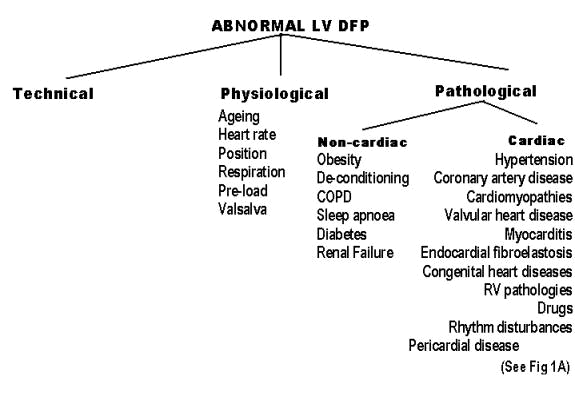 |
Fig 1B: Diagnostic algorithm for an abnormal LV DFP (list not exhaustive)
When confronted with an abnormal DFP the following questions need to be answered (fig 1B). If it is technically proper, is it physiological or pathological? If pathological, what is the LV function? If the LV systolic function is good then it has some diagnostic role: In that case is the DFP a relaxation abnormality? (hypertension or ischaemia) or an abnormality of compliance? (restrictive cardiomyopathy or pericardial disease). If the systolic function is not satisfactory, then one can prognosticate using the LV DFP as mentioned above. When reporting a Doppler finding it is better to say “abnormal LV DFP probably due to… ” or “abnormal mitral valve DDP probably due to…” rather than “diastolic dysfunction”.
As of today, Doppler assessment of diastolic function borders on mere academic hairsplitting fit for conference sessions. It has very little clinical relevance. That is because DFP is very sensitive to various cardiac and non-cardiac disorders. This is compounded by the fact that Doppler is sensitive to mundane hemodynamic and physiological changes. Doppler studies are too sensitive resulting in too many false positive results.
We do not need an abnormal DFP to diagnose LV diastolic dysfunction. The very presence of a cardiac pathology can point to the existence of diastolic dysfunction. This may not be evident on Doppler. LV DFP is the cardiological equivalent of the erythrocyte sedimentation rate (ESR). It has only a minor diagnostic role. The detection of abnormal LV DFP (relaxation abnormality) should make the clinician search aggressively for causes like hypertension, ischaemic heart disease, cardiomyopathy or pericardial disease in the young (below 50 years of age). That is assuming these were missed in the clinical examination and electrocardiogram! This is also assuming that there were no conflicting cardiac, extracardiac and hemodynamic factors that affect the DFP. Again, the absence of abnormal DFP need not imply absence of serious cardiac disease.
In the case of impaired systolic function DFP could be used as a prognostic indicator.19,20 The distinction between reversible and irreversible DFP21 may have some therapeutic implications. There are no major trials on diastolic dysfunction. The ongoing randomized multi-centric trials (like the PEP-CHF trial) could provide some answers.22 Here again studying a mercurial variable like DFP would have many pitfalls.
Table 1:
Practice points
|
It is time we took the Doppler assessment of diastolic function in the
right perspective (see table 1). Diastole is an important part of the cardiac
cycle. Diastolic dysfunction is real and ubiquitous. Doppler patterns are easy
to acquire and are intriguing. However the interpretation is difficult. This
makes assessment of diastolic function by Doppler an onerous task. Abnormal
LV DFP could be a pointer to common cardiac disorders in the young. Diastolic
heart failure is clinically relevant. But it is a diagnosis of exclusion. A
normal systolic function has to be demonstrated. It is time to demystify
abnormal Doppler diastolic patterns and look at them on more realistic terms.
References
1. Nishimura R, Tajik A. Evaluation of diastolic filling of left ventricle in health and disease: Doppler echocardiography is the clinician's Rosetta Stone. J Am Coll Cardiol 1997;30(1):8-18.
2. Oki T. State of the art: "diastology" research 1998. J Med Invest 1998;45(1-4):9-25.
3. Thomas G. Just what do you mean by diastolic dysfunction? – Echo doppler considerations. Cardiology Today 2001; V-5:302-305
4. European study group on diastolic heart failure. How to diagnose diastolic heart failure? Eur Heart J. 1998;19:990-1003.
5. Henry C. M. Yu, John E. Sanderson. Different Prognostic Significance of Right and Left Ventricular Diastolic Dysfunction in Heart Failure. Clin. Cardiol. 1999; 22:504–512.
6. Kuecherer RF, Kee LL, Modin G, et al. Echocardiography in serial evaluation of left ventricular systolic and diastolic function: importance of image acquisition, quantitation, and physiologic variability in clinical and investigational applications. J Am Soc Echocardiogr 1991;4:203-214.
7. Jaffe WM, Dewhurst TA, Otto CM, et al. Influence of Doppler sample volume location on ventricular filling velocities. Am J Cardiol 1991;68:550-552.
8. Mohan JC, Aggarwal R, Arora R, et al. Effect of preload and heart rate manipulation on Doppler transmitral flow velocity pattern: search for load--independent parameters. Indian Heart J 1991; 43(2):105-108.
9. ACC/AHA Guidelines for the Clinical Application of Echocardiography. Cardiomyopathy and Assessment of Left Ventricular Function: Echocardiographic Parameters. Circulation 1997;95(6):1686-1744.
10. Mantero A, Gentile F, Gualtierotti C, et al. Left ventricular diastolic parameters in 288 normal subjects from 20 to 80 years old. Eur Heart J 1995;16(1):94-105.
11. Tardif
JC, Rouleau JL. Diastolic dysfunction. Can J Cardiol
1996;12(4):389-398.
12. Solin P, Naughton MT. Left ventricular diastolic dysfunction in non-hypercapnic central sleep apnoea. Chest 1997;(Abstract 029).
13. Tutar E, Kaya A, Gulec S, et al. Echocardiographic evaluation of left ventricular diastolic function in chronic cor pulmonale. Am J Cardiol 1999;83(9):1414-1417.
14. Maisel A. B-type natriuretic peptide levels: A potential novel "white count" for congestive heart failure. J Card Fail 2001;7(2):183-193.
15. Yu CM, Cheung BM, Leung R, et al. Increase in plasma adrenomedullin in patients with heart failure characterised by diastolic dysfunction. Heart 2001;86(2):155-160.
16. Davie AP, Francis CM, Caruana L, et al. The prevalence of left ventricular diastolic filling abnormalities in patients with suspected heart failure. Eur Heart J 1997;18(6):981-984.
17. Caruana L, Petrie MC, Davie AP, et al. Do patients with suspected heart failure and preserved left ventricular systolic function suffer from "diastolic heart failure" or from misdiagnosis? A prospective descriptive study. BMJ 2000;321(7255): 215-218.
18. Petrie MC, Caruana L, Berry C, et al. "Diastolic heart failure" or heart failure caused by subtle left ventricular systolic dysfunction? Heart 2002;87(1):29-31.
19. Cerisano G, Bolognese L. Echo-Doppler evaluation of left ventricular diastolic dysfunction during acute myocardial infarction: methodological, clinical and prognostic implications. Ital Heart J 2001;2:13-20.
21. Sohn DW, Kim YJ, Lee MM, et al. Differentiation between reversible and irreversible restrictive left ventricular filling patterns with the use of mitral annulus velocity. J Am Soc Echocardiogr 2000;13(10):891-895.
22. Cleland
JG, Tendera M, Adamus J, et al. Perindopril for elderly people
with chronic heart failure: the PEP-CHF study. The PEP investigators: Eur J
Heart Fail 1999;1(3):211-217.
