
Spark Plug Fault Diagnosis |
This section identifies some common faults associated with spark plug wear, incorrect applications and general problems with engine running conditions. The condition of the firing end of a spark plug is a good indicator of the general health of an engine. |
| Appearance | Possible cause/resolution | |
 |
Normal Light brown, tan or grey firing end. |
A good indicator that the plug is functioning correctly and general engine conditions are good. |
 |
Dry and wet fouling |
Can be caused by many different conditions. Carbon deposits build up when the plug fails to fire correctly and burn them off. Air/fuel mixture too rich, choke stuck on, electrical problem, extended periods of low speed driving, plug heat range too cold. All should be investigated |
 |
Overheating When overheating occurs, deposits which have accumulated on the insulator tip may melt and give the tip a glazed appearance |
Possible causes are overadvanced ignition timing, air/fuel mixture too lean, water or oil level too low, plugs not fitted (tightened) correctly, plug heat range too hot. |
 |
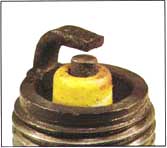
Deposits Insualtor nose and electrodes encrusted with a build of deposits - usually off white in colour. |
This is often caused by oil leakage through the piston rings or valve seals. Could be due to the wrong viscosity of oil being used. |
 |
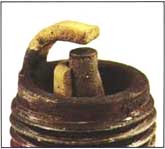
Lead fouling Lead deposits on the insulator nose. These are usually a yellowish brown in colour. |
Lead content of petrol used is too high. Try petrol with a lower lead content. |
 |
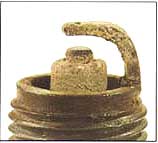
Breakage |
Usually caused by abnormal thermal expansion in the combustion chamber. Maybe thermal heating or cooling shock. Causes as for overheating above. |
 |
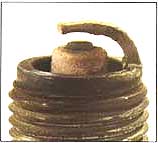
Normal life Growth of the plug gap during a plug's working life is normal. However, the increased gap will mean the spark is less efficient and hence fuel is wasted and strain is put on the ignition system. |
Plugs are at the end of servicable life. Replace plugs as a set. |
 |
Abnormal erosion |
due to the effects of corrosion, oxidation and reaction with the lead in petrol. |
 |
Melting |
Due to excessively high temperatures in the combustion chamber. Causes as for overheating above. |
 |
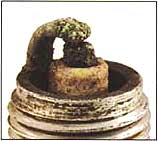
Erosion, Corrosion, Oxidisation The surfaces of the electrodes are rough, in extreme circumstances the electrode material will have oxidised to the point of turning green |
Possibly due to age, vehicle standing for a long time without use. |
 |
Lead Erosion The ground electrode will appear worn away, the central electrode will appear chipped and the insulator nose will take on a yellowish brown. |
This is due to chemical reaction between the nickel alloy electrodes and the lead compounds in petrol. |
