(continued) William D. Edwards, MD; Wesley J. Gabel, MDiv; Floyd E Hosmer, MS, AMI
Crucifixion Practices Crucifixion probably first began among the Persians. (34) Alexander the Great introduced the practice to Egypt and Carthage, and the Romans appear to have learned of it from the Carthaginans. (11) Although the Romans did not invent crucifixion, they perfected it as a form of torture and capital punishment that was designed to produce a slow death with maximum pain and suffering. (10,17) It was one of the most disgraceful and cruel methods of execution and usually was reserved only for slaves, foreigners, revolutionaries, and the vilest of criminals. (3,25,28) Roman law usually protected Roman citizens from crucifixion, (5) except perhaps in the case of desertion by soldiers. In its earliest form in Persia, the victim was either tied to a tree or was tied to or impaled on an upright post, usually to keep the guilty victim's feet from touching holy ground. (3,11,30,34,38). Only later was a true cross used; it was characterized by an upright post (stipes) and a horizontal crossbar (patibulum), and it had several variations (11). Although archaeological and historical evidence strongly indicates that the low Tau cross was preferred by the Romans in Palestine at the time of Christ, (2,7,11) crucifixion practices often varied in a given geographic region and in accordance with the imagination of the executioners, and the Latin cross and other forms also may have been used. (26)
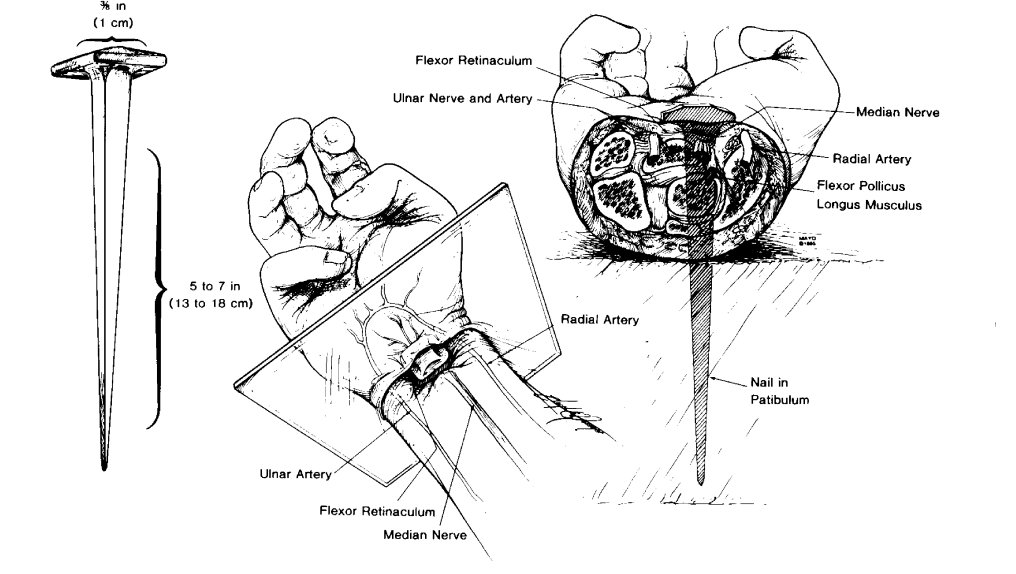
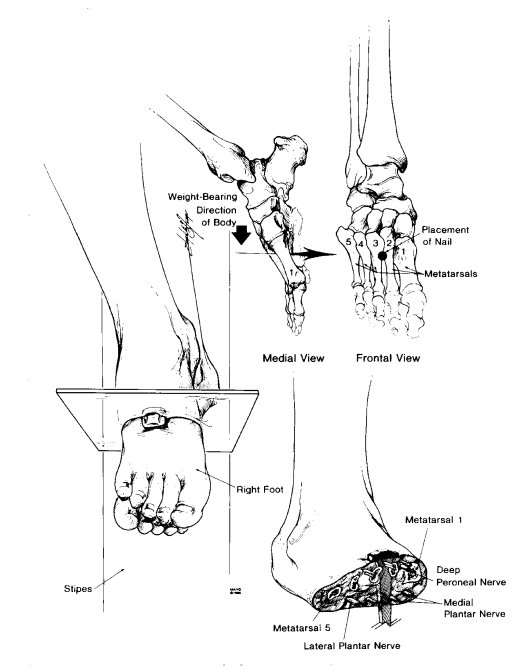
Outside the city walls was permanently located the heavy upright wooden stipes, on which the patibulum would be secured. In the case of the Tau cross, this was accomplished by means of a mortise and tenon joint, with or without reinforcement by ropes. (10,11,30) To prolong the crucifixion process, a horizontal wooden block or plank, serving as a crude seat (sedile or sedulum), often was attached midway down the stipes. (3,11,16) Only very rarely, and probably later than the time of Christ, was an additional block (suppedaneum) employed for transfixion of the feet. (9,11) At the site of execution, by law, the victim was given a bitter drink of wine mixed with myrrh (gall) as a mild analgesic. (7,17) The criminal was then thrown to the ground on his back, with his arms outstretched along the patibulum. (11) the hands could be nailed or tied to the crossbar, but nailing apparently was preferred by the Romans. (8,11) The archaeological remains of a crucified body, found in an ossuary near Jerusalem and dating from the time of Christ, indicate that the nails were tapered iron spikes approximately 5 to 7 in (13 to 18 cm) long with a square shaft 3/8 in (1 cm) across. (23,24,30) Furthermore, ossuary findings and the Shroud of Turin have documented that the nails commonly were driven through the wrists rather than the palms. (22-24,30) After both arms were fixed to the crossbar, the patibulum and the victim, together, were lifted onto the stipes. (11) On the low cross, four soldiers could accomplish this relatively easily. However, on the tall cross, the soldiers used either wooden forks or ladders. (11) Next, the feet were fixed to the cross, either by nails or ropes. Ossuary findings and the Shroud of Turin suggest that nailing was the preferred Roman practice. (23,24,30) Although the feet could be fixed to the sides of the stipes or to a wooden footrest (suppedaneum), they usually were nailed directly to the front of the stipes. (11) To accomplish this, flexion of the knees may have been quite prominent, and the bent legs may have been rotated laterally (23-25,30) When the nailing was completed, the titulus was attached to the cross, by nails or cords, just above the victim's head. (11) The soldiers and the civilian crowd often taunted and jeered the condemned man, and the soldiers customarily divided up his clothes among themselves. (11,25) The length of survival generally ranged from three or four hours to three or four days and appears to have been inversely related to the severity of the scourging. (3,11) However, even if the scourging had been relatively mild, the Roman soldiers could hasten death by breaking the legs below the knees (crurifragium or skelokopia). (3,11) Not uncommonly, insects would light upon or burrow into the open wounds or the eyes, ears, and nose of the dying and helpless victim, and birds of prey would tear at these sites. (16) Moreover, it was customary to leave the corpse on the cross to be devoured by predatory animals. (3,11,12,28) However, by Roman law, the family of the condemned could take the body for burial, after obtaining permission from the Roman judge. (11) Since no one was intended to survive crucifixion, the body was not released to the family until the soldiers were sure that the victim was dead. By custom, one of the Roman guards would pierce the body with a sword or lance. (3,11) Traditionally, this had been considered a spear wound to the heart through the right side of the chest -- a fatal wound probably taught to most Roman soldiers. (11) The Shroud of Turin documents this form of injury. (5,11,22) Moreover, the standard infantry spear, which was 5 to 6 ft (1.5 to 1.8 m) long (30) could easily have reached the chest of a man crucified on the customary low cross. (11) Medical Aspects of Crucifixion With a knowledge of both anatomy and ancient crucifixion practices, one may reconstruct the probably medical aspects of this form of slow execution. Each wound apparently was intended to produce intense agony, and the contributing causes of death were numerous. The scourging prior to crucifixion served to weaken the condemned man and, if blood loss was considerable, to produce orthostatic hypotension and even hypovolemic shock. (8, 12) When the victim was thrown to the ground on his back, in preparation for transfixion of his hands, his scourging wounds most likely would become torn open again and contaminated with dirt. (2,14) Furthermore, with each respiration, the painful scourging wounds would be scraped against the rough wood of the stipes. (7) As a result, blood loss from the back probably would continue throughout the crucifixion ordeal.
The major pathophysiologic effect of crucifixion, beyond the excruciating pain, was a marked interference with normal respiration, particularly exhalation. The weight of the body, pulling down on the outstretched arms and shoulders, would tend to fix the intercostal muscles in an inhalation state and thereby hinder passive exhalation. (2,10,11) Accordingly, exhalation was primarily diaphragmatic, and breathing was shallow. It is likely that this form of respiration would not suffice and that hypercarbia would soon result. The onset of muscle cramps or tetanic contractions, due to fatigue and hypercarbia, would hinder respiration even further. (11) Adequate exhalation required lifting the body by pushing up on the feet and by flexing the elbows and adducting the shoulders. (2) However, this maneuver would place the entire weight of the body on the tarsals and would produce searing pain. (7) Furthermore, flexion of the elbows would cause rotation of the wrists about the iron nails and cause fiery pain along the damaged median nerves. (7) Lifting of the body would also painfully scrape the scourged back against the rough wooden stipes. (2,7) Muscle cramps and paresthesias of the outstretched and uplifted arms would add to the discomfort. (7) As a result, each respiratory effort would become agonizing and tiring and lead eventually to asphyxia. (2,3,7,10) The actual cause of death by crucifixion was multifactorial and varied somewhat with each case, but the two most prominent causes probably were hypovolemic shock and exhaustion asphyxia. (2,3,7,10) Other possible contributing factors included dehydration, (7,16) stress-induced arrhythmias, (3) and congestive heart failure with the rapid accumulation of pericardial and perhaps pleural effusions. (2,7,11) Crucifracture (breaking the legs below the knees), if performed, led to an asphyxic death within minutes. (11) Death by crucifixion was, in every sense of the word, excruciating (Latin, excruciatus, or "out of the cross"). Crucifixion of Jesus After the scourging and the mocking, at about 9 AM, the Roman soldiers put Jesus' clothes back on him and then led him and two thieves to be crucified. (1) Jesus apparently was so weakened by the severe flogging that he could not carry the patibulum from the Praetorium to the site of the crucifixion one third of a mile (600 to 650 m) away (1,3,5,7) Simon of Cyrene was summoned to carry Christ's cross, and the processional then made its way to Golgotha (or Calvary), an established crucifixion site. Here, Jesus' clothes, except for a linen loincloth, again were removed, thereby probably reopening the scourging wounds. He then was offered a drink of wine mixed with myrrh (gall) but, after tasting it, refused the drink. (1) Finally, Jesus and the two thieves were crucified. Although scriptural references are made to nails in the hands (1), these are not at odds with the archaeological evidence of wrist wounds, since the ancients customarily considered the wrist to be a part of the hand. (7,11) The titulus was attached above Jesus' head. It is unclear whether Jesus was crucified on the Tau cross or the Latin cross; archaeological findings favor the former (11) and early tradition the latter. (38) The fact that Jesus later was offered a drink of wine vinegar from a sponge placed on the stalk of the hyssop plant (1) (approximately 20 in, or 50 cm long) strongly supports the belief that Jesus was crucified on the short cross. The soldiers and the civilian crowd taunted Jesus throughout the crucifixion ordeal, and the soldiers cast lots for his clothing. (1) Christ spoke seven times from the cross. (1) Since speech occurs during exhalation, these short, terse utterances must have been particularly difficult and painful. At about 3 PM that Friday, Jesus cried out in a loud voice, bowed his head, and died. (1) The Roman soldiers and onlookers recognized his moment of death. (1) Since the Jews did not want the bodies to remain on the crosses after sunset, the beginning of the Sabbath, they asked Pontius Pilate to order crucifracture to hasten the deaths of the three crucified men. (1) The soldiers broke the legs of the two thieves, but when they came to Jesus and saw that he was already dead, they did not break his legs. (1) Rather, one of the soldiers pierced his side, probably with an infantry spear, and produced a sudden flow of blood and water. (1) Later that day, Jesus' body was taken down from the cross and placed in a tomb. (1) |