|
Leftist-Democrats Movement: A
Network Structure
Proposal written by Abbas (Kozo) Hashem
ABSTRACT
The following proposal is based on two main necessities: To have a
democratic system and to preserve the relative independence of each
constituent group. The former requires a simple system because the more
complex a system is the less democratic it is. It also requires majorities
and minorities to be represented. Last but not the least, it demands basic
accountability procedures. The relative independence is important if we want
our movement not to become static: It is the amount of freedom you give to
the groups that determines the movement ability to create new ideas.
MEMBERS
• When a member wants to join the movement, he/she must either join one of
the existing working groups, or form a new one.
• A member can vote on all issues within his/her working group, run for
elections to any position in the movement and vote in the national committee
elections.
• A member can put any item on the agenda of the national committee provided
that his/her proposal gathers at least ten signatures.
WORKING GROUPS
• They form the building blocks of the movement.
• A working group is defined as a group of members working in the same
environment: a university, a syndicate, a cine-club etc…
• Working groups have their own committees. They decide their own internal
structure.
• Each working group decides on alliances, activities, and everything that
is specific to its working environment as long as those activities are not
in a large contradiction with the movement as a whole: For example, the AUB
working group decides its alliances but might not be allowed to ally itself
to the Amal movement.
NETWORKS
• Networks are the basis for taking decisions when several but not all
working groups are concerned.
• If a group intends to raise a Lebanese student’s issue, it forms a network
with the other student working groups.
• Because in each national assembly, the number of members of each group is
counted and recorded, it is easy to make a percentage representation of each
group in the temporary network.
• Physically, the network could be a temporary coordination committee that
transfers each group decision and concludes by simple majority.
• Network constituents must represent all the actual concerned working
groups.
NATIONAL ASSEMBLY
• Every year, all members of the movement must meet in a national assembly.
• Attending the assembly is obligatory since it provides the only way to
define who the members are, what are the working groups and their
environments, and how many members are in each group.
• Failing to attend the assembly will freeze a person’s membership in the
movement until the next assembly without freezing his/her membership in the
working group: An illustrating example. If a member does not attend the
national assembly, he/she will still vote within the working group, but will
not be counted in the official number of members; which means that a working
group of actually 10 members will be represented by 9 votes in the networks.
• A member votes regardless of the opinion of his/her working group.
• The assembly will elect a national committee and an executive responsible.
• The National Committee will be elected by percentage instead of simple
majority: Lists will be formed and the elected committee will represent the
percentage of votes of each list.
• The executive responsible will be elected by simple majority.
NATIONAL COMMITTEE
• Decides on everything that is beyond the networks: Anything that concerns
all the movements and is not bound to one or several environments will be
decided by the National Committee and requires simple majority.
• Amendments to the bylaws will be votes upon in the National Committee and
require 2/3 of the votes.
• Can demand the re-election of the executive responsible at any time by
simple majority.
• Gives or refuses the vote of confidence to the executive committee by
simple majority.
• Can refute the decision of a network if and only if it can prove that
there are working groups that are concerned by the issue and where not
represented in the network.
EXECUTIVE RESPONSIBLE
• Forms the executive committee and assigns positions and tasks.
• Is accountable at any time by the national assembly.
• Is the official speaker of the movement.
EXECUTIVE COMMITTEE
• Its main task is to execute the general plan set by the national
committee.
• Can ask working groups to form certain networks on special issues.
• Negotiates with other parties and movements
• Forms temporary committees to follow up on all pending issues.
AN ILLUSTRATING EXAMPLE
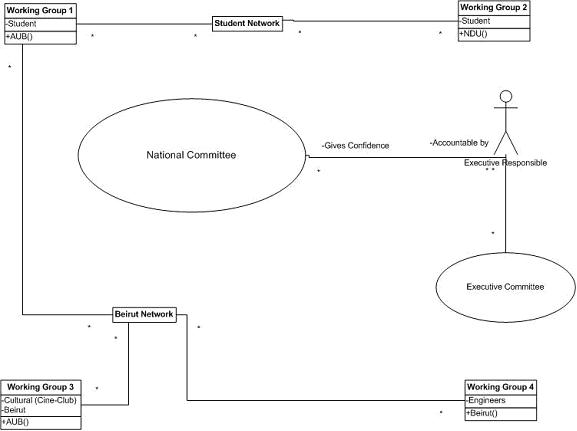
Here is an example of a movement following the described structure: Two
networks were temporarily formed in this example. The student network was
formed because they intend to form a national student council for all
universities. On the other hand, a Beirut network was formed because the
constituent groups are working on the issue of pollution in Beirut. The
working groups are represented with their name, their type of work and their
area of work. An environment can be a type of work, an area of work, or
both.
 |


