Termite Control
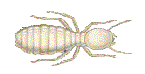 Termite Termite
Termites are social insects. Their workers are best described as "little white things" or "little white ants" that are often found in damp, rotting wood. Termites have a strict caste system, which consists of worker termites, soldiers, winged reproductive termites, a queen termite, and a king termite.
Termite images, termite description
Workers represent the majority of the colony population and are responsible for caring for eggs, constructing and maintaining tunnels, foraging for food and feeding and grooming of other caste members. They are white and soft bodied.
Soldiers are responsible for defending the colony. They are white, soft bodied with an enlarged, hardened head containing two large jaws, or mandibles, which are used as a weapon against predators.
Winged reproductives produce the offspring in the colony and swarm at certain times of the year. Colonies can have both primary reproductives (one king and one queen), and hundreds of secondary reproductives to assist in egg laying and colony growth. See Flying Ants article for more.
The King termite assists the queen in creating and attending to the colony during its initial formation. He will continue to mate throughout his life to help increase the colony size.
The Queen termite creates the colony by laying eggs and tending to the colony until enough workers and nymphs are produced to care for the colony. She can live for more than ten years and produce hundreds of eggs each year. Colonies can each several million termites with the help of secondary queens who also produce eggs.
Termites have the ability to change from one caste type to another during their immature stages. This allows the colony to change the proportion of different caste members as the need arises.
The two most common types of termites are "drywood" and "ground" termites. Both types of termites eat cellulose for nutrition. Cellulose is found in wood and wood products. Both types of termites have the "flying termite" or "winged reproductive". These winged termites are new kings and queens attempting to establish a new colony. They may also be referred to as "swarmers". Ant colonies also send swarmers, which have nearly the same appearance as termites, but may be identified upon closer inspection. Below you will see the obvious differences between ant and termite swarmers.
Identification
Of the two types of termites, ground and drywood, ground termites typically do much more damage to structures over a shorter period of time.
At the surface ground termites create mud tubes from the soil to wooden portions of a structure. These tubes provide a protective "highway" for termites to attack your home.
Other less obvious access points include:
through construction joints
through retaining wall joints and cracks
through floor cracks over 1/16th"
through plumbing, electrical, or other slab penetrations
GROUND TERMITES require three things to survive:
food (wood or other cellulose material)
a consistent source of moisture
moderate to tropical environment
GROUND TERMITES can consume over 15 pounds of wood in a single week.
GROUND TERMITES can create secondary nests above the ground called "aerial colonies". These independent nests may survive independently of the ground if a water source is available. Common interior water sources include; roof leaks, plumbing leaks, leaky showers or tubs, toilet leaks, etc... Aerial infestations must be located for effective control.
GROUND TERMITES die rather quickly from dehydration when exposed to the environment due to their thin exo-skeleton. To maintain the needed humidity and protect them from predators they build protective mud tubes and remain unseen most of the time.
GROUND TERMITES produce a chemical odor called a pheromone, which other termites, in the colony follow to find food and water.
|