Carcharodon carcharias
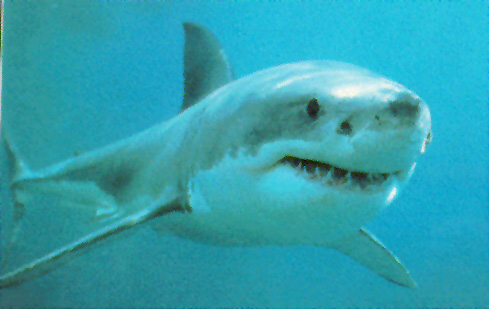 Facts:
Family: Lamnidae
Genus: Carcharodon
Species: carcharias
Common Name: Great White
The Great White shark, my favorite shark and animal, is found almost worldwide. Though, it is found in predominately temperate climates, whites have been spotted in equitorial and high latitudinal waters. In these environments their favorite prey thrives - seals and sea lions.
To catch a potential prey item, the white would circle it from below, undetected. It would then disappear into the depths. When the timing was right, the white would swim from the depths, its jaws open, with an enormous burst of speed. Most likely, the prey item would be decapitated in the initial blow. The shark would then disappear once again and then return ten minutes later to finish its meal.
White shark attacks on humans are relatively rare. Most attacks are on surfers who are laying on their boards paddling. To the Great White, this looks exactly like a seal or sea lion. Even if the shark attacks a human, it will most likely let go, because we taste differently than a prey item. Sure, there are people who will argue this case, but it's the truth. Great Whites are not bloodthirsty human eaters. It's mainly mistaken identity.
The white has been recorded in lengths in excess of 20 ft. The largest being 23 feet and nearly three tons. Sightings of whites of about thirty feet have been made, but no evidence has been found to prove this. I'm not saying that they aren't out there. In fact its thought-to-be extinct cousin, megalodon, fits these instances almost perfectly.
Whites are often elusive to humans. Scientific studies on boats have waited days on end to spot a great white with no luck. Most encounters with these creatures are rare. When an encounter does occur it's into the cages the scientists (or divers) go. Encounters are often very short, adding to the reasons why whites are hardly understood.

Back

