Mick's Astro Page
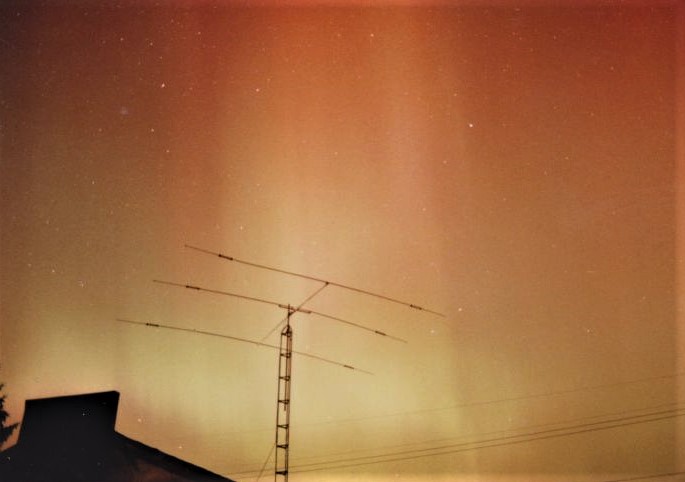
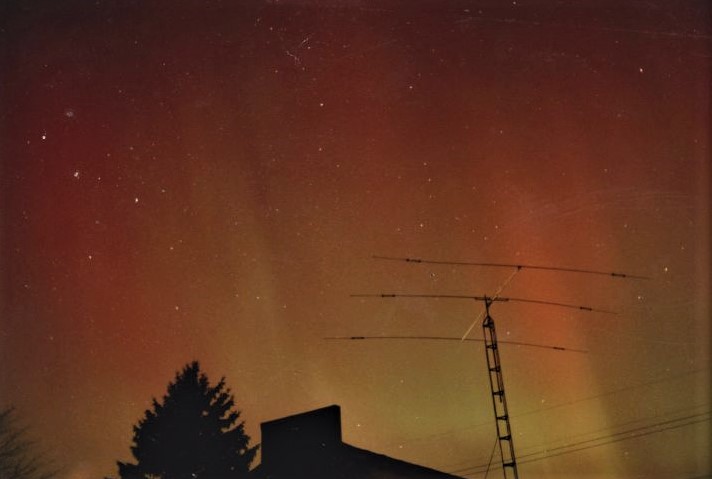
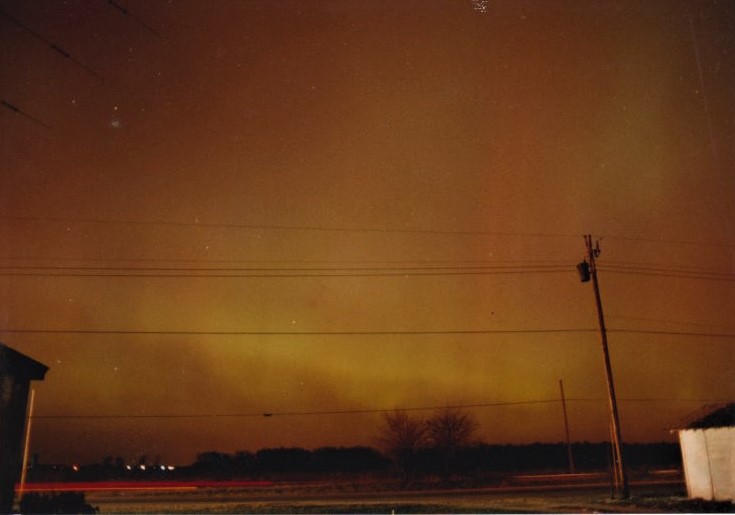
Nice Aurora Borealis "Northern Lights" Nov 1991.
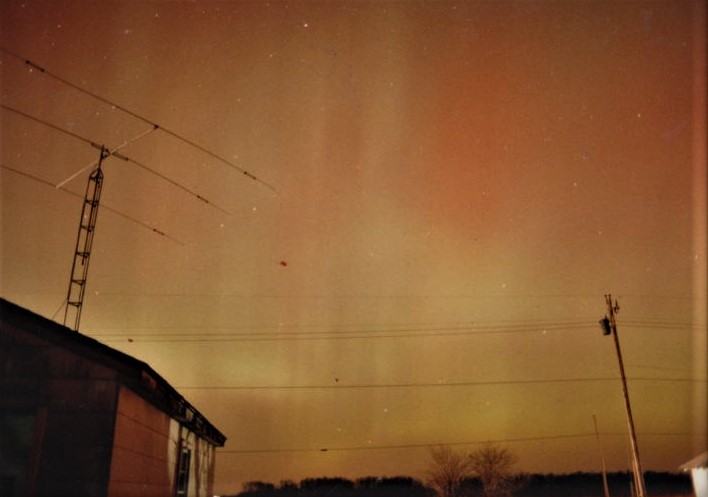
Brightened for detail.
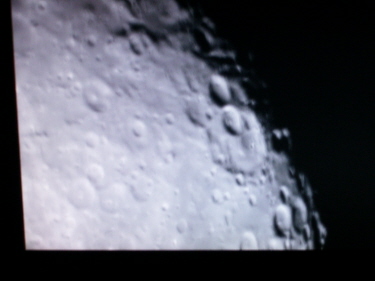
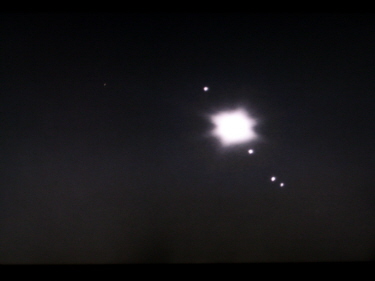
Cats eyes crater reflections going into lunar sunset...Jupiters moons.
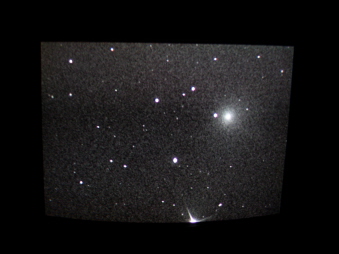
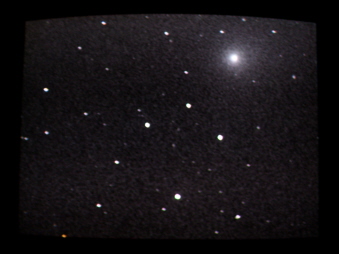
Comet Garrard 1 hour apart. Check out the kite shape of stars to its left for comparison.

Mars overwhelms the distant galaxy nearly lost in the glare.
A visible supernova from the backyard, a bit rare. 9/15/11 10pm
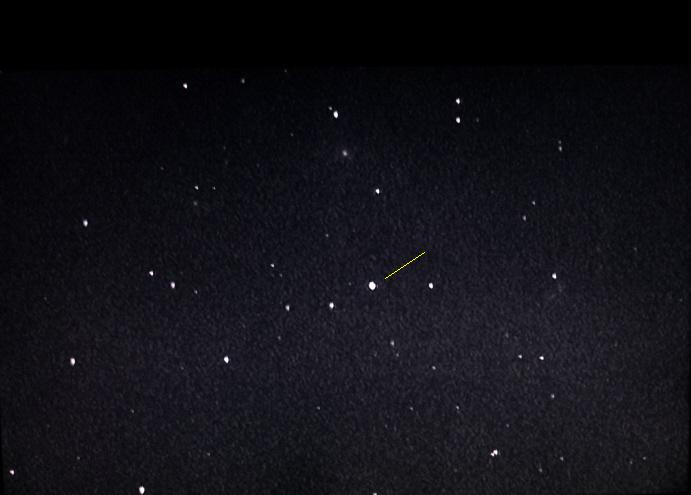
Comet Garrard same night.
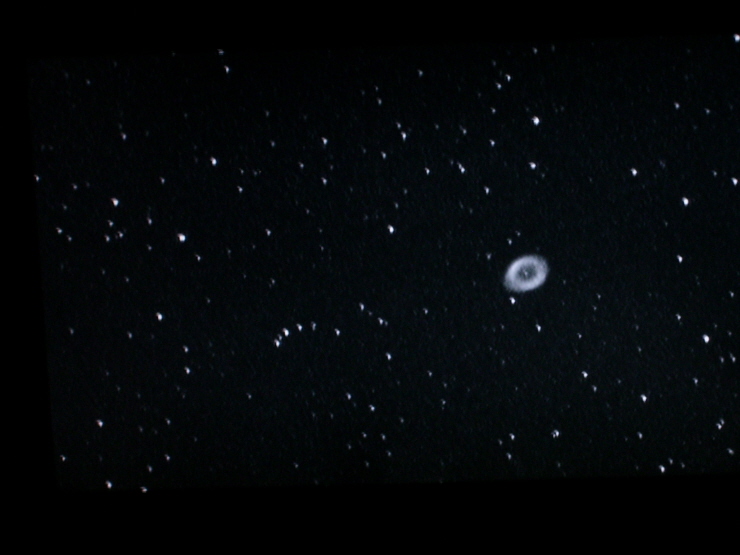
Ring nebula
Did you get a star named after you for Christmas? The International Star Registry
is a (more or less a novelty company) that, for a fee, will send you a certificate that "names" a star for you or someone
you may name as a gift recipicate. You get a star map showing the location and a certificate created by them.
Is it really your star? No, its like a "pet rock" you might say. But, they do use official astronomical star data bases
and the star can be found with proper equipment and your own adequate star maps. The star's named are well below
eyesight but can be found with 8-inch minimum scopes. I have a star and I found and photographed it.
A nice challenge and cool. If you have one, let's go find it. Send me the star co-ordinates and magnitude found
on the map you receive. I will get back to you when it will be in the evening sky for finding.


The Sombrero galaxy and the Ring Nebula on the big screen.
The Sombrero measured 18 inches across on the screen but in the eyepiece it only appears as the faintest streak of light you can detect.
A new scope, a B/W starlight camera, a projector and screen, a lot of fun and all LIVE in real time. Don't need eyepieces for this.
It's on the live screen, in focus for everyone and the camera brings in more than can be seen through the eyepiece anyway.

The Ring Nebula, a summer showpiece gas ring the the sky.
I've never been able to see the central star inside the Ring, even in a 13-inch scope..until now.

And then on May 8 a comet passed by.
I have a 2.5 hour video of the flyby in real time and the movement of the comet can be seen as it passes over background stars.
Nearly blew me away. But then, every time I get this out, I'm nearly blown away by something new.
Forgive my enthusiasm, I've been addicted for 55 years and its coming to a peak with modern technology.

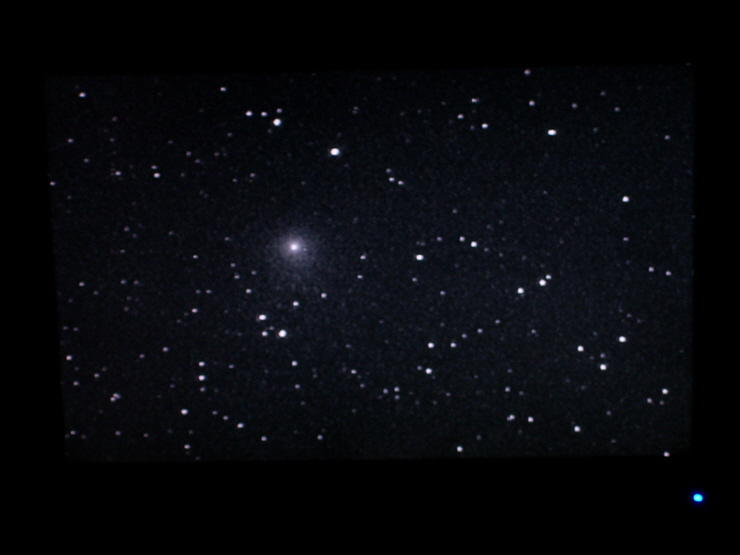
Another summer showpiece, M-13 the great Globular Star Cluster in Hercules.

Saturn overly bright to bring out several of it's small moons.
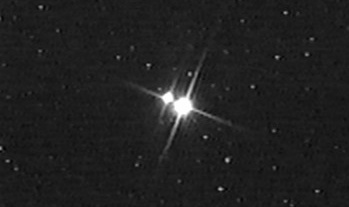

Left: The double star Alberio in Cygnus, a bright yellow star with a smaller gas-blue companion, beautiful in an eyepiece.
On the right: the double-double star in Lyra. Each of the double are a double themselves. 4 for the price of 1.
But it takes high power to split them all the way. Its a challange to see how many dim stars
can be seen in the eyepiece "between" the doubles. The camera shows several easily.


Pluto is a really big challange in an eyepiece. Takes a 8-inch scope minimum, a very dark and clear sky,
eyes that have dark-adapted for at least 30 minutes, a good chart giving it's location,
2 or 3 nights to relocate the suspected object to see if it slightly changed position among the background stars,
(if your suspect object did not change position then you were seeing a star, try again.)
And then it is still the faintest speck of light that your eye can detect, plus its hiding in all the other faint stars
in the immediate area. The camera picks it up easily, the challange is too identify it now, not to see it.
Here are 2 shots of the area Pluto is in taken 2 hours apart. Find the speck that moved (to the right). Pluto was only discovered in 1930
and 8-inch scopes only became common in recent years for the average guy. The professional astronomers with the big equipment
have been mostly the only human beings to see the light of Pluto, and all this only since 1930.
In the entire human race since the beginning, only a very very small percent have seen Pluto live.
(Its great to be among the few in my unusual sort of way.)

Neptune and it's big moon Triton, they look like a double star at the 2 billion mile distance that they are.
Triton is about as bright "or dim if you wish" as Pluto as they are nearly the same size and same distance from us.
When I realized Triton was in range of the camera, it became one of my goals to see it last fall.
Neptune's position wasn't good for me at the time because of trees and the weather. I only had one "good" opportunity
before winter and all I got was a shot of an object that appeared to be a close double star.
I gave up thinking just that. This year I again began the search and again found this "close double star" at a new location.
I then finally realized that this was Neptune and Triton as both have changed position against the background stars
and Triton was seen to be on a different side of Neptune.
Again, nearly blew me away.

Asteroid Eunomia in the center (169 miles wide and 139 million miles away August 2006) was identified by it's slight movement to the right
from the left pic to the right. But another asteroid (I assume) was found at the upper right also by it's motion, a much dimmer one.
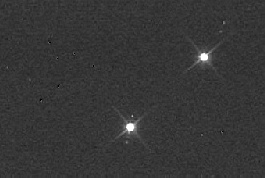
The planet Uranus (center) and 3 of it's largest moons. A star of same brightest upper right. Uranus is easy in binoculars and just detectable
naked eye at favorable conditions and very good eyesight. The moons, a very tough sight through the eyepiece.
This was not through the eyepiece however. The sensitive little live camera and projected on the side of the garage.
You think this all sounds FUN? Great, stop on by and bring a lawn chair most any clear evening. The setup will probably be out and the screen
hung on the side of the garage. Daylight savings time isn't as bad now because 9pm is dark enough now.
but hey, we have all night anyway. Its common to pack up and go in when the birds are heard to be waking up.
Or maybe we'll give the park a try some weekend.
Another Time Another Camera
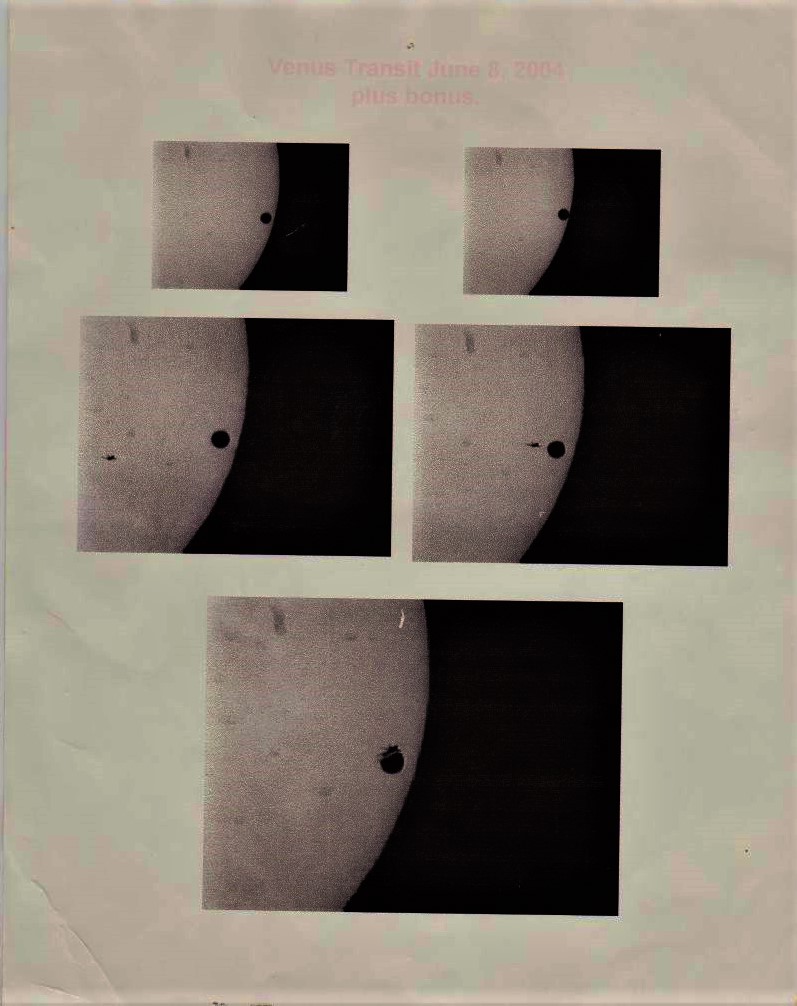
The Sun, the planet Venus and a jet "stacked" June 2004 from Parker City.
In all the images posted online I did see a few with a plane.
But none had a plane passing over Venus. One and only in the world?
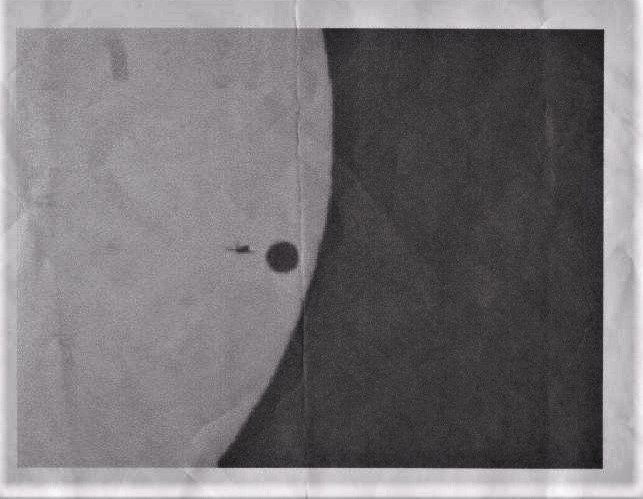
Mercury Transit with plane

