Student Section
Lesson Plan 3
Wings
In the previous lesson, we learned that lift happens because air flows around a surface
in such a way as to create a difference in air pressure.
Now, it only makes sense that the more wing you have, the more lift you generate. However,
wings also create drag.
Question: Who remembers what drag is? Drag is the resistance caused by the shape of an object and its movement
through the air.
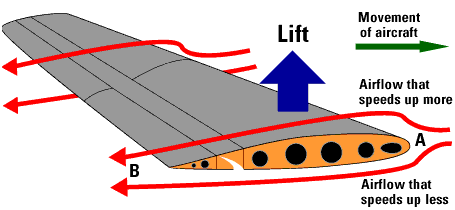
Notice this wing. It is thick and long, so it can generate lots of lift. Notice the lines
along the wing. The wing is not in one piece, inside the wing are motors, that push and pull the sections of the
wing. These sections are called flaps. These flaps change the shape of the wing, so the wing generates different
amounts of lift and drag at different times. Parts of the airplane that move to change lift and drag are called
control surfaces.
Bernoulli teaches us that air going faster exerts less pressure. It is the difference
in pressure that creates lift. It is the shape which creates drag. Other people will tell you the air going over
the wing speeds up because it has further to go. This is wrong. The air going over the wing actually gets to Point
B faster than the air going under the wing.
Various Types of Wings
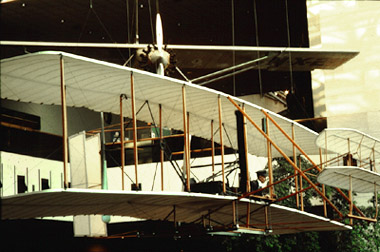
This is the Wright Flyer, from 1903
There are two wings. Notice how big the wings are? This is because the Wright brothers
didn't have a very powerful engine to create thrust, so they needed lots of lift to keep their aircraft up.
Question: who remembers what thrust is? Thrust is the force developed by a propeller or jet engine that drives
an airplane through the air.
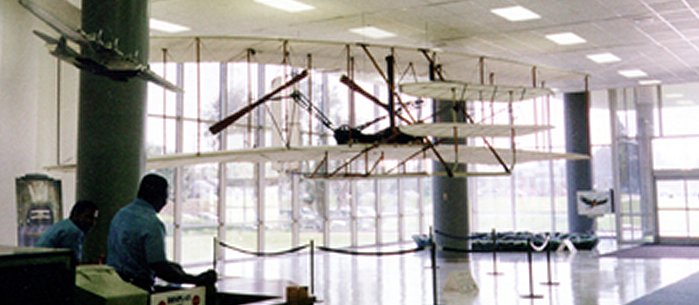
Notice something else about the Wright Flyer. It almost seems like it was built to fly backwards! Do you see
the smaller control surfaces in front of the big wings? Moving those control surfaces steered the airplane. The
Wright brothers put the engine on the back, and the two propellers pushed
the Flyer. The two propellers turned in opposite directions. Can you think why?
Answer.
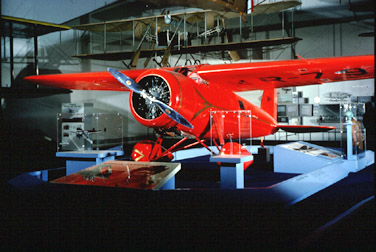
This is the Lockheed Vega, from around 1930
What has changed from the Wright Flyer? There is a very powerful engine in the Vega, increasing
thrust. All the sticks and wires are gone from the outside, reducing drag. There is only one wing, instead of two,
because the engine generates enough thrust to reduce the need for lifting surface area.
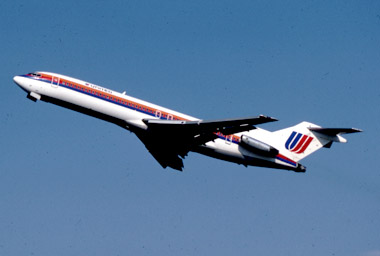
This is the Boeing 727, still in service.
What has changed from the Vega? Notice the wings are angled back. See how thick the wing
is near the body, and thin near the tip of the wing? This swept-back wing helps the aircraft fly very fast because
it reduces drag forces at the tip of the wing. The 727 has turbofan engines which generate far more thrust than
the propeller of the Vega. Because it can fly fast, and has tremendous thrust, the 727 can carry a lot of weight.
Aircraft are measured on a thrust-to-weight ratio.
The 727 engine thrust is 14,000 lbs
Its gross weight is 152,000 lbs (fully loaded )
Its empty weight is 86,602 lbs
Who remembers the definition for weight? Weight is a measure of the heaviness of an object.
________
Answer: With the propellers turning in opposite directions, the twisting
force of the propellers on the wings cancel each other out. The wings were fragile: the Wright brothers didn't
want an S shaped wing, they wanted a nice flat wing.

