Student Section
Lesson Plan 2
The principle of lift
Bernoulli was a Swiss mathematician in the early 1700's. He discovered that when flowing
air or water
changes speed, its pressure also changes. These experiments are very much like the ones he did, long ago.
Experiment 1: USE YOUR LIPS TO LEVITATE
Materials: Piece of paper

Hold a piece of paper between your thumb and forefinger, as shown in the picture. Now
blow over the paper. What happens?
Experiment 2: BALLOONS THAT BOGGLE
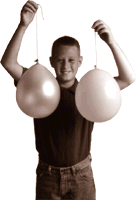
Try this activity with a friend. Blow up two balloons and tie each one to a string. Hold
the balloons a few inches apart and try to blow them together. Can you do it? What happens? Try different ways
of blowing on the balloons to see what happens. (Hint: Squirt a little water into the balloons before you blow
them up. This will help steady them.)
What are we learning here?
First, we are learning about what happens when air moves. Air may be invisible, but it
is very real. When it moves, the pressure changes.
What is true of air is also true of water. When water moves, the pressure changes.
Air is pushing on us all the time. Air never pulls, it only pushes. Don't listen if
anyone tries to tell you air creates suction. Suction is negative pressure. A vacuum cleaner creates suction
with its fan, but the dirt flies in because air has mass, and PUSHES the dirt inside.
The higher we go in the air, the less air is pushing on us. In fact, air is so thick
and heavy that aircraft cannot fly fast when they are down low: it will tear the wings off the aircraft if they
fly fast! This is why airliners fly so high up in the air, so that they can fly fast. They fly so high that the
airplanes need to be pressurized inside, like a bicycle tire, or the people would die.
Bottom Line:
Lift is generated by a difference in pressure. We can create differences in pressure
by moving air over a surface.

