
 Student Section
Welcome to the Weather Watching Unit!
You are about to embark on
some exciting cyber-weather experiences. You will be thinking like a
meteorologist, gathering weather data, using weather tools, discovering
hurricanes and also having fun. Bring along your cyber-sunglasses, umbrella,
boots, and coat for you just might need them all…
Someone
once said, "Everyone complains about the weather, but no one does anything
about it". The best we can do is to prepare for it, if we know what is
coming. Weather affects our daily lives in many ways. It determines where we
go, when we get there, how we get there and perhaps what we will do. Have you
ever been delayed by rain or a snowstorm? Have you ever had to cancel an
outdoor event because of bad weather?
Your
weather watching unit has 7 lessons. Each one is in some way tied to the
Internet. Before we begin, let’s find out what you already know about weather
and hurricanes. Fold a piece of writing paper into three equal parts. You
should have three columns. At the top of the first column write the words WHAT
I THINK I KNOW. Then write at least five things you think you already know
about weather. At the top of the middle column, write WHAT I WANT TO LEARN.
Then write at least five things you would like to learn about weather and
hurricanes. The last column should have the words WHAT I LEARNED. At the end of
this unit, you will add five new things you learned about weather and
hurricanes. You will share this information with your teacher and your
classmates.
Your graphic organizer
should look like this:
|
What I think I know about weather and hurricanes. |
What I want to know about weather and hurricanes. |
What I learned about weather and hurricanes. |
|
1. 2. 3. 4. 5. |
1. 2. 3. 4. 5. |
1. 2. 3. 4. 5. |


I.
Lesson One: Making a Glossary
You are going to build some weather tools, but
before you begin you need to know some weather terms.
Click on to this site: http://www.weather.com/glossary
On this site find the words below. Then make a
glossary and remember to put the words in alphabetical order.
1. hurricane 2. barometer 3. cyclone
4. temperature 5.
meteorologist 6. weather
7. atmosphere 8. evaporation 9. precipitation
10. anemometer
II. Lesson
Two: Making Weather Tools
Now that you have finished your glossary, find two
friends to join you in your weather data gathering efforts. The three of you
will make a barometer and an anemometer. All the materials you need are
probably already in your home.
Click below to find directions to make a barometer.
http://www.miamisci.org/hurricane/weathertools.html
The barometer will help you measure air pressure.
Keep your barometer indoors. Record its reading at the same time everyday.
Click below to find directions for making an
anemometer
http://www.miamisci.org/hurricane/weathertools.html
The anemometer will help you determine wind speed.
This one is a challenge.


III. Lesson Three:
Weather Watchers/ Weather Station
Now you are ready for your weather watch. Every day
for two weeks you and your two friends (with your teacher’s permission and
adult supervision) are to go into the playground at the same time everyday. You
need to bring a Centigrade or Fahrenheit thermometer, an anemometer, and a
weather vane. Record the temperature and the wind direction and calculate the
wind speed with your anemometer. Also note if there are clouds or if it is
sunny and if there is precipitation. When you return to your class log on to
the Weather Channel’s web site http://www.weather.com/homepage.html and click on weather
information for your zip code. Write both your readings and the Weather Channel’s
readings on the blackboard. Compare them and make predictions about what
weather is to come.
o
What
patterns do you see over time?
o
What
apparel choices would you make based on your weather data?
o
Are
your readings and the Weather Channel’s readings similar or different?
o
What
would influence a difference in the readings?
Write down the answers to these questions and share
them with your teacher and classmates.
IV.
Lesson Four: Hurricanes
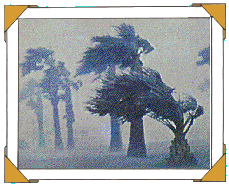
Read
about hurricanes and how they are named.
Click here http://www.weathereye.kgan.com/cadet/disaster/hurricanes.html
Read all about it. Click below
for more information
http://www.fema.gov/kids/dizarea.htm
Here is a writing
assignment for you:
o
Who would you name a
hurricane after? Tell why and submit it
to your teacher.
IV.
Lesson Five: Disaster Math 
Exercise your math muscle. Try to solve the "disaster math".
Click here http://www.fema.gov/cgi-shl/kids/quizbuilder.cfm?quiz=mathhurr&prize=l
Don't
forget to check your score!
V.
Lesson Six: Centigrade or Fahrenheit? 
Temperature readings may be given in degrees Centigrade
or degrees Fahrenheit. Most of the readings you will find will be in
Fahrenheit. It is also important to know how Fahrenheit and Centigrade readings
relate to each other.
In
order to convert degrees Fahrenheit to degrees Centigrade, subtract 32 degrees
and multiply by 5. Divide the result by 9.
For example:
Water boils at 212º F
212º – 32º = 180º
180º x 5º = 900º
900º / 9º = 100º
Water boils at 212º F or 100ºC.
Click here http://www.weather.com/weather/us/states/html
to get to Weather Forecasts for forecasts anywhere in the USA.
Find the temperatures of these cities in Fahrenheit
degrees and convert them to Centigrade degrees.
|
|
||
|
Cities |
Degrees Fahrenheit |
Degrees Centigrade |
|
Chicago, Illinois |
|
|
|
Atlanta, Georgia |
|
|
|
Anchorage, Alaska |
|
|
|
Missoula, Montana |
|
|
|
San Francisco, California |
|
|


VI.
Lesson Seven:
What Did You Learn?
Let’s go back to the very beginning of our unit.
Remember the graphic organizer in which you wrote down what you thought you
knew about weather and hurricanes? You also wrote five things that you wanted
to learn about weather and hurricanes. In the final column, add five new things
you learned while doing this unit.
SELF ASSESSMENT 
1. Was
I able to construct the two weather tools?
|
Yes |
Somewhat |
No |
2. Was I able to use the weather tools?
|
Yes |
Somewhat |
No |
3. Can I describe the three characteristics of a
hurricane?
|
Yes |
Somewhat |
No |
4. Did I score high on my disaster math quiz (no more
than two wrong)?
|
Yes |
No |
|
5. Can I apply my new knowledge of weather to my
daily life?
|
Yes |
Somewhat |
No |
Explain
your answer.
6. Did I enjoy my weather learning experience in
cyber-space?
|
Yes |
Somewhat |
No |
