WELCOME TO MY HOMEPAGE
 Index Page For ELLHNIKH MOUSIKH, Concerts, New Music, Nea, kai alla.
"Gia sas paidia" and I am honored that you have decided to visit my humble homepage. My name is Demetris and I temporarily away from my Home, mentally however I am always there -- Ah yes!!
Anyways I am, hopefully, an Architect in the making.
I admire and love Classical Hellenic Architecture. One of my ambitions is to erect a "Modern Parthenon" at the level of Kallicrates' and Ictinus' PARTHENON. "Good luck, eh?" Anyways, ambitions!!! Before you go any further I would like to tell you that my spelling is not the good.
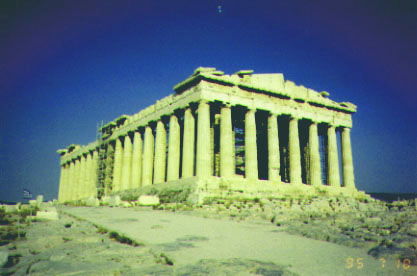
Some of my favorite structures include The Palace at Knosos -- c. 1600 BC, Hagia Sofia in Costantinople -- 532 - 537 AD -- by Antemios and Isador, and obviously my favorite, the PARTHENON -- 447 - 432 BC -- by Ictinus and Kallicrates, which exemplifies nothing less than "PERFECTION!!"
The Parthenon was a temple built for the patron goddess of Athens -- Athena. It was proposed as part of a building project on the Akropolis of Athens by Pericles "The Olympian", civil year 448/7 BC. It was begun in 447 BC and was under the direction of one of the best ancient sculptors Pheidias, who was the master sculptor of the Parthenon sculpture series and directly made the chiselephantino sculpture of Athena Parthenos which stood in the naos until c.500 AD. The architects were Kallicrates and Ictinus. The building was finished in 438 yet all the sculpture were completed and added by 432. Pheidias, Ictinus, and Kallicrates had accomplished what Pericles wanted, an immortal Athens. The Parthenon was everything Athens was, everything she proved to be, and much much more. Perfection was achieved.
It measures 69.5m long and 30.87m wide. It housed three rooms: the Pronaos, the Naos, and the Opisthodomos. It was the largest Doric temple of its time. Eight columns stand across the front and back (east and west) and seven-teen across the sides (north and south). None of the columns stand vertically to their "resting" plain and each is different than the one next to it. All this was to make the structure seem flawless to the human eye -- engineering, technology -- and what we now call "optical illusion".
The Parthenon has three sets of decorative sculpture sequences: the metopes, the frieze, and the pediment/gable sculpture. All are precision carved and the pediment sculpture carved in the round even though the back sides of the sculpture were not visible to the temple's viewers/admirers.
The Parthenon is a structure based on theory , strict order, beauty, as it achieves idealness. Pictures and videos (trust me I know) cannot capture what one feels once she/he is confronted by THEE -- even as it stands in ruins. It is something remarkable that words cannot fully describe only touch upon it.
It stood unharmed until the 5th century AD when it was converted into a Christian Church which required few alternations and most damaging were an addition of an apse on the eastern end and the removal of the chriselephantino sculpture of Pheidias. It stood like this until the 15th century when the Ottoman Turks turned it into a mosque with few changes as it continued to exemplify Athenian Perfection until ......
On Thursday, September 26, 1687 Pericles, Pheidias, Ictinus, Kallicrates, the Athenians (dead or alive), and all the Hellenes lost their major battle against the "BARBARIANS"; the Parthenon stood fully no more. While at war against the Venetians, the Ottoman Turks (who were in control of the Akropolis) decided to store their amunition inside the temple that was visible from throughout the Attican plain -- go figure. The Venetians under Morosini had no mercy and a serving German soldier bombed what had stood almost 2000 years unharmed influencing and civilizing the world.
If this wasn't enough in the begining of the nineteenth century a British "ambasador" at Costantinople got permission from the Ottoman Turks to remove whatever he wanted from the temple and that he did at great cost. Lord Elgin with no mercy or respect uncarefully removed whatever sculpture he could causing great damage to the ailing temple. All this because he said he wanted to "protect" the marbles from the Ottoman Turks who were at the time removing parts and pieces from the temple so they can melt the marble down and make limestone. And yet 200 years later these "stollen" marbles still remain in a British museum as the British are still "protecting" them even though Greece gained her independence some 20 years after Elgin had left with the "Goodies".
Today it stands on the Akropolis hill of Athens in ruins as it reminds the world of barbaric sacrilidge and the struggle of a civilization that has survived the many barbaric peoples as depicted on the Parthenon Metopes and it still generates idealism and influences many. It has undergone several restorations to help it from "modern" Industrialization which was forced upon the city as was the pollution that came with the package. The marble is slowly being disintegrated as many work around the clock to preserve what is left of a temple that means so much. It has been proposed to be covered by a glass domed shell but what will happen is still in question. If you could and have the chance go see it, it will be worth the time and money.
Architecture & Me.
About the PARTHENON
Links to Classical Structures
Getting In Touch With Me
If you have any questions, suggestions, spotted spelling errors, about my "humble" site please e-mail me at
 oaetos@yahoo.com
This page was first posted on January 24, 1997.
It was last updated on October 21, 1999.

