SECRETS
HISTORY OF FREEMASONRY
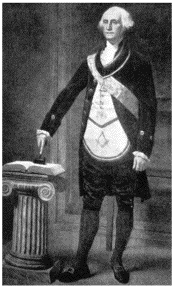
Freemasonry is the oldest and largest fraternity in the world. There are 6 million members worldwide, just under 3 million in the U.S.. It has symbolic and mythic origin at the building of King Solomon's Temple. Historical roots of the Craft are unknown. Henry W. Coil, in his "Freemasonry Through Six Centuries", states that there are over 24 theories relating to the origin of Freemasonry. These theories range from the beginning of time to the Middle Ages when operative masons began accepting what we would refer to today as honorary members. The oldest document associated with Freemasonry is the "Regius Poem" or Hallwell Manuscript. It was written about 1390 and is said to have been copied from an older document. The Regius poem outlines the first "convention" of the Craft held in York in 926 A.D. under the leadership of Prince Edwin. The Regius Poem is followed by The Cooke Manuscript of circa 1410 and a host of younger documents known as The Old Charges. A significant change in the Craft occurred when four (4) existing Lodges in London formed the Grand Lodge of England on June 24, 1717. The Grand Lodge of England chartered many Military or Traveling Lodges. These Military lodges served with regiments in The American Colonies and helped bring Freemasonry to this continent. It followed that Provincial Grand Lodges were formed in the Colonies. Military, Traveling, and Provincial Lodges all existed during the same period. One of the first Provincial Lodges formed in the Colonies was St. Johns Lodge in Boston July 30, 1733. The charter for this Lodge was issued by Lord Viscount Montague, Grand Master of England. PROVINCIAL PERIOD The first Provincial Grand Master, Daniel Coxe, was appointed to oversee New York, New Jersey, and Pennsylvania. He formed one of the oldest Lodges in the New World still in existence, St. John's #1 in New York City December 27, 1757. Lodge #139 of Savannah, Georgia (1735) has retained it's original identity. It was renamed Solomon #1 in 1776. The Lodge kept English registry till 1813 even though it was on the Grand Lodge of Georgia rolls. THE REVOLUTIONARY PERIOD The History of Freemasonry in America is almost synonymous with the history of our country. Paul Revere, Benjamin Franklin, and John Hancock were among the early Patriots who were Masons. One of the most famous Lodges in the New World was St. Andrew's Lodge which met at the Green Dragon Tavern in Boston. Many historians are convinced that the participants in the Boston Tea Party were members of that Lodge. Dr. Joseph Warren received his degrees in this Lodge. It is believed that he and other brothers were involved in the Boston Tea Party. Warren County was named for Dr. & General Joseph Warren, hero of the American Revolution and the first Provincial Grand Master of Masons in the Colony of Massachusetts (December 27, 1769). He served as such until he was killed at the Battle of Bunker Hill (June 17, 1775). The Grand Lodge of Massachusetts assumed its independence on March 8, 1777 becoming the first independent Grand Lodge in the United States. Peyton Randolph, the first President of the Continental Congress was Provincial Grand Master of Masons in the Virginia Colony. He died on the floor of the Second Congress in 1775. Benjamin Franklin was Grand Master of Masons in Pennsylvania. It is believed that through his influence and strong Masonic ties in France and the rest of Europe, Masonic stalwarts such as Lafayette and Baron Von Steuben came to the aid of the Colonies. At the Battle of Saratoga October 17, 1777, General Burgoyne surrendered to General Horatio Gates. On October 17, 1877, Grand Master J.J. Couch laid the cornerstone of the monument in Schuylerville commemorating that battle. The monument has four carved niches; three of which are filled with groups of bronze figures representing the three famous colonial generals who participated in the battle: Schuyler, Gates, & Daniel Morgan. The fourth niche is vacant with a solitary word "ARNOLD" to remind us that the glory Benedict Arnold won at Saratoga would be later lost in his treason at West Point. Had Arnold died in that battle instead of just losing his leg, he would have been remembered as a great American Hero. All four men were Masons. Another Freemason at the battle was General Kosciusko. EARLY FREEMASONRY IN THE NEW REPUBLIC After the Revolution, the American Grand Lodges became sovereign and independent. Eventually a Grand Lodge was created in every State and the District of Columbia. The Grand Lodge of New York was formed in 1781 under the Atholl Charter. Lesson #7 details the Structure of The Grand Lodge of the State of New York. Among the early Governors of New York who also served as Grand Master of Masons in the State include: Daniel D. Tompkins (later Vice President of the United States), DeWitt Clinton, and Morgan Lewis. Attending the first inauguration of George Washington on April 30, 1789 was a Who's Who of Freemasonry in New York State. The altar Bible of St. John's Lodge was used by Chancellor Robert L. Livingston to administer the oath of office. The Bible has been used to swear in a number of Presidents, including George Bush on Jan. 20, 1989. At the first inauguration the President-elect was escorted by selected military units commanded by General William Malcolm (a Freemason). His aides were Morgan Lewis (later Grand Master of New York), Jacob Morton and Leonard Bleecker (all prominent Freemasons). Jacob Morton was the Grand Secretary of Grand Lodge and Master of St. John's Lodge #1 (the owner of the Washington Bible). He later became Grand Master of New York. Surrounding Washington at the inauguration were: Richard Henry Lee, Henry Knox, Arthur St. Clair, Baron Von Steuben, House Speaker Frederick A.C. Mulenberg, and New York Governor George Clinton -- all Freemasons. George Clinton was later to become the Vice-President of the United States. He was also the uncle of the future Governor and Grand Master DeWitt Clinton who was present at the inaugural. On September 18, 1793 Washington laid the cornerstone for the Capitol in full Masonic ritual. The trowel he used was later utilized by the Grand Master of Virginia to lay the cornerstone of the Washington Monument on July 4, 1848. Both the trowel and the apron used by Washington are kept at the Washington Masonic National Monument in Alexandria, Virginia. Between 1822-1827, a schism developed between upstate and New York City Freemasons. Freemasons from "Upstate" felt that Grand Lodge should be held in Albany and not in New York City, since Albany was more centrally located. In 1825, Stephen Van Rensselaer was elected Grand Master to heal the wounds. The pact of June 7, 1827 resolved these differences. Van Rensselaer was a prominent public servant. Early that year it was his vote in the U.S. House of Representatives which gave John Quincy Adams a sufficient majority to win election to the Presidency. THE MORGAN AFFAIR The disappearance of William Morgan in September of 1826 set the stage for the influence of Freemasonry in government to be greatly diminished. An individual by the name of William Morgan, had joined a Royal Arch Chapter in LeRoy, New York. He moved to Batavia and petitioned to join a Chapter there. Characterized as an undesirable, he was rejected. He then conspired with David Miller, a publisher whose habits were in harmony with Morgan, to print the "secrets" of Freemasonry. This disturbing news upset some over-zealous Freemasons who "allegedly" abducted Morgan from jail. He was not heard from since. A body was found at Oak Orchard Harbor near Niagara. A claim was made that it was that of Morgan. Although the claim later proved to be false, detractors of Freemasonry used the claim to build suspicion and hatred against the Craft. The Anti-Masonic political party was formed. Churches expelled from their congregations any member who would not renounce Freemasonry. Most Masonic lodges were dissolved. A few remained in operation by meeting in secret. In 1827, there were 800 Lodges in New York State with over 20,000 members. By 1830 only 82 Lodges were left with 3,000 members. It was not until 1857 that New York membership would be back to the 1827 level. The Morgan affair caused a decline in Masonic membership, especially in North East America, for a period of about 20 years. A NEW ERA The cornerstone for a new Masonic Hall for Grand Lodge was laid June 8, 1870. The dedication of the completed structure took place June , 1875. In 1891 the cornerstone for the first building for the Masonic Home in Utica was laid. By 1893 the first guests at the home were received. In 1947 the Masonic Foundation for Medical Research and Human Welfare was established. The cornerstone was laid in 1956 for the Masonic Medical Research Lab building. The building was completed in 1958. Freemasonry gradually grew back in numbers until, in New York State, membership peaked to 343,700 in 1929.
THE ORIGIN OF MASONIC SYMBOLS
The domain of freemasonry has included the design and construction of ecclesiastical buildings throughout their history. This has demanded an intimate and detailed knowledge of religious doctrines and tenets, which must be reflected in the structure and especially in the detail of its ornamentation. King Solomon’s Temple, completed about 950BC after seven years and more under construction, is a pre-eminent example of the vision and inspiration required in the conception and erection of such a building. Every feature of that magnificent edifice was of religious and symbolic importance. The details provided in the first books of Kings and Chronicles preclude any doubt of the comprehensive knowledge that the masons and their associated artificers had of the symbolism embodied in the structure and its lavish furnishings, both inside and outside. The renowned Jewish historian, Josephus, records that when Herod the Great restored the second, or Zerubbabel’s Temple, around the beginning of the Christian era, not only did he carry out the work piecemeal to avoid interrupting the usual ritual observances, but also trained 1,000 priests as masons to build the shrine. The restoration was completed in 64AD, but the temple was completely destroyed by the Romans in 70AD. Operative masons were then engaged continually in the massive construction projects of the Roman Empire, until the fall of Rome, which was captured by the Visigoths in 410AD. This was followed by the invasion of northern Italy by Attila the Hun in 452AD, then the sacking of Rome by the Vandals in 455AD. However, Constantinople had become the Christian capital of the Roman Empire in 330AD, in direct opposition to heathen Rome. As the Byzantium Empire it established Christianity in the East, carrying out the first great wave of Christian ecclesiastic building. These great works surpassed even the efforts of the Persian renaissance, continuing unabated until Constantinople fell to the Turks in 1453AD. As the Dark Ages from the fifth to at least the ninth century drew to a close in western Europe, an incredible era of cathedral building was ushered in, spanning the late Middle Ages through the Renaissance. Even in Britain, seriously hampered by the Reformation in the mid-1500’s, work on ecclesiastical buildings continued into the 1700’s. Hundreds of churches, castles and civic buildings were constructed. Chartres Cathedral in France, the first in the “Gothic” style, is a renowned example. York Minster in England is another prime example; frequently called “poetry in stone”, it was some two and a half centuries in building. These events spanned almost 3,000 years, usually under ecclesiastical influence or control, whence the underlying principles of speculative freemasonry and its symbolism largely derived, developing in parallel with the operative art. All extant records of the ceremonials in operative lodges confirm that symbols played a vital part in the teachings of operative free masons, which stimulated the development speculative contemplation. The incorporation of symbols into the rituals of purely speculative lodges was a natural extension of this long established practice. Indeed, having regard to the principles actuating those who formed the first purely speculative lodges, this was an inevitable outcome which prompted them to describe freemasonry as “a peculiar system of morality, veiled in allegory and illustrated by symbols”, aptly defining one of its central tenets.

THE MYSTICAL THEME
An important mystical theme is hidden beneath the superficial moral theme of the more important allegories, which are in the nature of the “Passion Plays” of the Middle Ages. The first allegory relates to a late stage in the construction of King Solomon’s Temple, when several of the workers feared that they would not be given the modes of recognition and therefore would not be able to obtain work after the completion of the temple. When the principal architect was accosted he remained true to his vows and was slain, so that substitute modes of recognition had to be used thereafter. The superficial story is that death is preferable to dishonour and that we must perform our allotted tasks whilst we can, believing that we will be a rewarded appropriately in a life hereafter. The esoteric message is that mortal death is only a gateway for the resurrection of the spirit, which can be achieved by steadfast faith in the Most High. The theme continues in a dramatic allegory in the cryptic degree of Royal Master, with the promise that the “True Word” will be preserved in a place of safety, esoterically signifying that the “True Word” transcends all mortal delinquency and can always be found through faith. The second allegory connects the foregoing allegories, also relating to the construction of the first temple. In its various forms it relates to either the great cornerstone or to the keystone required to complete the arch of the secret vault. In the superficial story a diligent and faithful mason prepares a beautiful piece of stonework, essential to complete the structure. Because it can not be found on the plans it is rejected and work comes to a standstill. When the missing stone is recovered and work continues, the skilful craftsman receives his just reward. The esoteric meaning is that the acceptance or rejection of this life’s work is not within the province of mortal man, the gates of victory being opened only through the grace of that living Stone which the builders rejected, but which became the chief cornerstone, as foretold in Psalm 118 and confirmed in I Peter 2. A subsequent allegory relates to the period after the destruction of the first temple, when the captives in Babylon are released by the Decree of Cyrus and are instructed to return to Jerusalem and rebuild the temple. The ceremony called “passing the veils” concerns three sojourners who journey to Jerusalem and present their credentials to the Sanhedrin, asking to be given work on the new temple. However, the veils allude to the Tabernacle erected by Moses and the Scripture readings refer to the Exodus story, replicating a ceremonial carried out every seven weeks by the Therapeutae Essenes of Qumran in the first centuries BC and AD, exhorting obedience to the Covenant until the second coming of the Lord. The moral is revealed in the allegory of the Royal Arch, when the sojourners are put to work to clear away the rubbish in preparation for the second temple. Through their diligence the “Lost Word” is recovered, teaching that all men are equal in the sight of God and that the lowest work will receive full and just reward if properly carried out. The esoteric lesson is that salvation can be found only through a complete faith in the “True Word”, representing the present, future and eternal “I Am”.