Anthony Quinn
-
Born - 21 April
1921 -
Chihuahua, Mexico.
Died 4 June 2001
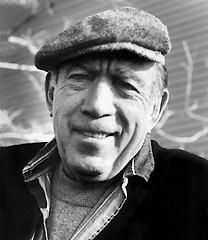
Dynamic, prolific
character actor and occasional leading man who, during the course of his
nearly 60 years in motion pictures, has played nearly every exotic ethnic
type imaginable at least once. For much of his screen career an effective,
quietly persuasive per former, Quinn in recent years has taken to overacting
and has sometimes exercised poor judgment in accepting roles. Born to an
Irish father and Mexican mother, Quinn enjoyed a brief career as a prizefighter
before entering movies in 1936.
He had small roles
in Parole, Sworn Enemy and Night Waitress (all 1936) before signing with
Paramount, for which he appeared exclusively until 1940, mostly playing
gangsters and Indians. Quinn's Paramount films include The Plainsman (1936,
directed by Cecil B. DeMille, who became Quinn's father-in-law the following
year), Waikiki Wedding, The Last Train From Madrid, Daughter of Shanghai
(all 1937), The Buccaneer (also for DeMille), Dangerous to Know, Tip-Off
Girls, Bulldog Drummond in Africa, King of Alcatraz (all 1938), King of
Chinatown, Television Spy DeMille's Union Pacific (all 1939), Parole Fixer,
The Ghost Breakers and Road to Singapore (all 1940).
During the war years
Quinn worked mostly at Warner Bros. and 20th CenturyFox, although he did
return to Paramount for a hilarious deadpan turn as an Arab sheik in the
Crosby-Hope vehicle Road to Morocco (1942). Still a character player, he
was assigned increasingly important and showy roles in bigger, more expensive
pictures, including City for Conquest (1940), Blood and Sand, Manpower(both
1941),They Died With Their Boots On (also 1941, as Chief Crazy Horse),
The Black Swan, Larceny, Inc (both 1942), The Ox-Bow Incident, Guadalcanal
Diary (both 1943), Buffalo Bill, Roger Touhy, Gangster, Irish Eyes are
Smiling (all 1944), Where Do We Go From Here? and Back to Bataan (both
1945, superb in the latter as a Filipino guerilla, costarring with John
Wayne).
Quinn and his wife
Katherine, DeMille's adopted daughter and a talented actress in her own
right, starred together in Black Gold (1947), a low-budget sleeper released
by Allied Artists. Playing a proud but kindly Indian who discovers oil
on his property and allows a Chinese refugee to race his prize thoroughbred,
Quinn delivered a warm, heartfelt performance that ranks among his best.
He subsequently appeared in Sinbad the Sailor, Tycoon (both 1947), The
Brave Bulls (1951, marvelous in this bullfighting story), Against All Flags
and The Brigand before winning his first Academy Award as the brother of
a Mexican revolutionary (played by Marlon Brando) in Viva Zapata! (all
1952). (He also replaced Brando in the original Broadway production of
"A Streetcar Named Desire.")
Quinn's career picked
up following his Oscar win; he got better roles and worked almost nonstop
throughout the remainder of the decade. High spots include La Strada (1954,
the classic Fellini film and Best Foreign Film Oscar-winner, in which he
played a brutish, simple-minded strongman who tours with acrobat Richard
Basehart), Ulysses (1955, as Antinous), Lust for Life (1956, playing artist
Paul Gauguin, a performance for which he won his second Best Supporting
Actor Oscar), and The Hunchback of Notre Dame (1957, playing the hunchbacked
Quasimodo to Gina Lollobrigida's Esmeralda). His other 1950s films include
Mask of the Avenger (1951), The World in His Arms (1952), Seminole, City
Beneath the Sea, Ride, Vaquero!, Blowing Wild (all 1953), The Long Wait
(1954), The Magnificent Matador, Seven Cities of Gold (all 1955), The Wild
Party (1956), The River's Edge, Wild Is the Wind (both 1957, Oscar-nominated
for his work in the latter), Hot Spell (1958), Warlock and Last Train From
Gun Hill (both 1959). His father-in-law gave Quinn a shot at directing
with the 1958 remake of The Buccaneer a critical and commercial disappointment.
In 1959 he chalked
up a memorable portrayal as a stoic Eskimo in The Savage Innocents. By
now his once slender, swarthy face had become craggy, and he'd put on quite
a bit of weight. That stood him in good stead for his role as the former
prizefighter humiliated by his work as a "professional" wrestler in Requiem
for a Heavyweight (1962). That same year he contributed a vibrant performance
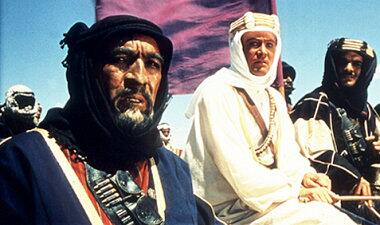
as an amoral Bedouin chieftain (who is "a river to my people") in David
Lean's Lawrence of Arabia In 1964 he secured another Academy Award nomination,
this time for his starring role in Zorba the Greek the story of an earthy
Greek peasant he helped produce (and a role to which he returned a quarter-century
later on Broadway). He again played a robust Greek character in A Dream
of Kings (1969), a low-key drama set in Chicago's Greek community.
In 1965 he divorced
Katherine DeMille, by whom he'd had three children.

The 1970s saw the
beginning of a decline for Quinn, who increasingly took roles in poor American-made
pictures and poorer foreign ones. Moreover, his burgeoning tendency to
overact was not curbed by most of his directors. He has remained a compelling
on-screen figure, however, even in his latter-day films.
OTHER FILMS INCLUDE:
1960: Heller in
Pink Tights 1961: The Guns of Navarone 1962: Barabbas (in the title role);
1964: Behold a Pale Horse 1965: A High Wind in Jamaica, Marco the Magnificent
1966: Lost Command 1967: The 25th Hour, The Happening 1968: Guns for San
Sebastian, The Shoes of the Fisherman (in the last-named as a Russian-born
Pope); 1969: The Secret of Santa Vittoria 1970: Flap, R.P.M., A Walk in
the Spring Rain 1971: Arruza 1972: Across 110th Street 1973: Deaf Smith
and Johnny Ears, The Don Is Dead 1974: The Destructors 1977: Mohammad,
Messenger of God 1978: Caravans, The Children of Sanchez, The Greek Tycoon
(in the latter as an Onassistype billionaire); 1979: The Passage 1981:
Lion of the Desert, The Salamander 1982: Valentino/1919 1985: Ingrid 1988:
"Onassis: The Richest Man in the World" (miniseries); 1989: Stradivari
1990: Revenge, Ghosts Can't Do It (opposite Bo Derek, a career low point);
1991: A Star for Two (opposite Lauren Bacall), Mobsters, Jungle Fever,
Only the Lonely (wooing Maureen O'Hara); 1993: Last Action Hero 1994: This
Can't Be Love (telefilm, opposite Katharine Hepburn). |