Jack Lemmon
Born - 8 February
1925 -
Boston Massachusetts.
Died 28 June
2001
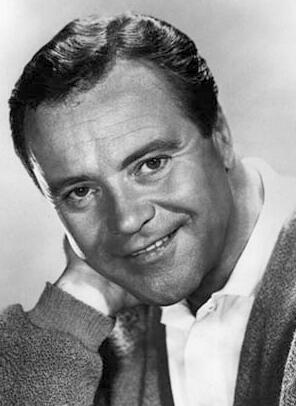
Lemmon was a semi-private
man, always congenial and lighthearted, but with a certain reserve that
hinted of his Boston birth and Ivy League education. Nonetheless, he's
willing to reflect openly on the beginnings of his life as an actor, all
part of performing his chore of calling attention to his new film, "The
Odd Couple II," which opens today. He rejoins his old sparring mate, Walter
Matthau, in a script by Neil Simon, a follow-up to their 1968 hit.
Lemmon, winner of
two Academy Awards, has enjoyed 45 years of uninterrupted stardom in films.
"I was attracted
to acting for the simple reason that I was accepted by my peers, the kids
at school, when I performed. I said, 'Gee, this is terrific.' It had nothing
to do with talent; it had everything to do with being accepted.
"So I kept at it
and started doing bits between classes. The kids would start coming over
and saying, imitate W.C. Fields for us or Mae West. Do this, do that, tell
us a story. Every night, instead of studying, I'd make up stories
at home. Then I'd tell them to the kids. Later I fell in love with it when
I started acting."
Thanks to his schooling
at Phillips Academy in Andover, Mass. he was accepted to both Harvard and
Yale. He decided on Harvard to be close to his family in Boston. Later,
he realized he could have taken advantage of the Yale Drama School. Harvard
had no such curriculum, but he did appear in plays for the Hasty Pudding
Club and the drama club.
Before his service
in the Navy, Lemmon spent two seasons in summer theater. After the war
he studied with the great teacher-actress Uta Hagen as well as the coach
David Alexander. "We did scene-study classes with David," Lemmon recalls.
"On Wednesday nights we would do the scenes before the class, and the students
would critique it. Then he would say, 'What about counterpoint, going
exactly the opposite? What would happen?' Now, the scene wouldn't hold
up that way. But it was interesting ...to see the actor trying to play
it that way, stretching himself, also using what David called obstacles:
thinking of things to get in the way of achieving what the actor does in
the scene."
This helps explain
the Lemmon style, especially in comedy: It's offbeat, seemingly tentative,
often surprising. You're never sure what he's going to do next, hence you
need to keep your eyes on him.
In New York, Lemmon
began finding jobs in radio and off-Broadway, playing piano in bars during
lean periods. Then came one of the great American acting schools: live
television.
During the 1950s,
the networks offered numerous dramatic programs that brought experience
and recognition to a new generation of actors, among them Paul Newman,
Grace Kelly, James Dean, Rod Steiger, Cliff Robertson, Lee Remick, Steve
McQueen, Eva Marie Saint, Charlton Heston -- and Jack Lemmon. "It
was great training, no question," Lemmon says.
Actors needed to
learn their roles fast and be prepared for any emergency. No retakes, no
second chances. The programs were transmitted instantaneously to millions.
One of Lemmon's first shows was an hour drama for Kraft Television Theater.
During a long speech, he drifted to a fireplace. Unbeknownst to him, that
part of the set had been hauled upwards, "exposing three guys playing cards."
Lemmon went sprawling. He got up, said, "I'm sorry," and continued his
speech.
Television helped
attract Hollywood interest. Lemmon costarred with Judy Holliday in his
first movie, "It Should Happen to You." As Ensign Pulver in his fourth
film, "Mister Roberts," he won the 1955 Academy Award for supporting actor,
and his career was established.
In 1973, he won the
Oscar as best actor for "Save the Tiger," and he has been nominated for
"Some Like It Hot," "The Apartment," "Days of Wine and Roses," "The China
Syndrome," "Tribute" and "Missing." Lemmon has been working almost
nonstop for two years. He won't be in front of the camera again until the
fall when he and Matthau shoot "The Odd Couple III." He also planned to
make a TV movie version of "Inherit the Wind," the play and later a film
that fictionalized the Scopes trial. George C. Scott will costar.
Unfortunately, that never came to pass.
"I love it," Lemmon
says. "I'll never quit." He didn't - really.
 .... .... .... ....
|