
Unto the Nobles and Commons of the Barony of Coeur d'Ennui and Our Canton of Axed Root, do Baron Master
Syr Angus of Blackmoor and Baroness Diana MacLean send greetings.
As you are aware, this year's Lilies War theme places the forces of our fair Barony and the Baronies of Lonely Tower and Forgotten Sea against the power hungry baronies of Three Rivers, Vatavia and Mag Mor. As principals in the War, it is crucial that all members of our populace put forth as much effort as possible. If you are attending the war, we need help staffing Troll on Tuesday, running the Party on Monday night, waterbearing, marshaling, heralding; the list goes on.
We would like to thank Lady Jaquemette for offering to coordinate our party on Monday night. We expect that she will have many volunteers to help her out. If you are unable to attend, please think about sending gifts of largesse for Their Majesties.
This fall, Lord Ceanntigern and Lady Brihtwynn will exchange marriage vows. We will hold an event in their honor. Lord Edward will be the event steward and Countess Lenore will be the feast steward. We will look forward to this day with great anticipation. If you are interested in helping out with this event, please contact Lord Edward.
Vivat Coeur d' Ennui!
Angus and Diana
A Gentle Life by Baroness Mistress Jocelyn du Biers
To find yourself in the pastime of the SCA is to find yourself in "the gentle life." This is a way of being and enjoying that is far removed from our normal day to day living. People are referred to as "gentles." A great emphasis is placed on using manners and courtly graces. Anyone may be spoken to gently as milord or milady. You are greeted in this manner with a smile and a nod of the head. Those who have earned the honor may be "Lord" or "Lady." Those who wear a coronet of any rank are an "Excellency."
Strangers will offer to carry heavy burdens for you or guide you when are lost. A smile and a "thank you" are all any such service requires. Seldom, if ever, are voices raised in anger (well, some of the fighters will loudly rag on their opponents, but 'tis in jest). Gentles open their homes for strangers after an Event, so that any and all can have a safe, comfortable place to sleep before their journey home.
Food is prepared in abundance by cooks who volunteer to prepare a feast for many gentles at an Event. There are entertainers of both serious and silly natures who willingly share their talents, hoping only for applause.
In SCA, you are an important part of the group, the day, the feeling, and the graces. You are, for even a brief time, away from the "you" that must deal often with the banality of the modern age. You can be a "Gentle" and live the gentle life! What a treasure!
 [picture] Artwork by Sadhbh
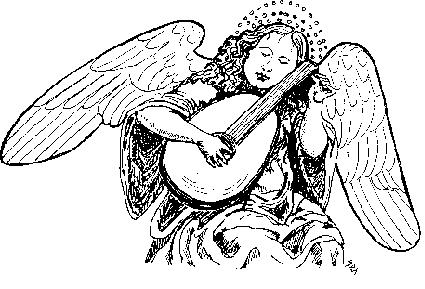
Bheansidhe. Detail from the Brizio Chapel of the Orvieto Cathedral, Italy.
Luca Signorelli painted the frescoes (c.1500)
[picture] Artwork by Sadhbh
Bheansidhe. Detail from the Brizio Chapel of the Orvieto Cathedral, Italy.
Luca Signorelli painted the frescoes (c.1500)
An Argument for Women in Medieval Theater
(Let me explain that I have not fully researched this topic. While doing other research into medieval theater, I got a little sidetracked. I hope that this article will inspire another gentle to delve into this matter. With any luck, my ideas will be proven true.)
Cast a woman in any SCA production and you will invariably hear "Women weren't in the theater." This statement has been the standard in history texts for ages. Historians like John Marshall and Meg Twycross have stated flatly that only men were used in theatrical productions. This "fact" just seemed wrong to me.
My first thought was "What about Hildegarde of Bingen?" She was famous for writing plays. It is well documented that they were performed in her abbey. Were these plays only performed by priests and monks? Did Hildegarde's own sisters have to sit and watch tonsured men pretend to be young virgins? I easily dismissed this apparent contradiction. I assumed that this was one of those extremely rare occasions that historians forget about when they make their generalizations.
The question arose again as I was sitting in Dr. Madison's early medieval history class at Iowa State. We were discussing the Eastern Roman Empire (Byzantines) when Dr. Madison mentioned that Justinian's wife was an actress. I had always heard that she was a harlot. Dr. Madison explained that actors were on the same social level as prostitutes, but that it didn't follow that they actually practiced that trade. Again, I wrote this off. It wasn't really Europe after all.
Then as I was doing some research on early medieval theater, as I was looking through the library stacks trying to find the right section, I came across a book with an interesting title. I pulled The Rise of the English Actress off the shelf and flipped through it. Lo and behold, there I found the following statement. "A record exists of a payment of 100s made to Elizabeth Blount 'for wages' relating to a masque of 1 January 1515..." (Richards.) I read it again. It really did say that a woman was paid as a participant in a play. It didn't, however, say she was an actor. This got my goat, and now I had to know. As I continued to skim the text, I found a section that spoke of the play The Roaring Girl. This play was written in 1611. It was about Moll Cutpurse, a female who acted at the Fortune in men's clothing.
Now I was really going. I began to grab other books and look for any reference to female actors. Mostly, I was disappointed. But then I came across another text. In E. K. Chambers' Medieval Stage: Volume II, William Prynne is quoted as saying "...in Michaelmas 1629 they had French women actors in a play personated at Blackfriars..." Granted this was a post period reference, but it was solid enough to keep me going.
That's when I hit paydirt. Glynne Wickham's Early English Stages, 1300-1600 gave me what I wanted. This book often quotes manuscripts available in the British Museum. The one I was most drawn to was the Harleian manuscript #2104. This manuscript mentions a 15th century Assumption play in which the part of the Virgin is assigned to "Ye Wyfes of Ye toun." This same manuscript also speaks of a certain London Lord Mayor's Show in which payment was made to "Gleyns daughter of thassumpcion..." and "...Child eldest daughter for saynt Ursula..."
I grant that this does not prove that women had regular roles in the theater. However, this does seem to be more than mere coincidence. Perhaps on my next trip to the library, I will come across something else to add to my argument. Until then, judge it as you will. But don't say that women were "NEVER" in the medieval theater.
References:
The Mediaeval Stage. Chambers, E. K. Oxford University Press, 1903.
Early English Stages, 1300 - 1660. Wickham, Glynne William Gladstone. Columbia University Press, 1959.
The Rise of the English Actress. Richards, Sandra. St. Martin's Press, 1993.
Dr. Kenneth Madison, Asst. Professor of History ISU. Lectures, 1999.
Olde Fart's Soapbox #49 The SCA Apocrypha, Part II
The following is a true story, though it falls in the apocrypha category.
A young Andrew of Seldomrest was on his way to Pennsic on his motorcycle one dark and stormy night when he came upon a car accident. A person had lost control of his car, slid down an embankment and had hit a bridge abutment. The driver had crawled out of the car and was laying in the ditch. Andy went down and offered his help (he is a nurse, mundanely), and the driver looked up at him and passed out.
At the hospital, the driver told this story. He had admitted to them that he had been drinking, and the drink and the rain-slicked roads had caused him to slide off the road. He climbed out of the car and dragged himself halfway up the ditch and gave up.
He knew he was dying. The rain was pelting his body and lightning criss-crossed the sky. Out of the night, a great fire-belching machine rumbled up the side of the road. (Andy was on a Harley, wearing his armor, including his helmet which had a warface painted on it.)
The driver continued on, saying a huge demon got off this machine and slowly walked towards him with a sching-sching sound of metal chains. As the demon got to him, it looked down at him with a horrible face. Then the demon reached up and took off his head and held it under his arm. The demon then knelt down to him and in a deep, booming voice said, "Don't worry, I'm a nurse." The driver then said, "Considering my options, I passed out."
True story. Andy is now referred to as Duke Syr Andrew of Seldomrest.
"Fear is not an unknown emotion to us."
- Neil Armstrong
"The human race is a race of cowards; and I am not only in that procession but carrying a banner"
- Mark Twain
"There are more old drunkards than old physicians."
- Rabelais
"I always keep a supply of stimulant handy in case I
see a snake - which I also keep handy." - W.C. Fields
"Television is great, I hardly ever watch radio anymore."
- Gracie Allen
[All right, brain, I don't like you and you don't
like me - so let's just do this and I'll get back
to killing you with beer. - Homer Simpson]
Caoimhin McKee
Treasurer's Report
As the summer months are fast approaching, I am pleased to report the well-being of our fair barony's treasury. Any of the quarterly reports are available for your perusal; all you need to do is ask.
In Service to the Barony,
Edward Blythe of Nottinghamshire, Treasurer
Greetings, good gentles of Coeur d'Ennui from the Baronial Minister of Arts & Sciences
I would like to thank everyone for their efforts with the Salisbury Faire. As I am writing this before it actually happens, I will now make some predictions.
Greetings to all the new people. You will be a great boon to us with your new ideas and energy. I hope you will find a home within Coeur d'Ennui. I am glad that it stayed dry for the faire this time. Those who don't remember the mud pit should count your blessings. I am glad we had several entrants in the baronial A&S championship. Our new champion shall represent us well at Lilies.
As for A&S stuff, please let me know what you are doing. I need to include this in my report. It may also help generate ideas for A&S nights. June's A&S night will be an intro for all the new people. If you can help explain our customs and culture, please contact Anna (our chatelaine). If Baron Yoshi and I can find time to get together, July will feature a philosophy night.
I trust you will continue in your endeavors, for without the Arts and Sciences our society would be sorely lacking.
In service,
Murdoch
J
ust a little note to everyone back at the Barony and Canton. I am very sorry that I didn't get to say good-bye to anyone in person. Between job slavery and moving, I just couldn't get away. I would like everyone to know that I will miss them, and I will always be wondering what is happening back at the Barony. My e-mail will always have room if anyone wants to drop me a note once in a while. And if anyone happens to be in the area, look me up. Thank you all for your friendship.Eston Woodruff
Christopher Allard, 5030 - A Starfish Drive SE,
Saint Petersburg, Florida 33705, (727) 894-9997
strcrushr@aol.com
Court Notes (from April's Fools Court)
compiled by Roberto de AnvardJacqueline "Jacques" de Meux was the King of Fools with Pieter as his/her charming Queen. Cullen was dubbed the "contrary fool," and Lord Magnus was appointed the court jester for the day. Her Excellency Diana was the beautiful herald.
Lord Simon presented to our treasurer, Lord Edward, an official green jester hat for "passing the hat" at meetings.
Lady Brihtwynn got permission from the populace to approve of the media release form for the Salisbury Faire. This would grant the Faire permission to use the participants' likeness for promotional purposes. Brihtwynn also announced that anyone who is interested in participating in the Calontir Navy at the Lilies Regatta to contact her.
Lord Albrecht reminded everyone of the Performing Arts Day on July 22nd to be held here in Coeur d'Ennui.
Here are some Salisbury tips from Lord Murdoch: parking (no vehicles on-site after 9:30 a.m.); no smoking on Education Day (Friday); alcohol is permitted on-site AFTER the Faire closes; the A&S competition (intermediate level) will take place Sunday morning; Lady Anna is in charge of the photo booth.
The baronial phone list is available from Lady Winnifred. Another phone list with more recent corrections and updates will be forthcoming.
Huzzah to Lady Sadhbh for having her artwork grace the cover of last month's issue of the kingdom newsletter, The Mews.
 [picture] "Dude, Dude, Dude looks like Milady!"
H
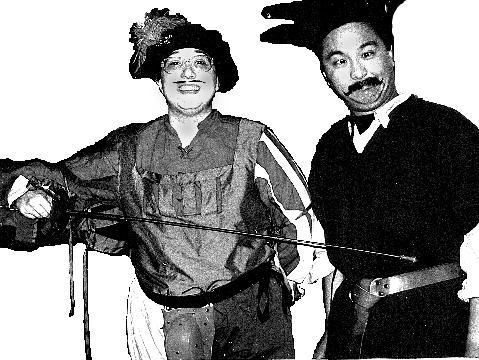
izzexcellency "Jacques" de Meux preparing to skewer Foolish Lord Roberto. Photo by Caoimhin McKeeSummer and the Choleric Humor
by Jaquemette de ChaponayMany doctors in the Middle Ages followed the teachings of the Greek physicians, Hippocrates and Galen, that health was governed by four primary body fluids, or humors, and that the humors could be affected with foods or conditions that were hot or cold, wet or dry. It was best if none of the four humors dominated, but often one did, with many implications for the individual's health.
Both Greek and medieval physicians characterized the season of summer as warm and dry. These properties led to the increase of the warm, dry humor of choler (also known as red bile or yellow bile) between May 8 and August 6. Some people tended always to a choleric (or bilious) complexion, especially those who lived in hot, dry regions, but in summer the tendency toward warmth and dryness was increased in everyone. Of the four elements, fire was associated most with the warmth and dryness of summer and with choleric individuals.
Physical properties associated with an abundance of the choleric humor were well-developed muscles, thinness, hairiness, dark or curly hair, and dark or red skin. The choleric were thought to suffer from stomach troubles, poor appetite and ringing ears more than other physical types did. Medieval physicians extended theories on the humors to personality types as well as physical types, saying that the choleric person tended to be ambitious, vain, and often prone to anger or even violent. Someone choleric was likely to be a bold speaker - and a bold liar!
In the warm, dry season of summer, it was best to seek out cool places on hilltops and to not work more than one's station in life required. Washing one's face often was recommended to cool the senses. Cool, open places with vines and tree boughs strewn about were the best places to dine in summer. In a summer that was too wet, skin diseases would be more common because extreme heat and extreme dampness together was very unhealthy weather. Summer was the one time of year that daytime naps were held to be healthful, but even then, too much sleep in the afternoon was to be avoided.
Since it was healthiest for all the humors to be in balance, summer was the best time for the phlegmatic, those with an excess of the humor of phlegm. This cold, wet humor was the most in opposition to choler.
In the summertime, the healthiest foods were those that were cold and moist. Meat was eaten in smaller portions. Wine was diluted with water so that more could be consumed to quench thirst. Lettuce and fresh fruit like oranges and cherries were best eaten in summer. Squash and melons were healthful then, and were always beneficial to the choleric. Fresh cheese was best in the summer. Sorrel, eaten as a salad or cooked into a drink, was good for reducing choler, and so was a sauce made from vine tendrils. Meat gelatin increased yellow bile and was to be avoided by the choleric, though brains were cold and moist and could be eaten more safely. Sugar was normally warm and moist, not dry, but could be converted into choler when consumed by someone of a choleric temperament. Most spices were warm and dry and thus harmful to the choleric, but among them pepper was the worst. Some physicians also held onions to be harmful for the choleric.
Other details of daily life had benefits or dangers to those of choleric complexion. Linen clothing was good for warm complexions and seasons, especially if worn with or blended with silk. Anger was dangerous for those of warm temperaments, especially the often ill-tempered choleric; the study of philosophy was recommended to counter this tendency. Those of choleric complexion needed just seven hours of sleep each night, even though they tended to dream of fire and violence.
Principal Sources:
Platina, on Right Pleasure and Good Health, tr. Mary Ellen Milham. Tempe, Arizona: Medieval and Renaissance Texts and Studies, 1998.
The School of Salernum, tr. Sir John Harington. New York: Augustus M. Kelley, 1920, reprinted 1970.
Galen: Selected Works, tr. P. N. Singer. Oxford: Oxford University Press, 1997.
Oh No, It's Poison Ivy!
by Lady Sadhbh BheansidheO
h, yes, I've already suffered from a poison ivy encounter this spring (thanks to Stardust bringing it home to me), and Waterworks Park is filled with the noxious plant. Be careful leaning against trees or looking for firewood. Direct contact or contact with contaminated objects like shoes, clothes, gloves or animals results in itching, skin inflammation and blisters.Washing within fifteen minutes of contact with cold water and detergent soap like Dawn, Joy or Palmolive will reduce the redness and swelling; otherwise, expect a reaction within 12-48 hours. It's important to wash any contaminated objects with detergent to prevent re-infection. (Lucky Stardust got two baths.)
Various ivy blocks are on the market to protect against contact. To build up the immune system, those with Vitamin C are recommended. Homeopathic remedies, after contact, include applying a mixture of jewelweed leaves, aloe vera gel and comfrey tea, or Tea Tree oil, and taking Oral Ivy and Rhus Tox available at health stores. I go right to hydrocortisone ointment and call the doctor for oral steroids and steroid cream because I know how badly I react.
On the Web
NEW Baronial Website (webmaster: Azalais)
https://www.angelfire.com/ia2/barony/index.html
Vikings:
Explore the gentler side of Vikings. Take a walk through a Viking village, learn how the Vikings and their ships changed the face of European society, access a primer on Runes and try your hand at dendrochronology, or tree-ring dating.http://www.pbs.org/nova/vikings/
Medieval Art
http://www.hwy66.com/~weid/art.htm
Medieval insults
http://www.win.bright.net/~blbeast/medieval/insults.html
The Robin Hood Project:
Everyone's favorite robber is chronicled here in ballads and illustrations.http://www.homeworkcentral.com/knowledge/vsl_files.htp?fileid=21833&tg=LITERA&flt=CAB
English & Scottish Timelines
http://www.homeworkcentral.com/knowledge/vsl_files.htp?fileid=146813&flt=CAB
Sadhbh's Top 10 things you see at Renaissance Faires but usually not at SCA events:
1. Dresses with ruffles, sequins, and zippers left over from prom night.
2. Repulsive, mud-caked, drooling peasants.
3. (See Above) hauling a cart calling out "Bring out your dead" or selling plague rats.
4. Expensive turkey legs, flavored coffees, sodas, ice cream and fried snacks.
5. Performers portraying queens and kings and fictional characters like Robin Hood or Captain Hook.
6. Professional jousters on horseback with bad puns.
7. Fighting with live steel weapons, especially bare-chested and kilted.
8. Pretend gypsies reading palms and cards.
9. Fairies, wizards, hobbits, trolls, Conan and Red Sonja and Xena look-alikes or wannabes.
10. Buxom wenches and gorgeous pirates...hmmm, on the other hand....
Page 2