
| Remember When?
By Cecil Hall First published in the Saguache Crescent 9 January 1997 - #41 HISTORY OF THE FLOUR MILL AT SAGUACHE, COLORADO
Believing in the maxim promulgated by Miles Standish in the story of his “Courtship”, written by Longfellow to the effect that if anyone wanted anything done to suit him, he should do it himself. I have undertaken to indite a brief account of the institution known above, from the time of first settlement of the land upon which the same is situate, up to the present year of 1931.
The grain having been previously washed and winnowed after being tramped out by the use of horses, but mostly with sheep. I might add that the grain was cut with cradles. Afterwards. however, binders were used which tied with wire instead of twine This necessitated the installation of pairs of magnets to remove parts of broken wire, before the grain was ground. I might mention that there was a small quantity of blue corn raised, also. Aside from the objectionable method of threshing used primarily this process produced a meal that for health and nutritiousness is much superior to the present day flour used for bread. Since it is not the purpose of this article to go into the ethics of the comparative value of the various food products which would require more time than I intend to devote to this article, I will proceed to a description of the remainder of the machinery. A shaft about 2 inches in diameter extended thru the center of the buhr downward possibly 6 feet where it entered the hub of the water wheel. I, at the present writing, have the remains of a water wheel which I think was used at that time, but of this I am, however not positive, as the data now obtainable is somewhat vague and indefinite as well as contradictory. This wheel has a center hub about 6 inches in diameter and about a foot in depth, having a hole bored in its center for an upright shaft. I am endeavoring to give a somewhat detailed description of this because of its unique character. It being a model of simplicity but I have serious doubts as to its efficiency. To proceed, 5 arms or flanges radiated from this center hub, these flanges were cast with the hub body and measure 5x10 inches in thickness, looking much like a small wagon wheel with spokes 10 inches in width. Holes were bored in these flanges, possibly to permit the attachment of extension blades, these might have been hooked or curved construction. The principle appeared to have been to allow a stream of water under high velocity to strike these blades upon its outer circumference thus causing the wheel to spin or rotate. This wheel, like the buhr was supposed to operate without any casing. Under the bottom of the hub was a shallow concave depression to be used to rest upon a wooden post or pillar of some character. I was told that the water was conveyed to the wheel thru a medium of a hewn log trough arranged on an incline I however have heard this denied, but if this wheel described above was the original wheel employed for the purpose it was evident some such method was employed. The amount of head or fall couldn’t have been more than 5 or 6 feet wide and of shallow depth. Nevertheless, the capacity of the mill must have been small depending upon the fineness of the ground product. I would say, possibly a couple of bushels per hour, depending of course on the speed of the buhr. However, this mill being insufficient to meet the demands, it soon became necessary to haul grain to the mills situate at Conejos and San Luis to exchange for flour. (to be continued) |
| Related Stories:
#40 - 26 Dec 96 - George H. Robertson
|

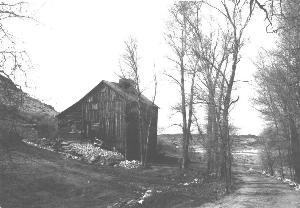 During
the year of 1867 a party by name of Sisinero, located on the west central
part of the quarter section upon which the present mill now stands, erected
a cabinet in the vale between the two hills, and cultivated a small tract
of land in proximity thereto. The next year, or year following, it is not
material for the purpose of this article, Ramon Sanchez constructed a small
mill about one-fourth of a mile southeasterly from the habitation above
mentioned, on the south side of the larger of the two hills, at a point
about two-thirds of its distance from the west end. Some of the upright
posts used in its construction are still standing at this writing. A ditch
with which to operate the same was constructed in a northwesterly direction
along the base of said hill, a distance of nearly half a mile until it
intersected the Saguache Creek, this being at a point nearly due south
from the summit of the hill which lies west of the aforesaid hill at whose
base the mill was built. This mill was a crude affair consisting of a small
log buil-ding possibly 16 feet square. The milling equipment consisting
of a four-foot flint buhr but was not enclosed within a curb, the meal
being discharged in all directions upon the floor where it was wiped into
piles with a sheepskin, afterwards being put in sacks by a board shovel.
No bolt or sieve of any description being used and I don’t think there
was any kind of cleaning machinery.
During
the year of 1867 a party by name of Sisinero, located on the west central
part of the quarter section upon which the present mill now stands, erected
a cabinet in the vale between the two hills, and cultivated a small tract
of land in proximity thereto. The next year, or year following, it is not
material for the purpose of this article, Ramon Sanchez constructed a small
mill about one-fourth of a mile southeasterly from the habitation above
mentioned, on the south side of the larger of the two hills, at a point
about two-thirds of its distance from the west end. Some of the upright
posts used in its construction are still standing at this writing. A ditch
with which to operate the same was constructed in a northwesterly direction
along the base of said hill, a distance of nearly half a mile until it
intersected the Saguache Creek, this being at a point nearly due south
from the summit of the hill which lies west of the aforesaid hill at whose
base the mill was built. This mill was a crude affair consisting of a small
log buil-ding possibly 16 feet square. The milling equipment consisting
of a four-foot flint buhr but was not enclosed within a curb, the meal
being discharged in all directions upon the floor where it was wiped into
piles with a sheepskin, afterwards being put in sacks by a board shovel.
No bolt or sieve of any description being used and I don’t think there
was any kind of cleaning machinery.